More Nigerians want to travel to Europe these days, either for holidays, business, weddings, or just to see family. Whether you’re headed to Paris on vacation or Germany for business, you have probably heard that you need a Schengen visa to get there.
The Schengen visa may sound complicated, but it actually is not once you understand the process involved. Every year, a huge number of Nigerians go through this exact process and come out successfully with an approved visa, and there’s no reason you wouldn’t too.
Do you want to travel to Europe for business, for medical care, or just for a visit? Then you might need a Schengen visa, as it gives you access to at least 29 countries in Europe.
This guide covers everything you need to know, from what a Schengen visa is, how to apply for it, its cost, its required documents, its various types, the cover letter needed, and the travel insurance needed. By the end of this article, you will know what it takes to get a Schengen visa.
Key takeaways
- You can apply for a Schengen visa through the embassy of the Schengen country where you will spend the most nights via VFS Global or TLScontact in Lagos or Abuja.
- The total Schengen visa costs range from ₦400,000 to ₦1,800,000 when using a visa processing agent, and it includes many services like insurance, flights, hotel, and visa processing beyond the base €90 application fee.
- You need a valid passport with at least six months’ validity, proof of funds, travel insurance, and proof of ties to Nigeria to apply for a Schengen visa.
- A well-written cover letter should explain your travel purpose, itinerary, financing, and strong ties to Nigeria to improve your chances of getting the visa.
What is a Schengen visa?
A Schengen visa is a single short-stay visa that allows you to travel freely across 29 European countries within the Schengen area without needing a separate visa for each country. With a Schengen visa, you are allowed to stay for up to 90 days within any 180-day period in the Schengen region.
As of 2026, the Schengen Area consists of 29 countries, with 25 of them being part of the European Union while the other 4 are European free trade states.
European Union (EU) Members in Schengen (25)
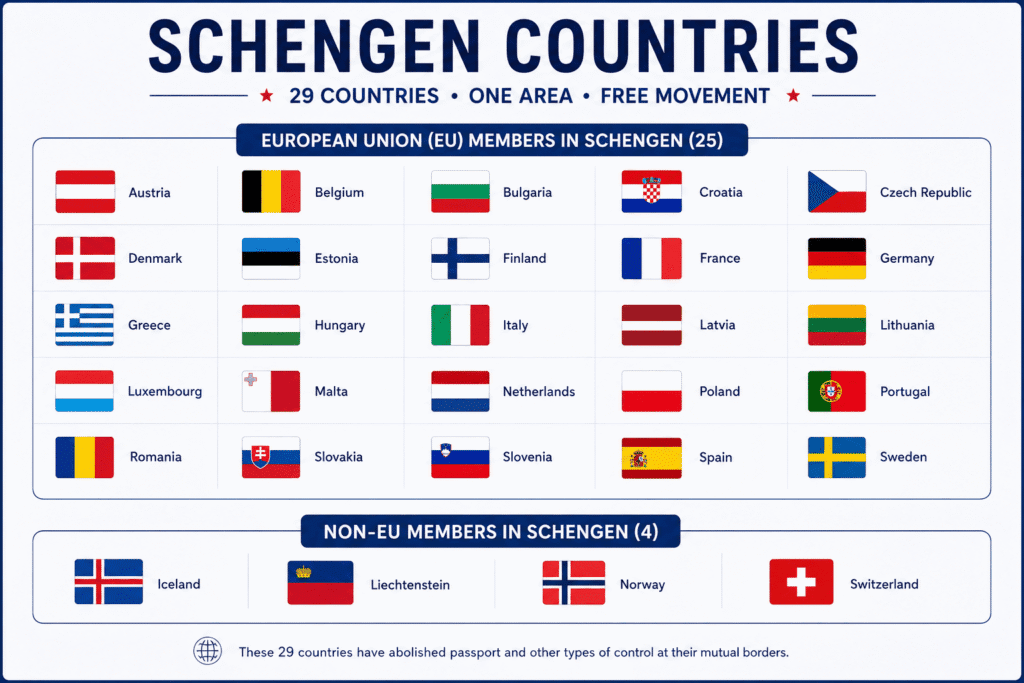
The European Union countries in the Schengen area are Austria, Belgium, Bulgaria, Croatia, Czech Republic, Denmark, Estonia, Finland, France, Germany, Greece, Hungary, Italy, Latvia, Lithuania, Luxembourg, Malta, Netherlands, Poland, Portugal, Romania, Slovakia, Slovenia, Spain, and Sweden.
Non-European Union Members in Schengen (4)
The Schengen countries that are not part of the European Union are Iceland, Liechtenstein, Norway, and Switzerland.
As a Nigerian, you don’t have visa-free access to the Schengen Area, so a Schengen visa is required before you travel, though the type you apply for depends on the kind of trip you are taking.
What are the Schengen visa types?
Now, before applying for your Schengen visa, you should know that not all Schengen visas are the same; the type you need depends on why you are travelling. Once you know which one applies to you, your application process becomes easier.
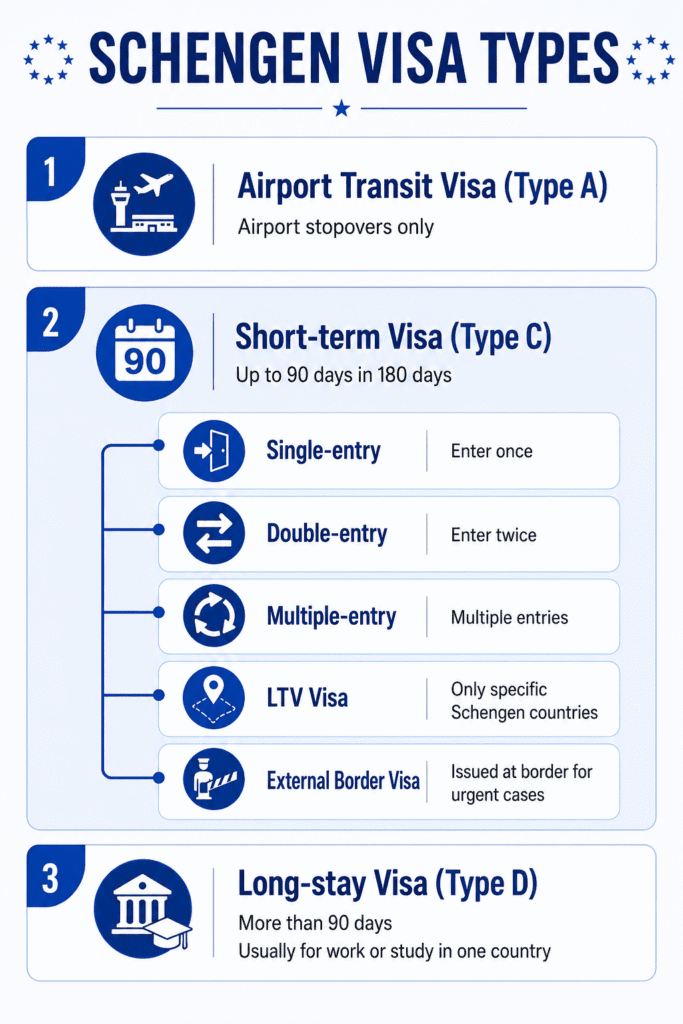
- Airport Transit Visa (Type A): The Schengen Type A visa is a transit visa that can allow you to travel through the international transit area of an airport in a Schengen country during a stopover or change of flight.
The Schengen Type A visa does not allow Nigerians to leave the international transit area of an airport. - Short-term visa (Type C): The Schengen visa type C can allow you to travel and stay in the Schengen area for not more than 90 days. It is a visa type good for visits or medical tourism.
The Schengen visa type C can be obtained in 3 forms.- Single-entry Visa: It can allow you, the holder, to enter the Schengen area only once and stay up to 90 days. Once you leave, you cannot re-enter, regardless of the visa validity period left.
-
- Double-entry Visa: It can allow you to enter the Schengen area twice. You can exit and re-enter the Schengen area during the visa validity period. The duration of stay must not exceed 90 days in a 180-day period.
- Multiple-entry Visa: It allows you to enter the Schengen area as many times as you want in 90 days. A multiple-entry visa is valid for a maximum of five years, and the duration of stay in the Schengen area must not exceed 90 days in a 180-day period.
The Schengen Type C visa also has two less common subcategories worth knowing about.
-
- The Limited Territorial Validity Visa (LTV): This Schengen visa doesn’t give you free movement across all 29 Schengen countries; rather, it restricts you to specific ones.
- The External Border visa: This Schengen visa is issued right at the border when something unexpected comes up, like a sudden medical emergency. It’s only valid for a very short time and usually covers just one or two countries.
- Long-stay (Type D): A Schengen Type D visa is a long-stay visa that allows you to stay in one Schengen country for more than 90 days. It’s issued by that specific country, not the whole Schengen region, which is why it’s also called a national visa. It is suitable for work or study.
With a Schengen Type D visa, you can still visit other Schengen countries, but only for short trips of up to 90 days within any 180-day period without living or working there.
For example, if France issues you a Type D visa for study, you can take short trips to Germany, Italy, or Spain, but you can’t relocate to live or work in those countries.
What are Schengen visa application requirements?
Schengen visa application requirements include
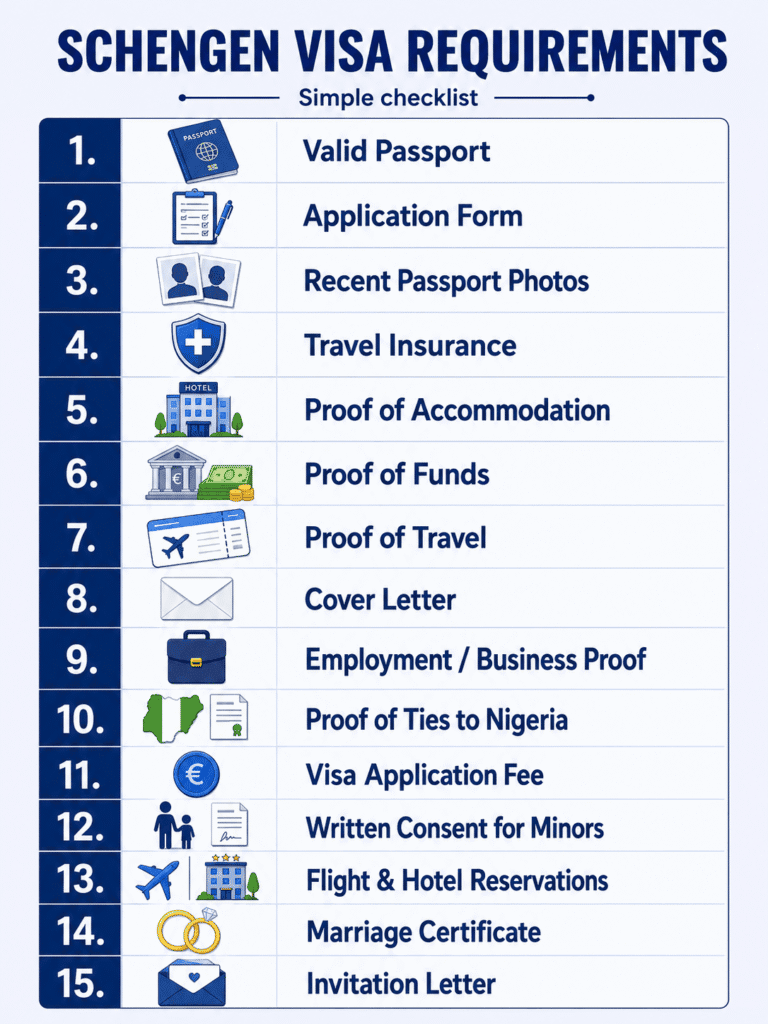
- Valid passport: Your passport must be valid for at least six months beyond the travel date; it must not be damaged or torn, and all pages should be intact. Ensure you have at least two to four blank pages for stamps.
- Application form: You must fill out and sign the Schengen visa application form completely, with no blank spaces.
- Recent passport: You need 2 recent biometric photographs with a white background.
- Travel insurance: You will need travel insurance that is valid for the entire duration of the trip, covering medical emergencies and repatriation with a minimum coverage of €30,000.
- Proof of accommodation: You will need documents showing your hotel bookings, Airbnb reservations, or a letter of invitation from a host.
- Proof of funds: You will need a bank statement from the last three to six months showing sufficient funds to cover the trip.
- Proof of travel: You will need documents that show your flight itinerary or a dummy flight booking showing entry and exit from the Schengen area.
- Cover letter: You will need a personal letter written to the embassy, explaining the purpose of the trip, travel dates, and intended itinerary.
- Proof of employment/business: You should prepare your employment letter, business registration, or pension statement for retirees, or school enrollment for students. CAC certificate (for business owners), payslip (for salary earners), Work ID card, Tax return certificate (for business owners), and company introduction letter are the kinds of documents needed.
- Proof of ties to Nigeria: You have to include documents like property documents, chieftaincy or church titles, and your children’s birth certificates.
- Visa application fee: You are to pay €90 (around ₦144,000) for adults, plus an additional VFS service fee of roughly ₦25,000–₦40,000, or €45(around ₦71,000) for children between six and eleven. Children under six are exempt.
- Written consent for minors: You will need to provide written consent if your children are travelling without you. It must be notarized.
- Flight reservations & Hotel reservation: You also have to include documents showing you have a place to stay and a means of transportation.
- Marriage certificate if married.
- Invitations letter.
Note:
The specific Schengen visa requirements you will need to provide may vary slightly depending on which Schengen country’s embassy you are applying through and the type of Schengen visa you are applying for.
Source: Europ-assitance
Step-by-step process of a Schengen visa application in Nigeria
Here is a detailed breakdown of how you can apply for a Schengen visa in Nigeria.
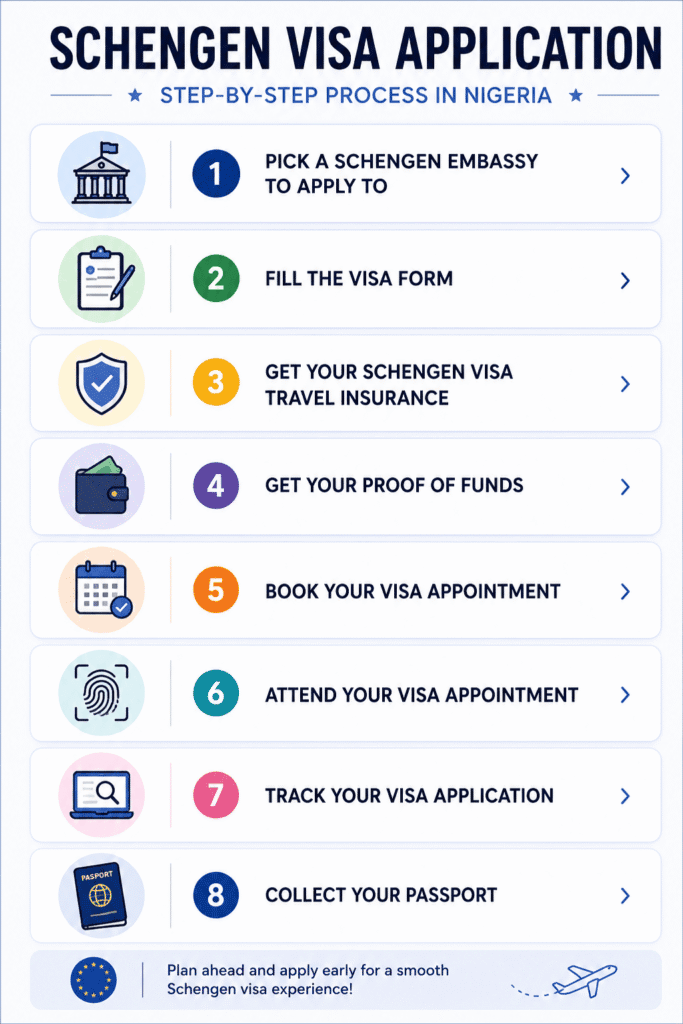
- Pick a Schengen embassy to apply to: Apply through the embassy of the country where you will spend most of your nights in the Schengen region. If you are splitting your time evenly? Go with whichever country you are entering first.
- Fill the visa form: Download the Schengen visa application form, fill in every field, then sign it. Don’t leave anything blank; if a question doesn’t apply to you, just put “N/A” so it doesn’t look like you skipped it.
- Get your Schengen visa travel insurance: Reach out to your insurance provider and get proof of cover. It needs to be at least €30,000 and valid across all the Schengen countries, not just the one you are headed to.
- Get your proof of funds: Get a recent bank statement, plus anything else that proves you can fund your trip comfortably.
- Book your visa appointment: Depending on your preferred embassy, book your visa appointment either through VFS Global or TLScontact in Lagos or Abuja.
- Attend your visa appointment: Take your international passport, a passport photo, flight reservation, proof of accommodation, and proof of ties to Nigeria to your appointment, where they will also take your fingerprints and photo.
- Track your visa application: Visit the online portal of the visa center you submitted your documents to check your visa status. The consulate usually takes about 3-4 business days to process everything, so check around that date.
- Collect your passport: Once your visa is approved, pick it up and take a moment to check the visa sticker and make sure the dates and number of entries are correct before you head off.
Make sure your dates line up across everything: your flight, your hotel, your insurance. That’s one of the most common reasons people get turned down, so take a second look before you submit.
VISA APPLICATION CENTRES FOR SCHENGEN VISA APPLICATIONS
What is the Schengen visa application cost?
The Schengen visa application cost from Nigeria ranges from ₦400,000 to ₦1,800,000; the more documents your preferred visa processing agent will help you get, the higher the Schengen visa application cost.
This Schengen visa application cost from Nigeria could include the Schengen visa application fee, set by the EU, the visa application centre charge, travel insurance, flight booking, hotel booking, and your visa processing agent charge, depending on the amount they charge you for processing your visa.
What is the official Schengen visa application fee?
Below is a breakdown of the Schengen visa fee for 2026, converted to naira for Nigerian applicants.
|
Schengen Visa Type |
Fee (EUR) |
Schengen Visa Fee in Nigeria |
|
Type A (Airport Transit) – Adult |
€90 |
₦141,579 |
|
Type A (Airport Transit) – Child (6–11) |
€45 |
₦70,789 |
|
Type A (Airport Transit) – Child (under 6) |
Free |
Free |
|
Type C (Short Stay) – Adult |
€90 |
₦141,579 |
|
Type C (Short Stay) – Child (6–11) |
€45 |
₦70,789 |
|
Type C (Short Stay) – Child (under 6) |
Free |
Free |
|
Type D (Long Stay) – Germany |
€75 |
₦117,982 |
|
Type D (Long Stay) – Poland |
€135 |
₦212,368 |
|
Type D (Long Stay) – France & others |
€99 |
₦155,736. |
The current prices in Naira are dependent on the exchange rate; always confirm the Naira to Euro exchange rate.
Source: European Commission
What is a Schengen visa cover letter?
A Schengen visa cover letter is a formal statement to the embassy that explains your travel purpose, itinerary, financial means, and ties to home to prove you will return.
Follow these guidelines to write a good Schengen visa cover letter:
- Use the right cover letter format
- Introduce yourself with your basic personal details
- State your purpose of travel
- State your travel dates and itinerary
- Say who’s paying for the trip
- List all your visa application supporting documents
- When necessary, state your inviter
- Explain anything unusual
- Briefly talk about your ties to Nigeria
- Add a polite closing
Sample of a Schengen visa cover letter
[Your Full Name]
[Your Address]
[City, State, Nigeria]
[Phone Number]
[Email Address]
[Passport Number]
[Date]
To:
The Visa Officer
Embassy/Consulate of [Country]
[City, Nigeria]
Subject: Application for Short-Stay Schengen Visa for Tourism
Dear Sir/Madam,
I am writing to respectfully submit my application for a short-stay Schengen visa to visit [Country/Countries] for tourism from [departure date] to [return date].
I intend to travel to [Country/Countries] to explore the cultural, historical, and tourist attractions of the region. During my stay, I plan to visit [list major cities/attractions, e.g., Paris, France; Amsterdam, Netherlands; and Brussels, Belgium]. My proposed itinerary and accommodation reservations are included with my application.
I am currently employed as [Job Title] at [Company Name], where I have been working since [month/year]. I have been granted approved leave from [leave start date] to [leave end date] and am expected to resume my duties on [resumption date].
[If self-employed/business owner: I am the owner/director of [Business Name], a business engaged in [brief description of business]. I actively manage the business in Nigeria and will return after my trip to continue overseeing its operations.]
I will personally finance this trip using my savings/income. I have enclosed my bank statements, employment/business documents, proof of accommodation, travel itinerary, travel insurance, and other supporting documents to demonstrate that I have sufficient funds to cover my expenses during the trip.
I have strong professional, financial, and personal commitments in Nigeria, which require my return at the end of my planned visit. I therefore intend to leave the Schengen Area before the expiry of my visa and return to Nigeria on [return date].
I have carefully reviewed the requirements for a Schengen short-stay visa and have provided the requested supporting documents. I would be grateful if you would consider my application favorably.
Thank you for your time and consideration.
Yours faithfully,
[Your Full Name]
[Signature, if submitting a printed copy]
[Phone Number]
[Email Address]
What is Schengen visa travel insurance?
Schengen visa travel insurance is a mandatory medical insurance obtained by non-Europeans applying for a Schengen visa that covers medical emergencies like sudden illness, hospitalisation, or being flown home for treatment.
Any Nigerian applicant for a Schengen visa needs Schengen visa travel insurance; without it, your visa will not be processed.
How to get Schengen visa travel insurance from Nigeria
You can get Schengen visa travel insurance from Nigeria either online from international providers or locally from Nigerian insurers that issue Schengen‑compliant policies.
International providers include AXA Schengen, Europ Assistance, VisitorsCoverage, SchengenCover, and HelloSafe marketplaces, while Nigerian providers include AXA Mansard, AIICO Insurance, Allianz Nigeria, and Leadway Assurance.
- Pick a Schengen insurance company.
- Enter trip details.
- Choose your Schengen insurance plan.
- Fill in traveller details exactly as in the passport.
- Make payment.
- Receive and verify the certificate.
- Print and submit.
Frequently asked questions
The validity depends on the type of visa. A short-stay Schengen visa lets you stay for up to 90 days within any 180-day period. Single-entry visas match your exact travel dates, while multiple-entry visas can last from 6 months to 5 years, but you still can’t spend more than 90 days in the zone within any 180-day window.
A Schengen country is a European country that is part of the 29 countries that make up the Schengen area.
In Nigeria, Schengen visa applications are typically submitted through VFS Global or TLScontact, which have visa centres in Lagos and Abuja.
Conclusion
A Schengen visa application can feel stressful, but it doesn’t have to be. Know your visa type, gather your documents, write a clear cover letter, and get insurance that meets the requirements. Then submit all the required documents at the visa application centre.
If you don’t want to get involved in the stress of processing your Schengen visa yourself, contact a reliable visa processing agent.