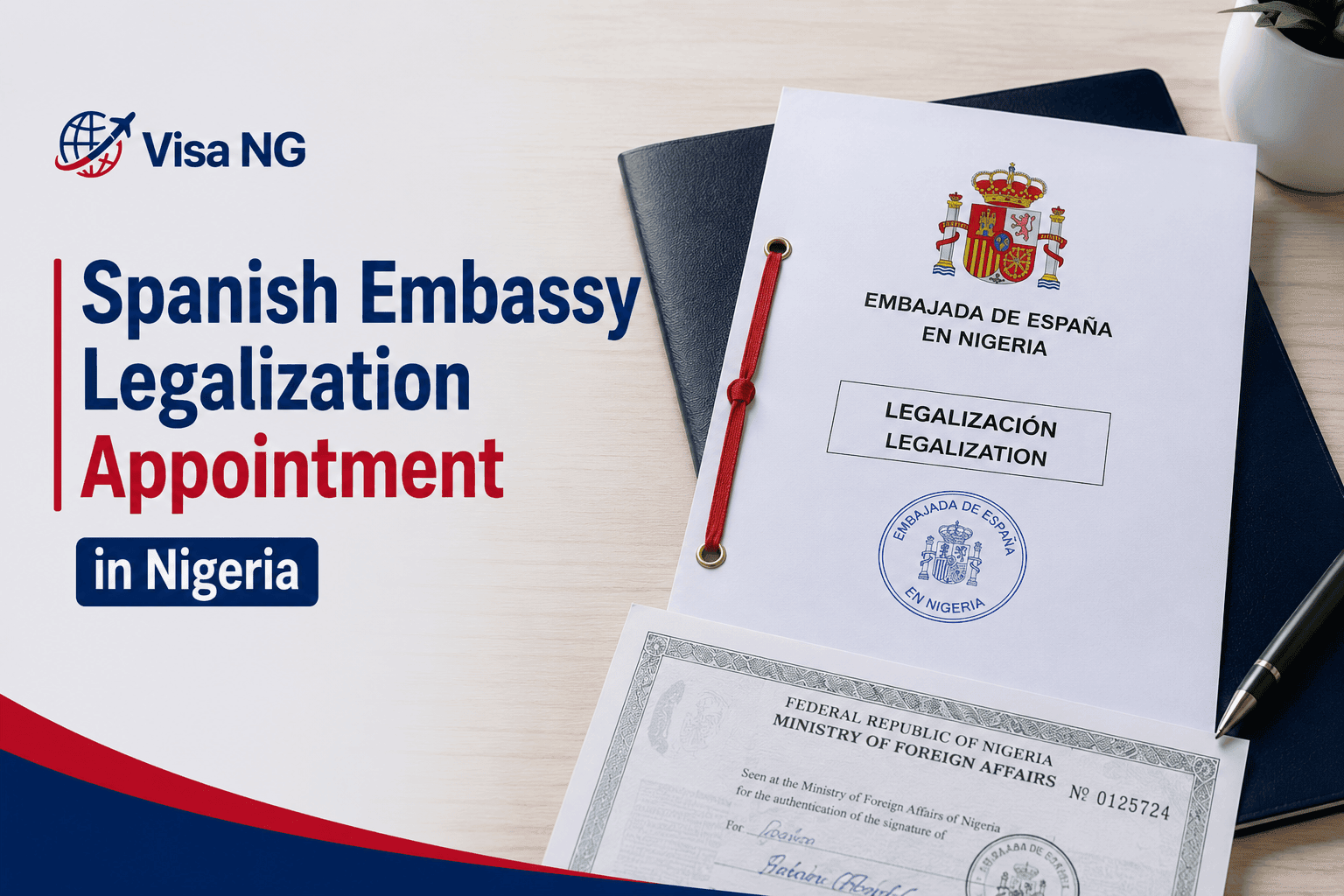
If you’re applying for a Spain visa, you’ve probably come across the word legalization on your document checklist. Good news: This process is not as complicated as it seems.
It is important for you to know that the Consulate General of Spain in Lagos is responsible for legalization, not the Spanish embassy in Abuja. You should also know that all your documents must be authenticated by the Ministry of Foreign Affairs of Nigeria before they can be accepted for legalization.
This guide will answer all your questions, covering everything you need to know about what legalization means for your document, which office actually handles it, and the exact steps to book your appointment. By the end, you’ll know exactly what to do next.
Key takeaways
- Legalization is the process of confirming that a document’s signature and signing authority are genuine, and in Nigeria it’s handled by the Consulate General of Spain in Lagos for documents to be used in Spain.
- BLS International only handles visa appointments, not legalization, so you must email the Spanish Consulate in Lagos directly to book a legalization appointment.
- The Spanish Consulate charges ₦69,800 per page to legalize a document, so the total cost depends on how many pages you have, going through an agent would cost ₦700,000.
- Before the Spanish Consulate will legalize anything, your document must have been authenticated by Nigeria’s Ministry of Foreign Affairs.
What is Spanish Embassy document legalization in Nigeria?
Spanish Embassy document legalization is the process of validating a foreign public document by verifying the authenticity of the signature and the legitimacy of the signing authority. It does not certify or vouch for the content of the document itself, only that the signature and the authority behind it are genuine.
For Nigerians, this step isn’t optional. Unless a specific exemption applies, every foreign public document, including those issued in Nigeria, must be legalized before it can be accepted as valid in Spain.
Source: Spain Ministry of Foreign Affairs, European Union and Cooperation
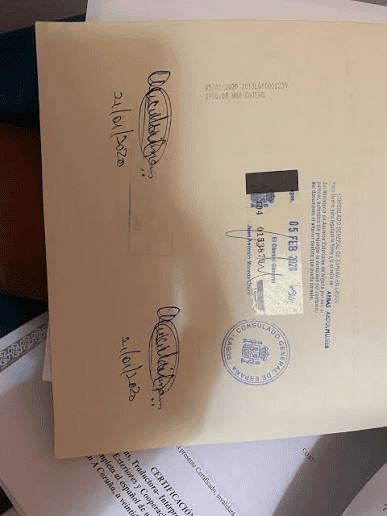
Sample of a document legalized by the Consulate General of Spain:
Is BLS responsible for Spanish document legalization appointments in Nigeria?
No, BLS is not responsible for Spanish document legalization appointments. If you’ve applied for a Schengen visa before, you probably went through BLS International, and it’s natural to assume they handle everything Spain-related, but they don’t.
BLS handles Spain visa applications and visa appointments only. Document legalization is a completely separate service, and it’s managed directly by the Spanish Consulate itself, not by any outsourced visa center.
Spanish Embassy legalization requirements
I want you to understand that the Consulate doesn’t publish a fixed checklist for every document type. Instead, they expect you as an applicant to email them directly so they can advise you on the specific requirements for your particular document, so treat the list below as a general guide.
Generally, you should be prepared to have:
- Original document already authenticated by Nigeria’s MFA
- A photocopy of the document
- Valid ID/passport of the applicant (or the person requesting on their behalf)
- Appointment booked in advance — for Lagos, requests go through the legalizations email (cog.lagos.leg@maec.es)
- Any supporting documents the Consulate specifically requests in their reply to your inquiry email
- Proof of payment for the legalization fee, once confirmed
- A translation note if the document isn’t in Spanish; it typically needs certified translation by a sworn translator (traductor/intérprete jurado)
How to book a Spanish Embassy legalization appointment in Nigeria
Here’s how a Spanish Embassy legalization appointment actually works, step by step.
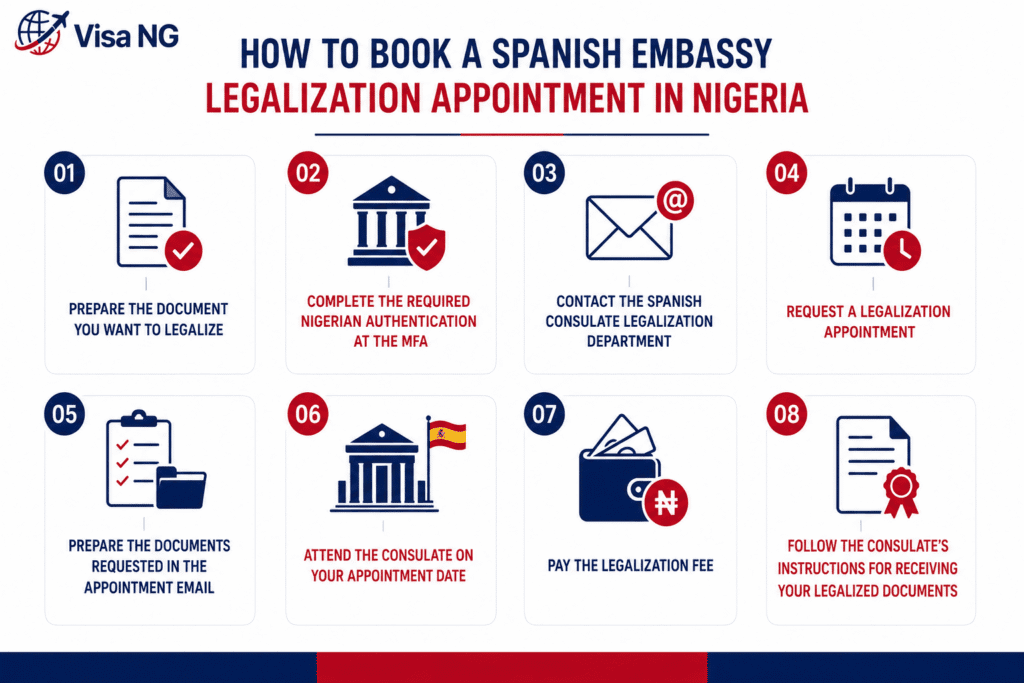
Step 1: Prepare the document you want to legalize:
Get the original copy of the document or documents in good condition. If it’s damaged, faded, or has alterations, the Consulate will likely reject it.
Step 2: Complete the required Nigerian authentication at the MFA:
This is non-negotiable. Your document must be authenticated at the Ministry of Foreign Affairs first before the Spanish Consulate will legalize it. No authentication means no legalization.
Step 3: Contact the Spanish Consulate legalization department:
The Consulate General of Spain in Lagos requires you to send an email first requesting procedure-specific guidance on how to go about the legalization of the document. The email address for legalization is cog.lagos.leg@maec.es
Step 4: Request a legalization appointment:
In that same email, don’t just ask for information; also ask for a legalization appointment date to be sent to you.
Step 5: Prepare the documents requested in the appointment email:
The Consulate will reply with a specific list based on your document type. Gather everything on that list exactly as described.
Step 6: Attend the Consulate on your appointment date:
Arrive with your original documents, your ID, and printed copies of any document requested by the Consulate.
Step 7: Pay the legalization fee:
Have your payment ready in the format the Consulate specifies. Confirm this beforehand.
Step 8: Follow the Consulate’s instructions for receiving your legalized documents:
The Consulate will tell you what to expect and how to receive your legalized documents.
Get help with your Spanish embassy legalization
How much is the Spanish Embassy legalization fee in Nigeria?
The official legalization fee published by the Consulate General of Spain Lagos is ₦69,800 per page, not per document, so your cost for legalization depends on how many pages the document you want to legalize has.
If you would rather go through an agent to help manage the process on your behalf, that will cover preparation of paperwork correctly and follow up with the Consulate on your behalf, especially if you’re not based in Lagos. The fee for legalisation is ₦700,000.
Spanish Consulate Lagos address and contact details
- Address: 21C Kofo Abayomi Street, Victoria Island, Lagos
- Legalization email: cog.lagos.leg@maec.es
- General email: cog.lagos@maec.es
- Phone: +234 209 460 3499
Common reasons why the Spanish embassy will not legalize your documents
Here are some common reasons why your documents may not be legalized;
- If it’s not a qualifying document: Only public documents, notarized documents, or private documents that have been publicly registered can be legalized.
- If it’s not an original or certified true copy: Legalization only applies to original documents or true copies issued by the same body that issued the original. Photocopies and laminated documents don’t qualify.
- If the signatory lacked the right authority: If the person who signed the document wasn’t acting in the capacity the document requires, it can’t be legalized.
- If a required signature is missing: Every legalization procedure has specific signatures it requires. If any are missing, or if a signatory didn’t have the power to sign, the document will be rejected.
- If it has an electronic signature instead of a handwritten one: Diplomatic legalization only accepts handwritten signatures; electronic signatures aren’t recognized.
- If the signature isn’t on file: The Legalization Service of the Ministry of Foreign Affairs, European Union and Cooperation can only verify signatures it already holds on record. If yours isn’t there, it can’t be legalized.
- If it’s in a foreign language with no official translation: Foreign-language documents need an official translation attached before they can be legalized.
- If it’s expired: If Spanish legislation considers the document to have expired, it can’t be legalized.
- If it’s been damaged, altered, or forged: Any tampering, forgery, or damage that obscures key details will disqualify a document from legalization.
Source: Spain Ministry of Foreign Affairs, European Union and Cooperation)
Frequently asked questions
To make an appointment at the Spanish Embassy for legalization, you book by email at cog.lagos.leg@maec.es, explain the document you want legalized, ask them for the specific requirements, and request an appointment date.
The Spanish Embassy legalization official fee is ₦69,800 per page, not per document. Multi-page documents would cost more than single-page documents.
For legalization matters specifically, the Spanish legalization email is cog.lagos.leg@maec.es.
The Spanish Embassy is not in Lagos, but it consulate General is in Lagos, located at 21C Kofo Abayomi Street, Victoria Island, Lagos.
Conclusion
You can now see that legalizing your documents for Spain isn’t as difficult as you once thought. The process starts with authenticating your document at the MFA first, then heading to the Spanish Consulate in Lagos, not BLS, for the actual legalization. Remember that booking the legalization appointment goes through their official email.
If this process feels like a lot for you to handle, remember you can always reach out to trusted agents to help you through the entire process.
Get your documents legalize for Spain