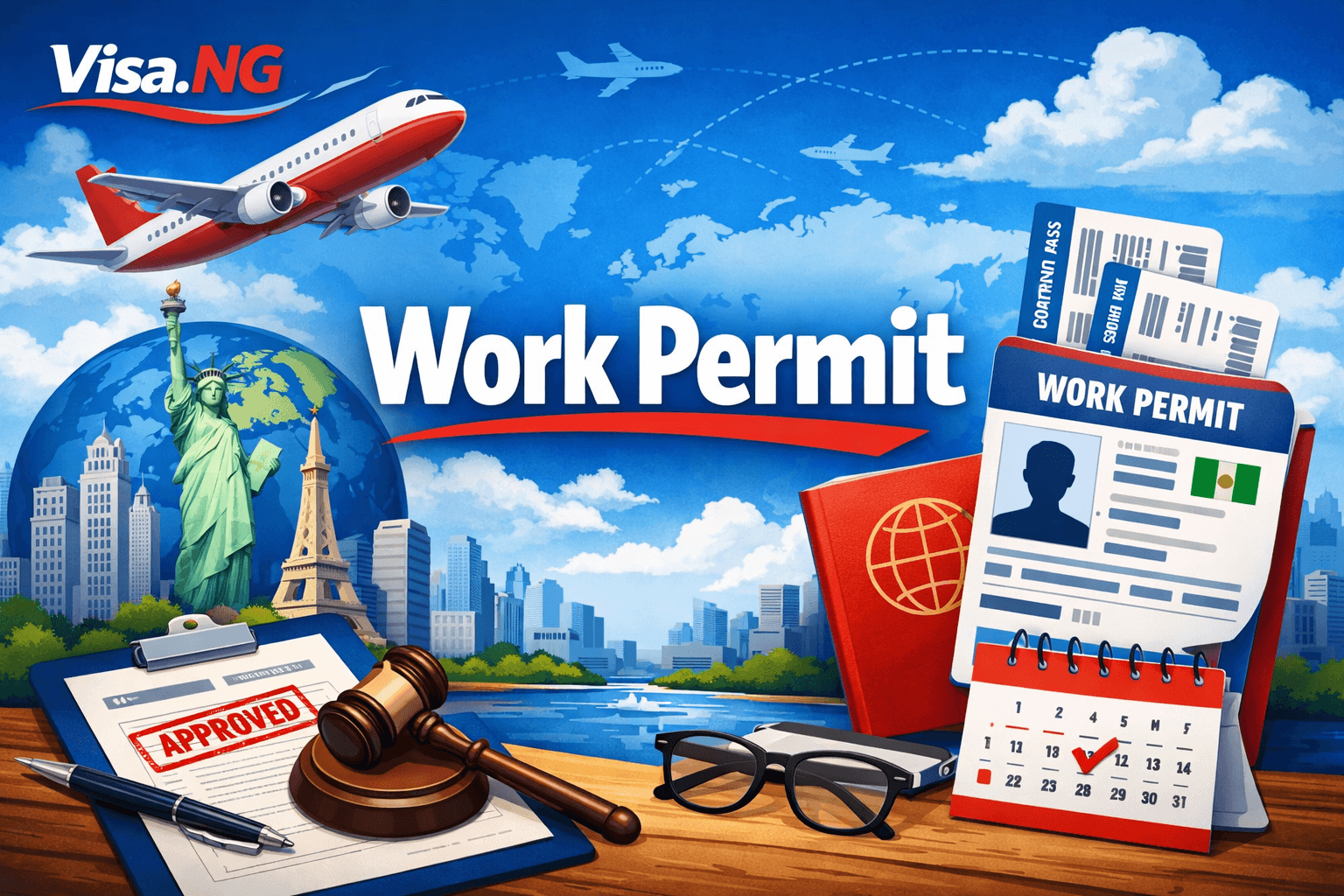
Every year, thousands of Nigerians move abroad in search of greener pastures, but some end up coming back because they cannot secure a work permit. Not because they were not qualified, but because their work permit was wrongly filed or never applied for.
A work permit is the single document standing between you and legally working in a foreign country. Without it, no job offer, no contract, and no salary is protected.
In this guide, you will learn what a work permit is, the types available, the documents required, and exactly how to apply as a Nigerian.
Key takeaways
- A work permit is an official government document that gives you the legal right to work in a foreign country for a specific period of time.
- Work permits come in different types, such as temporary, employer-sponsored, open, and critical skills permits, and the type you need depends on your situation.
- To apply, you need a job offer, the right documents, and a completed application form submitted to the immigration authority of your destination country.
- Work permit fees and processing times vary by country, so always check the official immigration website of your destination country before applying.
What is a work permit?
A work permit is an official document issued by the government of a specific country that gives a foreigner the legal right to work in that country for a particular period of time. Work permit fees and processing times vary by country.
A work permit is meant to protect a country’s labour market, to regulate the amount of foreign labour, and to protect foreigners from unfair wages and an unsafe working environment.
A work permit is not the same as a work visa. A work permit gives permission to work, while a work visa gives entrance into to the country.
Types of work permit
There are several types of work permits available in different countries, including a temporary work permit, a general work permit, a freelance work permit, a skill work permit, or other types of work permits.
Below are the explanation to this various types of work permits:
- Temporary work permit: it is for a fixed time, usually between 90 days and 2 years. It is meant for short-term work, project-based work, or seasonal work.
- Employer-sponsored work permit: This is when an employer offers you a job and sponsors your work permit application on your behalf. The permit is tied to that specific employer, meaning if you change jobs, you may need to apply for a new permit.
- Self-employment or freelance work permit: This is for individuals who want to work independently, by running a business, freelancing, or offering professional services, without being employed by a local company. Not all countries offer this.
- Student and exchange work permit: This work permit allows foreign students or exchange program participants to work legally in a country where they are studying or completing an exchange program.
- Open work permit: This work permit allows you to work for any employer in the country without being tied to a specific job or company. It gives the holder full flexibility in the labour market.
- Critical skills employment permit: This permit is for highly skilled professionals, such as ICT professionals and engineers, or any other occupations listed on the critical skills occupations list.
- Dependant/partner/spouse employment permit: This allows the dependants, spouses, and recognised partners of Critical Skills Employment Permit holders or certain researchers to legally work in the country. This is common in countries like Ireland.
- Intra-company transfer employment permit: This work permit is tied to the company rather than the individual’s role. It is issued to employees of multinational companies who are being relocated from one country branch to another.
- General employment permit: This covers a broad range of occupations unless the occupation has been listed as ineligible.
- Reactivation employment permit: This allows individuals who previously held a valid permit but fell out of the system through no fault of their own or experienced workplace exploitation, allowing them to work legally again.
- Sport and cultural work permit: issued to foreign nationals who are coming to a country specifically to work in the fields of sport, entertainment, music, film, theatre, or the arts.
Get your work permit
Documents Required for a Work Permit Application
The required documents depend on each country and the type of work permit, but the general work permit applications typically require a combination of personal identification, employer-backed documents, and supporting documents like:
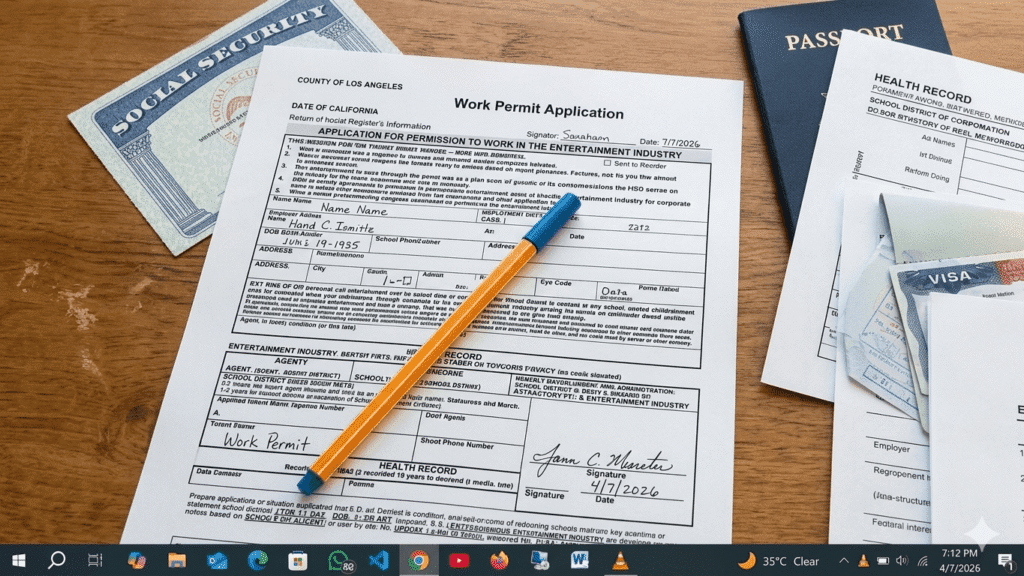
- Valid international passport (with at least 6 months’ validity)
- Recent passport-sized photographs
- Proof of current legal status (e.g., existing visa or residence permit)
- Signed employment contract or job offer letter/ Letter of sponsorship from the employer
- Employer’s business registration certificate, tax identification, or compliance documents
- Academic certificates (degree, diploma, or equivalent)
- Professional licences or certifications (for regulated occupations)
- Translated copies of foreign qualifications (if applicable)
- Reference letters from previous employers
- Proof of income or salary (pay slips or bank statements)
- Employer’s proof of ability to pay the offered salary
- Supporting documents ( like Proof of accommodation in the destination country)
- Health and vaccination report ( if applicable)
- Completed work permit application form
How to apply for a work permit
Applying for a work permit usually starts with confirming your eligibility and getting a job offer with sponsorship, then gathering and submitting all documentation required, attending interviews, and waiting for approval.
This process may vary with countries, but below is a universal step-by-step process for your work permit application:
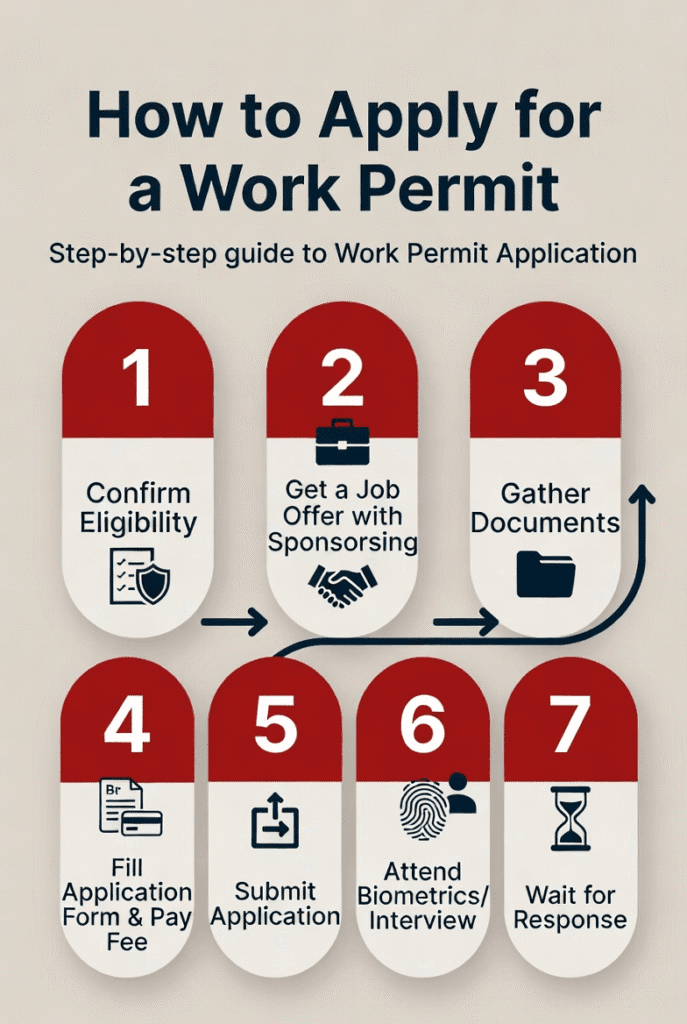
- Confirm eligibility: Check the destination country’s eligibility requirements, and confirm your job offer qualifies for a work permit.
- Get a job offer with Employer sponsorship: Secure a valid job offer from a licensed employer that is approved to sponsor foreign workers.
- Gather documents: Gather all necessary documents and supporting documents like your passport, health insurance, employment contract, qualification, etc.
- Fill the application form and pay any required fee: Complete the official application form accurately, then pay the required fee through the approved payment channel and keep your receipt.
- Submit application: Submit your completed form to the right place.
- Attend biometrics/interview: if required by your destination country, show up for any scheduled biometric appointment or interview with your original documents.
- Wait for the response: Track your application status where possible and wait patiently. Processing can take weeks or months.
Work permits by country: what Nigerians need to know
Each country has a different type of work permit and separate application requirements. Below are what you should know about the work permits of certain countries.
UK work permit: what you should know
The UK does not issue a work permit but rather a work visa that allows applicants to both enter and work in the UK. The different types of work visa include:
- Skilled Worker Visa: To apply for a UK Skilled Worker visa, you have to be sponsored by a licensed employer and have a qualifying job offer.
- Health and Care Worker Visa: A specific route for those in the healthcare sector
- Graduate Visa: For unsponsored work post-study period. Usually for a fixed time
- Global Talent Visa: For leaders or potential leaders in specific fields.
- Global Business Mobility Visa: for Senior or Specialist Workers, UK Expansion Workers, Graduate Trainees, Secondment Workers, and Service Suppliers.
- Temporary or Seasonal Work visa: includes Seasonal Worker, Creative Worker, Charity Worker, and Government Authorised Exchange visas.
- Business and Investment: Innovator Founder Route and Self-Sponsorship.
- Scale-Up Worker Visa: A hybrid route requiring sponsorship for the first six months.
To apply for a UK work visa, applicants have to meet certain criteria, including:
- Job offer and sponsorship from a licensed UK employer
- Proficiency in the English language
- Salary that meets the going rate for that role
- Financial proof that the applicant can support their own needs and any other dependents.
- A clean criminal and immigration history
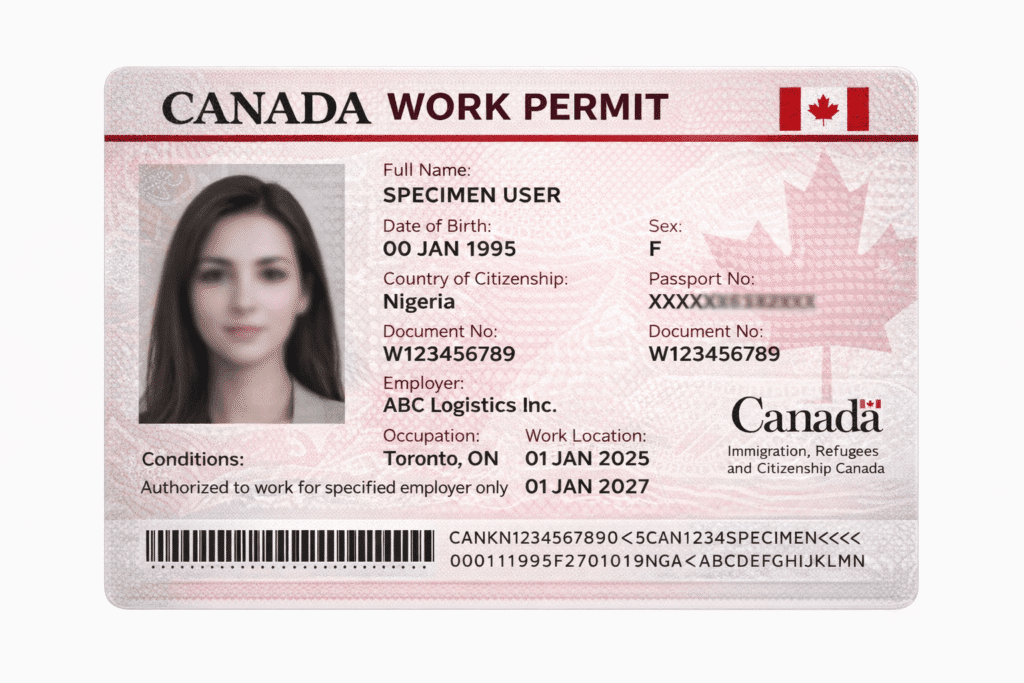
Canada work permit: what you should know
In Canada, work permits are broadly classified into two categories based on whether or not the employer needs to conduct a labour market test:
- LMIA-Required Permits: The employer must complete a Labour Market Impact Assessment (LMIA) to show that hiring a foreign worker won’t negatively affect Canadian wages or jobs.
- LMIA-Exempt Permits: These are for workers covered by international trade agreements, like exchange programs, or those providing a “significant benefit” to Canada (such as certain students or spouses).
Canada also uses two types of work permit structures: the open and the closed :
- Employer-Specific (“Closed”): You are legally tied to one employer; to change jobs, you must apply for a brand new permit.
- Open Work Permits: These allow you to work for almost any employer in Canada and are usually reserved for specific situations like post-graduation or the spouses of workers
To get a Canadian work permit, you need to meet certain criteria:
- A formal job offer from a Canadian employer.
- If the position is not exempt from LMIA, you must have a copy of the positive LMIA approval letter provided by your employer.
- If the job is located in Quebec, you may also need to obtain a Certificat d’acceptation du Québec (CAQ).
- You must submit an application to Immigration, Refugees and Citizenship Canada (IRCC).
- Depending on your country of citizenship, you may need a Temporary Resident Visa (TRV) or an Electronic Travel Authorization (eTA) to enter the country.
Understanding Work Permit Terminology
There are certain differences between common terms you should know, like the difference between a work permit and a work visa, work permit vs work authorisation, difference between a work permit and an open work permit.
Work permit vs work visa
|
Feature |
Work permit |
Work visa |
|
What it is |
A document allowing you to work legally in a country. |
An entry document that allows you to travel to a country for work. |
|
Purpose |
Authorises employment. |
Authorises entry. |
Work permit vs work authorisation
|
Feature |
Work permit |
Work authorization |
|
What it is |
A physical or digital document granting work rights. |
A broader legal status permitting you to work. |
|
Form |
Usually, a card or certificate. |
Can be a permit, visa, or status. |
|
Scope |
Often tied to a specific employer or job. |
Can be employer-specific or open. |
Work Permit vs Open Work Permit
|
Feature |
Work permit |
Open work permit |
|
Employer restriction |
Tied to a specific employer |
Work for any employer |
|
Job restriction |
Limited to the approved role |
No job restrictions |
Frequently Asked Questions
The government issues a work permit to a foreign national to work within its borders for a specified period and often under specific conditions.
A valid work permit is current, has not expired, and matches the holder’s employer and job role.
In most countries you cannot, but some countries offer skilled worker visas that allow you to apply without a job offer if you meet certain qualification and experience requirements.
Work permit fees differ with each country, work permit type, and duration, often ranging from $100 to $1,600.
Conclusion
A work permit is the first thing you need to be able to work in a foreign country. It is a government-issued document that gives you a legal right to work and earn in that country.
All countries have their individual work permit types and requirements; it is of critical importance that you apply for a work permit that fits your situation. Reach out to Visa.NG today for professional assistance on your work permit application.
Get your work permit