Germany is facing a severe labour shortage. The German Labour Minister confirmed that by 2035, the country will need 7 million additional skilled workers, and Nigerian professionals like you are qualified to fill that gap.
A German work visa is an official permit that allows foreign skilled workers to live and work legally in Germany. Thanks to recent immigration reforms like the Chancenkarte, getting one is more achievable than ever.
In this guide, you will learn what a German work visa is, the requirements, costs, how to apply, and interview questions to help you prepare.
Key takeaways
- A German work visa allows Nigerians to legally live and work in Germany, and the long-stay visa fee is 75€.
- There are 7 types of German work visas, so the one you apply for depends on your qualifications and employment situation.
- To get a German work visa, you need a valid job offer, recognised qualifications, proof of health insurance, and other requirements.
- Upon arrival in Germany, you have to convert your work visa to a residency permit.
What is a German work visa?
A German work visa is a type of visa that allows non-EU/Swiss/EEA citizens to enter and live in Germany for employment. Long stay visa fees are 75€ (₦119,407.50); it is required to apply for a German work visa.
If your application is successful, the German embassy or consulate in your country will issue you a work visa.
Upon your arrival in Germany, you are expected to apply for the conversion of your work visa to a residency permit for work (Aufenthaltserlaubnis).
German work visa types
The types of German work visa you can apply for include the qualified employment visa, EU blue card visa, self-employment and freelance visa, researcher visa, training/internship visa, job seeker visa, and opportunity card visa.
Here is a detailed explanation of the German work visa types:
- Qualified Employment (Skilled Worker): This visa is for workers with a university degree or vocational training that is recognised in Germany. The job offer must be for a “qualified” position rather than auxiliary tasks, though the job does not necessarily have to be related to your specific qualification.
- EU Blue Card: This is a visa for highly skilled workers. To qualify for this visa, you must have a German or comparable foreign degree and a job offer with a gross annual salary of at least €50,700 (₦80,719,470.00). For professions in high demand like STEM professionals, medical doctors, and ICT managers, the salary limit is lower, €45,934.20 (₦73,131,839.82).
- Self-Employment and Freelance: This visa is for people opening a business that meets a significant demand and has a positive effect on the economy. It also includes independent professionals who can show demand for their services and have sufficient funding.
- Researcher Visa: This is for individuals who have a hosting agreement or work contract with a German research institute.
- Training/Internship Visa: This is for individuals that Intend in participating in vocational training or professional internships.
- Job Seeker Visa: If you have not yet secured employment, you can apply for this visa, designed to allow you to enter Germany specifically to find a job.
- Opportunity Card (Chancenkarte): A newer option that also facilitates moving to Germany for the purpose of job hunting.
Get your German visa
Germany work visa sponsorship
A German work visa sponsorship refers to when a German employer is willing to hire you and vouch for you so that you can get a visa to work there.
But it’s not just any job. The position has to be a qualified one, meaning you will typically need either a university degree or a vocational certificate to be eligible for it.
The German employer sponsoring your work visa has certain roles to play, including providing a valid job offer for a qualified position, completing the necessary declaration of employment form for regulatory approval, and typically enrolling you in a health insurance policy once you arrive in Germany.
Germany Work Visa Requirements and Eligibility in 2026
For a successful German work visa application, you need to meet certain requirements, including a valid job offer, recognised qualifications, financial proof, language proficiency, economic interest, professional experience, and health insurance.
Below is a detailed explanation of all the requirements:
- Valid job offer: A valid job offer from a German employer. The job offer must typically be for a qualified position requiring a university degree or recognized vocational training and not for auxiliary tasks.
- Recognized Qualifications: You must hold a degree or vocational certificate that is comparable to a German qualification.
- Financial Stability: You must earn a salary enough to support yourself without relying on public assistance. The standard gross annual salary requirement is €50,700 (₦80,719,470.00) for an EU blue card, €45,934.20 (₦73,131,839.82) for Bottleneck Profession in-demand roles, and €55,770 (₦88,791,417.00) if you are over age 45 and entering for the first time.
- Language Proficiency: Depending on the specific job, you may be required to prove German language skills, typically at an A1 or A2 level.
- Professional Experience: For professional workers, you must have at least two years of experience in the last five years.
- Economic interest: For self-employed and freelance visa applicants, your eligibility is based on showing economic interest or demand for your service and proving you have the funds to finance the business.
- Health Insurance: No standard German work visa medical test is required, but you must have your health insurance coverage of up to €30,000; upon arrival, you are usually enrolled in a health policy by your employer.
How to get a German Work Visa from Nigeria
Applying for a German work visa (national visa) from Nigeria is not as complicated as most people think. The steps to apply for a German work visa from Nigeria start with getting a valid job offer, then gathering your documents, completing the application form, booking an appointment, attending an interview, providing biometrics, and waiting for your approval:
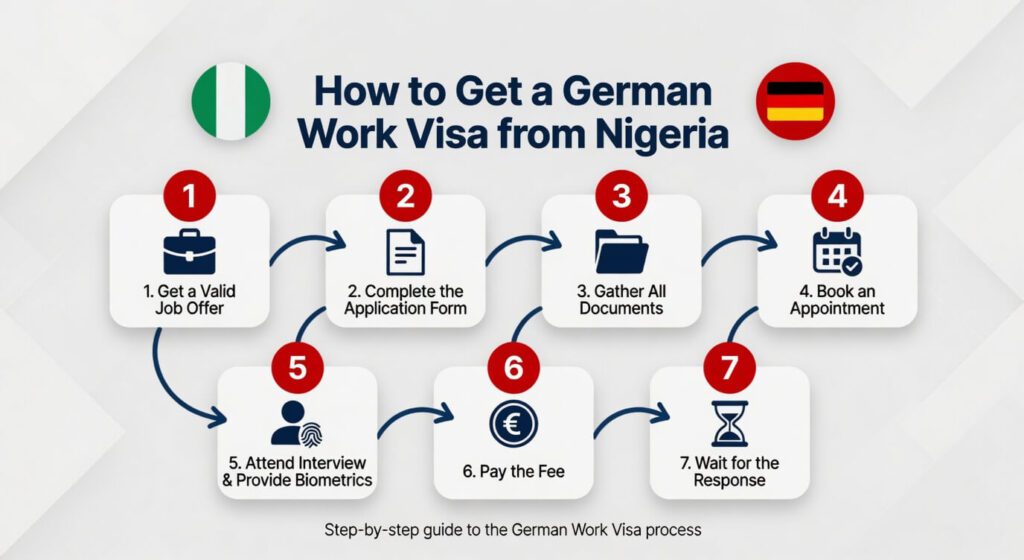
- Get a Valid Job Offer: Getting a German employer that pays the required annual salary is the first step. A valid job offer is compulsory, unless you are applying for a job seeker visa or an opportunity card visa.
- Complete the Application Form: You must fill out the long-term visa form (Visa D). This can be done online through the VIDEX platform.
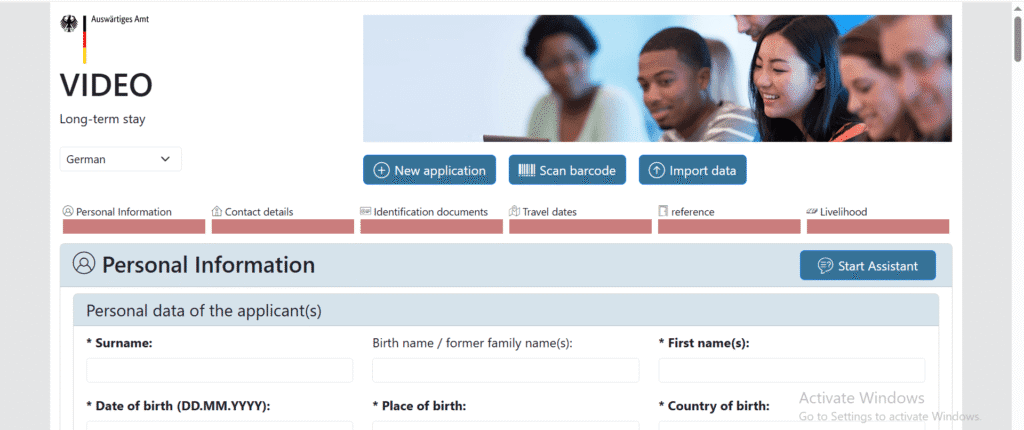
- Gather all documents: put together all documents like your valid passport, filled application form, job offer letter, qualifications, proof of finance, health insurance, and any other required documents
- Book an Appointment: You must schedule an appointment for an in-person interview at the German Embassy in Nigeria or through VFS Global
- Attend the Interview and Provide Biometrics: On your appointment date, you will submit your documents, answer questions, and provide fingerprints.
- Pay the Fee: The standard fee for a German national visa is €75 (₦119,407.50 )
- Wait for the response: Processing can take weeks or months. Track your application and wait patiently.
German work visa interview questions
Being nervous and unprepared can affect your interview performance, but don’t worry, we will help you understand what the interview is about to boost your confidence.
The interview revolves around questions that cover employer details, salary, job relevance to your experience, basic knowledge of Germany, qualifications, financial stability, and intent to return home or settle long-term.
Here are a few questions and answers to help you prepare:
- Do you have a job offer from a German employer?
Yes, I have a confirmed job offer from [Company Name] as a [Job Title], starting [Date].
- Why do you want to work in Germany?
Germany offers strong career growth opportunities in my field, competitive salaries, and a stable economy. I am eager to contribute my skills while building a long-term career there.
- What are your qualifications?
I hold a [degree/certification] in [field] from [institution] and have [X] years of experience in [industry].
- Can you speak German?
I currently speak German at a [A1/B1/B2] level and am actively improving my language skills through ongoing courses.
- How long do you intend to stay in Germany?
I intend to stay long-term, grow within my role, and eventually apply for permanent residency.
- Who is your employer, and what will you be doing?
I will be working with [Company Name] as a [Job Title], responsible for [briefly describe your role].
- Can you support yourself financially?
Yes, my employment contract guarantees a monthly salary of [amount], which comfortably meets Germany’s financial requirements.
- Have you ever been refused a visa?
No, I have never been refused a visa. / Yes, I was refused a visa to [country] in [year] due to [brief reason], but that issue has since been resolved.
TIP FOR YOUR INTERVIEW:
Be honest and confident during your interview, and be there on time.
Frequently Asked Questions
You can not work in Germany without a work visa.
A German work visa has a validity of up to one year. After moving to Germany, it is replaced by a residence title that can last up to four years.
The Opportunity Card (Chancenkarte) visa and the skilled worker visa have a high success rate.
Conclusion
To work and earn in Germany, you need a German work visa. The German immigration laws have made the application for non-EU citizens easier, including Nigerians.
With the correct documentation and the right application process, you can get your own German work visa.
For a smooth application, reach out to Visa.NG to handle your entire application without stress.
Get your German visa