Authenticating documents at Nigeria’s Ministry of Foreign Affairs can feel like running around a building without finding the door, especially if you are a first-time applicant with wrong documents, wrong information, or even the wrong office.
Authentication of documents at the Ministry of Foreign Affairs, Abuja, starts by preparing your documents, verifying your previous authentication, going to the MFA Abuja to fill the authentication form, paying Remita, and also physically submitting your documents.
In this guide, your questions are answered, from the costs, requirements, processing time, and step-by-step guidelines to authenticate your documents at the Ministry of Affairs in Abuja.
Key takeaways
- Authentication of documents at the Ministry of Foreign Affairs (MFA) is the Nigerian government’s official stamp that proves your documents are genuine and makes them legally accepted in foreign countries.
- To authenticate your documents, you need your original verified documents, a copy of your international passport, a Remita payment receipt of ₦20,000 and above per page, two photocopies of each document, and a completed MFA authentication request form.
- The full process involves preparing and pre-verifying your documents, paying the Remita fee, submitting at the Legal Services Division in Abuja, and collecting your stamped documents within 2 to 5 working days.
- MFA authentication cannot be done online or outside Abuja, so if you cannot travel, you must send a trusted person with an authorization letter or use a professional agency to handle it on your behalf.
What is the Authentication of Documents at the Ministry of Foreign Affairs (MFA), Nigeria?
Authentication of documents at the Ministry of Foreign Affairs is the Nigerian government’s official stamp of approval on your documents for international use from the Nigerian Ministry of Foreign Affairs.
It confirms that the signatures and stamps on your documents are genuine or real.
If you are planning to study, work, or do business abroad, foreign countries require this verification before accepting your documents. And since Nigeria isn’t part of the Apostille Convention, MFA authentication is your only valid option.
Why is Document Authentication at the MFA Important
The authentication of documents at the Ministry of Foreign Affairs (MFA) is important because foreign embassies won’t touch unauthenticated documents, so without it, the most important reasons are listed below:
- It makes documents legally valid outside Nigeria, as they have not yet ratified the Hague Convention.
- It verifies that documents are genuine and have not been tampered with.
- It serves as a necessary step before final legalization by a foreign embassy.
Types of Documents You Can Authenticate at the MFA in Nigeria
The documents that can be authenticated at the Ministry of Foreign Affairs, Abuja, are civil status documents, educational certificates, official and legal documents, and commercial and business documents.
- Civil Status Documents: Birth certificates, death certificates, marriage certificates, marriage declarations, and divorce decrees
- Educational Certificates: Transcripts, degrees, and Diplomas (often require prior legalization by the Ministry of Education).
- Official and Legal Documents: Police character certificates (PCC), court judgments, power of attorney, and statutory declarations/affidavits.
- Commercial and Business Documents: Certificates of incorporation, company board resolutions, and shipping documents (bills of lading).
What are the requirements for MFA Document Authentication in Nigeria
The authentication requirements for documents at the Ministry of Foreign Affairs (MFA) are listed below.
- Original documents submitted to the MFA must not have been notarized (if required) and verified by the issuing body. For example, the Ministry of Education for the WAEC certificate.
- A copy of your International Passport data page or other form of identification
- Remita payment receipt
- Two clear photocopies of each document for the MFA’s internal records.
- A completed MFA authentication request form
- An authorization letter if someone is submitting on your behalf
Step-by-Step Process of Authentication of Documents at the Ministry of Foreign Affairs (MFA), Abuja
The steps to authenticate your documents at the MFA in Abuja are discussed below. You have to make sure you follow the steps like a checklist to prevent omission of any of the steps.
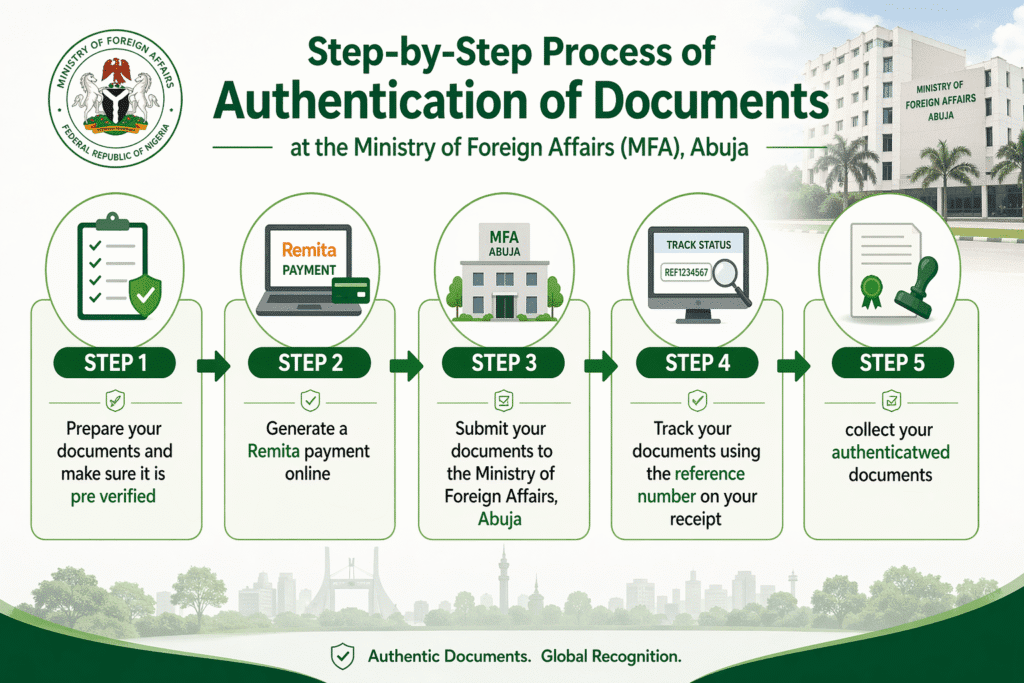
Step 1: Document preparation and Pre-Verification
Before heading to the MFA, your documents must have been notarized (if required) and verified by their respective issuing authorities first.
The Minister of Education (MOE) for academic records, birth certificates/marriage certificates by the National Population Commission (NPC), and Legal documents like affidavits or power of attorney must be notarized by a Nigerian Notary Public.
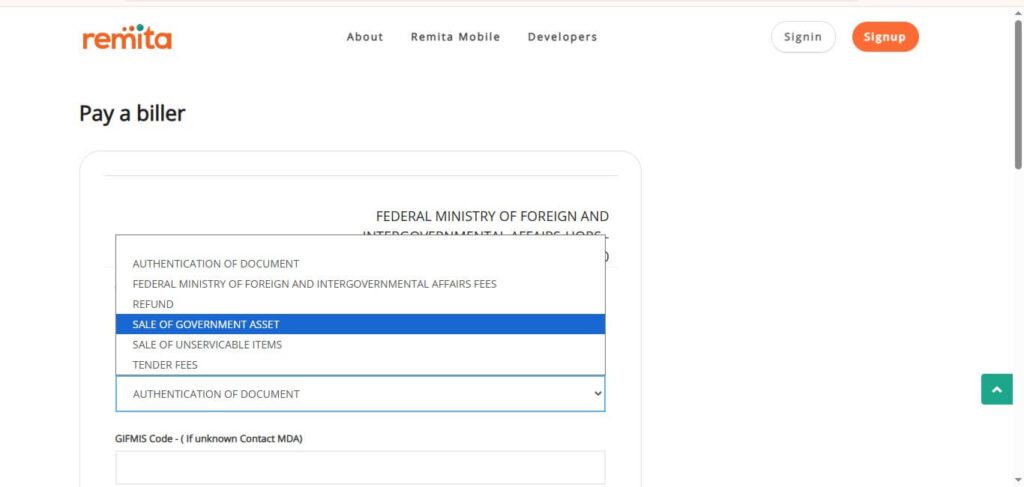
Step 2: Generate Remita Payment
- Go to the Remita pay a biller page. In the “Who do you want to pay?” box, type “Ministry of Foreign Affairs” and select it (look for Code: 011900100).
- Name of service/purpose: Select “Authentication of Documents” from the dropdown menu.
- Fill in your Name (as it appears on your passport), Email, and Phone Number.
- Payer Phone: Enter your valid Nigerian mobile number.
Once you click Submit, it will generate a Remita Retrieval Reference (RRR). You can pay immediately on that site with your debit card, or print the page and pay at any bank.
Step 3: Submission to the Ministry of Foreign Affairs, Abuja
Go to the Legal Services Division (LSD) at the MFA Headquarters, Tafawa Balewa House, Central Business District, Abuja. You will be given an authentication request form available at the desk.
Now submit your folder containing the requirements as listed above, and then you will receive an acknowledgment receipt with a tracking reference number.
Step 4: Track your Documents
The processing typically takes 2 to 5 working days, depending on current volume.
If processing takes longer than the expected timeline, you can use this tracking reference number to make inquiries by phone or in person at the Legal & Consular Department in Abuja.
Step 5: Collection
To collect your authenticated documents, present your acknowledgment receipt at the collection desk during designated hours (usually after 3:00 PM) to pick up your stamped and signed documents.
The MFA authentication stamp is generally valid for six months.
What is the cost of Authenticating Documents at MFA Nigeria
MFA authentication costs between ₦20,000 and above per document, depending on the document type and number of pages; more pages mean higher fees.
If your documents get delayed or rejected, that is another trip, another cost, which is why you have to go prepared to avoid spending more than necessary.
How long does MFA Document Authentication Take
The standard Ministry of Foreign Affairs authentication takes 2 to 5 working days, but several things, like complex documents requiring extra verification, high application volumes during peak periods like January and September, or incomplete submissions that need correction.
If you want it faster, arrive early, submit complete documents, and ask about express processing.
Can You Authenticate Documents Without Going to Abuja?
The Ministry of Foreign Affairs (MFA) is in Abuja, and that’s the only place where authentication occurs, so if you live in Lagos, Port Harcourt, or other states, you either travel or send someone trusted.
Get your documents authenticated
That’s where Visa NG comes in. They are a professional document processing agency that handles your MFA authentication from start to finish, no travel, no stress, no confusion. Just send your documents and relax.
What do I do after MFA Authentication
On the steps to the authentication of documents, the Ministry of Foreign Affairs’ authentication is not the last step; your document gets certified by the relevant Nigerian agency first, then authenticated by the MFA, and finally legalized by the foreign embassy of the country you are heading to, if required.
Without that final embassy legalization, many countries still won’t accept your documents. So after collecting from the MFA, head straight to the appropriate embassy for legalization.
Where to Authenticate Documents in Nigeria (MFA Office Location)
The official Ministry of Foreign Affairs authentication office is located at Tafawa Balewa House, Central Business District, Abuja. Head straight to the Legal Services Division; that’s where all authentication happens.
The building has a reception that directs you to the right floor, and their working hours are Monday to Friday, 8:00 am to 4:00 pm. Arrive early to beat the queue, bring all your documents, and expect to wait.
Frequently Asked Questions
Standard authentication takes 2 to 5 working days, but incomplete documents, high application volumes, or extra verification requirements can extend the timeline.
Authentication costs between ₦20,000 and above per document, and the exact amount depends on your document type and number of pages.
No, MFA authentication cannot be completed fully online. You must physically visit the Abuja office or use a trusted professional agency like Visa NG to process it on your behalf.
Conclusion
By now, I am sure you know exactly how the authentication of documents at the Ministry of Foreign Affairs(MFA) works, from the costs, requirements, and step-by-step guidelines to follow when you want to authenticate your documents with the MFA in Abuja.
If you are travelling abroad for school, work, or for business, MFA document authentication is not optional; it is a way of proving to foreign countries that your documents are legit and not fraudulent.
The good news is you don’t have to figure it out alone. Contact Visa NG to experience professional help with your document authentication from notarization to your submission to the Ministry of Foreign Affairs.
Get your documents authenticated