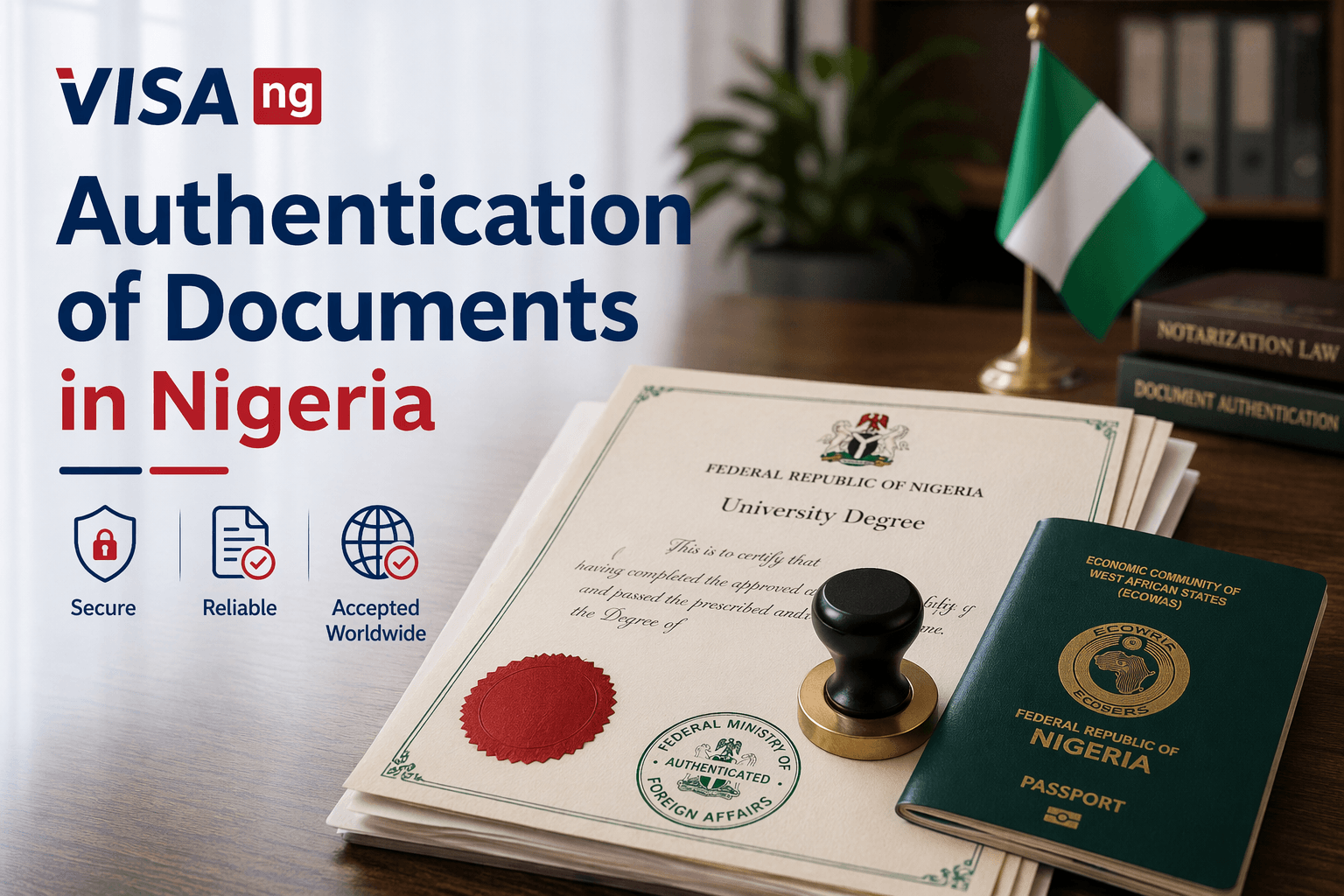
If you have been asked to authenticate your documents, you need to understand that you have been asked to prove that your documents are genuine.
Your documents must pass through four stages: from a Notary Public, ministry verification, the Ministry of Foreign Affairs (MFA) in Abuja, and, in some cases, the destination country’s embassy. Before it can be called genuine.
This guide will explain the authentication of documents in Nigeria, including the documents you need to authenticate, the cost, how long it takes for document authentication in Nigeria, and a step-by-step guide on how to authenticate your documents in Nigeria.
Key Takeaways
- Authentication of documents in Nigeria is the official process of getting your documents stamped and verified so that foreign governments, schools, and companies abroad can trust that they are real.
- Your documents must pass through four stages: from a Notary Public, ministry verification, the Ministry of Foreign Affairs (MFA) in Abuja, and, in some cases, the destination country’s embassy.
- The documents you can authenticate include academic certificates, personal documents like birth and marriage certificates, and business documents like CAC certificates and Tax Clearance Certificates.
What is the Authentication of Documents in Nigeria?
Document authentication means you are getting an official stamp or signature that proves your Nigerian document is real and can be trusted abroad.
I want you to think of it as your document getting a verified badge.
In most cases, people often confuse the differences between authentication and legalization of documents, although they are actually similar.
Authentication confirms the document is genuine, while legalization makes it legally accepted in the specific country you are traveling to.
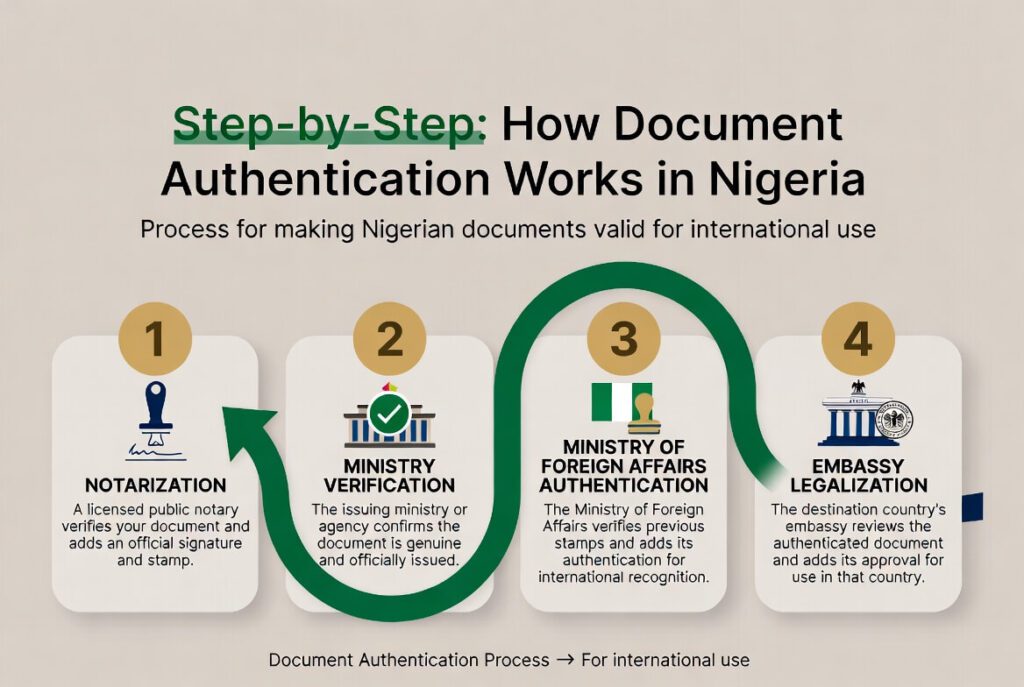
Step-by-step on how authentication Works in Nigeria
Think of authentication like a relay race; your document has to pass through different offices before it’s ready for the foreign world.
The steps for document authentication include notarization, ministry verification, authentication by the Ministry of Foreign Affairs, and embassy legalization.
Step 1: Notarization
Go to a public notary’s office near you or a licensed notary platform online, where a notary public will review your documents and confirm whether they are genuine, then sign and stamp them officially if they are genuine.
Step 2: Ministry Verification
Your documents will be verified by the ministry or agency that issued them to confirm that your documents originally came from where it says they came from.
For example, the Ministry of Education verifies educational certificates like WAEC (online) and NECO, while the Corporate Affairs Commission verifies business documents.
Not every document needs ministry verification, but if yours does, skipping it can get your application rejected.
Get your birth certificate authenticated
Step 3: Authentication at the Ministry of Foreign Affairs (MFA)
You will have to submit your documents yourself or through an agent to the MFA, and you will also be required to pay ₦300 through Remita.
Finally, submit the receipt to the legal services department of the MFA Abuja with the other requested documents.
They will review and confirm if the previous stamps are genuine before placing their own official stamp (authorization certificate) on your documents. This is when your documents become acceptable to the foreign country’s embassy.
Step 4: Embassy Legalization
Not all countries require this step, but if it is required by your destination country, you have to submit the authenticated documents to the embassy of that country for legalization.
For example, if you are heading to Italy, their embassy will review the MFA-authenticated document and add their stamp, officially clearing it for use in their country.
Always confirm with your destination country’s embassy first if legalisation is required.
Types of Documents that need Authentication
Below are the types of documents for authentication or required documents for authentication in Nigeria, and are split into academic documents, personal and civil documents, and business documents, depending on what you are traveling for.
- Academic Documents
- Degree certificates & Diplomas
- Academic transcripts
- Senior secondary certificate examination Results like WAEC, NECO, NABTEB, OR NBAIS
- Professional Certificates, such as the Nursing and Midwifery Council or the Medical Councils
- Primary/Secondary School Results: Form 137 or Leaving Certificates
- Personal and Civil Documents
- Birth Certificates/Attestation of Birth by the National Population Commission
- Marriage Certificates
- Divorce Certificates/Decrees issued by the court
- Single status certificate (Bachelor or spinsterhood)
- Police Character Certificate (PCC)
- International Passport Data Page
- Affidavits & Declarations for name change or non-impediment
- Death Certificate for inheritance or repatriation matters
- Business and Corporate Documents
- Certificate of Incorporation (CAC Documents)
- Memorandum and Articles of Association (MEMART)
- Board Resolutions
- Power of Attorney to act for the company
- Certificate of Good Standing to confirm company compliance
- Commercial Invoices & Bills of Lading for export/trade purposes
- Tax Clearance Certificates
How much Does Authentication of Documents Cost in Nigeria?
Authentication of documents in Nigeria costs ₦20,000 above per page for the entire process.
The prices for the authentication of documents vary depending on the number of documents you want to authenticate. Here is a price breakdown:
|
Step |
Cost Range (₦) |
Processing time |
|
Notary fees |
₦5,000–₦15,000 per document |
Depends on the document type. |
|
Ministry of Education fees (academic) |
₦20,000 per page (degree) |
1 – 3 days |
|
Ministry of Foreign Affairs official fees |
₦5,000 per page |
2 – 3 days |
|
Embassy legalization |
₦5,000–₦25,000+ (varies by country) |
Depends on the embassy |
|
Agent fees (optional) |
Varies by Agency |
The processing time for document authentication in Nigeria is within 2 to 6 weeks.
Why is the authentication of documents needed?
Authentication of documents is needed to prove that your document is genuine and officially issued, and to prevent fraud. It is also needed to:
- Confirm that the document was issued by the right authority and that it is not fake.
- Help foreign embassies, schools, employers, and immigration offices trust the document.
- Reduce fraud, forgery, and document rejection.
- Meet requirements for visas, study abroad, work permits, business registration, and legal matters overseas.
- Complete the step before embassy legalization for documents that will be used abroad (in Nigeria).
What are the differences between Authentication and Legalization
The main differences between authentication and legalization lie with who performs it and its purpose, which are discussed in the table below.
|
Aspect |
Authentication |
Legalization |
|
Purpose |
To prove that the documents are genuine and were issued in Nigeria. |
To prove that the document is accepted in a foreign country. |
|
Who performs it |
It is done at the Ministry of Foreign Affairs (MFA) in Abuja, Nigeria |
It is done at the embassy or consulate of the destination country in Abuja or Lagos, Nigeria. |
|
Who needs it |
Anyone sending documents to another country. |
People who are going to a country that requires it. |
|
Cost |
₦5,000 – ₦10,000 per document. |
Varies by country and embassy. |
Is an Apostille and Authentication the same?
No, they are not the same. Authentication is when the MFA in Abuja verifies if your document is real, while an Apostille is a single international stamp accepted by 120+ countries.
It replaces embassy legalisation entirely and verifies documents faster than authentication.
Nigeria doesn’t issue an Apostille because Nigeria is NOT a member of the 1961 Hague Apostille Convention.
Frequently Asked Questions
Authentication is the official process of proving that your document is genuine. It makes your Nigerian document trusted and accepted by foreign governments, schools, and companies abroad.
You have to start with a notary Public, then verify through the right ministry based on your travel purpose, submit to the MFA Abuja for stamping, and finally get embassy legalization if your destination country requires it.
An authenticated document is a document that is officially verified and stamped by the Notary public, MOE, MFO, and optionally by the foreign country’s embassy.
An authentication certificate is the official stamp or letter that the MFA places on your document, which tells any foreign authority that Nigeria’s government has confirmed that your document is legitimate and trustworthy.
Authentication in Nigeria works by getting your document verified and stamped by the Notary Public, the ministry that issued it, the Ministry of Foreign Affairs, Abuja, and finally legalized by the foreign country’s embassy (if your destination country requires legalization).
Conclusion
Now that you understand exactly what document authentication means in Nigeria, the four steps to follow, how much each process costs, and where to get it done.
The most important thing is to avoid cutting corners, skipping a step, using the wrong agent, or submitting incomplete documents, as it can only be a waste of time, money, and the opportunity you have been working so hard for.
If you need professional help with the authentication of your documents, reach out to Visa.NG, they provide quality authentication services.
Get your birth certificate authenticated