
You’re about to travel abroad, and you just found out that your birth certificate won’t be accepted in a foreign country unless you authenticate it. Don’t overthink it. Authentication of birth certificate is simply getting the Nigerian government to officially confirm that your birth certificate is real and stamp it.
It is a straightforward process if you know how to go about it. In this guide, you will find out what authentication of a birth certificate means, what is required, and how you can get it done.
Key Takeaways
- Birth certificate authentication is when the Ministry of Foreign Affairs (MFA) stamps your NPC birth certificate to prove it’s real for use in another country.
- You need it if you’re applying for a visa, studying abroad, working overseas, or getting married in a foreign country.
- The process costs around ₦15,000 and takes about 3 to 7 working days in standard time, or longer, after you submit your documents at the MFA in Abuja.
- You’ll need an original NPC document, photocopies, your international passport data page, passport photos, and proof of Remita payment before you go to the MFA office.
What Is Authentication of a Birth Certificate in Nigeria?
Authentication of a birth certificate just means getting the Nigerian government to officially confirm that your birth certificate is real and stamp it. It is the only way of proving to other countries that the birth certificate is genuine.
Birth certificate authentication in Nigeria is carried out by the Federal Ministry of Foreign Affairs (MFA). But before it gets there, you first need the certificate (or age declaration) from the National Population Commission (NPC), then have it notarized by a Notary Public. Only after these two steps can it go to the MFA for authentication.
Without that stamp, embassies, schools, and employers in other countries won’t accept it, even if it’s 100% genuine, because they have no way to know that on their own.
Birth Certificate vs NPC Attestation of Birth
Both the NPC Birth Certificate and NPC attestation of birth are documents issued by the National Population Commission, but there are some key differences between them; these are listed in the table below
|
Birth Certificate |
NPC Attestation of Birth |
|
|
What it means |
Your official proof of birth, straight from the registration records |
A backup document for people whose birth was never formally registered |
|
Who needs it |
Anyone born after Nigeria’s birth registration system was up and running (After 1992) |
Older Nigerians, usually born before 1992 (or before 1979 in some areas), who never got registered at birth |
|
Who issues it |
National Population Commission (NPC) |
National Population Commission (NPC) |
Why do you need to Authenticate Your Birth Certificate?
Here’s something you should know: not everyone who uses a birth certificate needs to authenticate it. If you’re using your birth certificate within Nigeria, you don’t need to authenticate it. You’ll only need to authenticate birth certificate at the Ministry of Foreign Affairs if you’re:
- Applying for a visa to most countries where your age or nationality has to be proven
- Enrolling in a foreign university that requires certified civil documents as part of admission
- Applying for a work permit or job abroad
- Handling legal proceedings involving a foreign court or agency
- Applying for citizenship or residency in another country, where your Nigerian origin needs to be officially confirmed
- Getting married abroad, where the foreign registry needs proof of your identity and age
Most times, authentication of documents only comes into play when the document is heading outside the borders of Nigeria, or in front of a foreign authority that needs proof it’s the real thing.
Get your birth certificate authenticated
Requirements for Authentication of Birth Certificate in Nigeria
The documents you need to authenticate birth certificate at Ministry of Foreign Affairs in Nigeria are:
- Original NPC birth certificate
- Two to four clear photocopies of the birth certificate
- A copy of your international passport data page for identification
- Proof of Remita payment/Remita receipt
- A completed authentication request form
- Two recent passport photographs
- A form of identification, like a NIN or ID card
- Affidavit of age declaration from a high court (in some cases)
- Notarization (Some embassies might request a notarization before taking it to the MFA)
NOTE:
For third-party submission, your representative must have an authorization letter, a valid ID, and a copy of your ID. The above-listed documents must be in good condition, without tears or damage.
How to Authenticate a Birth Certificate in Nigeria
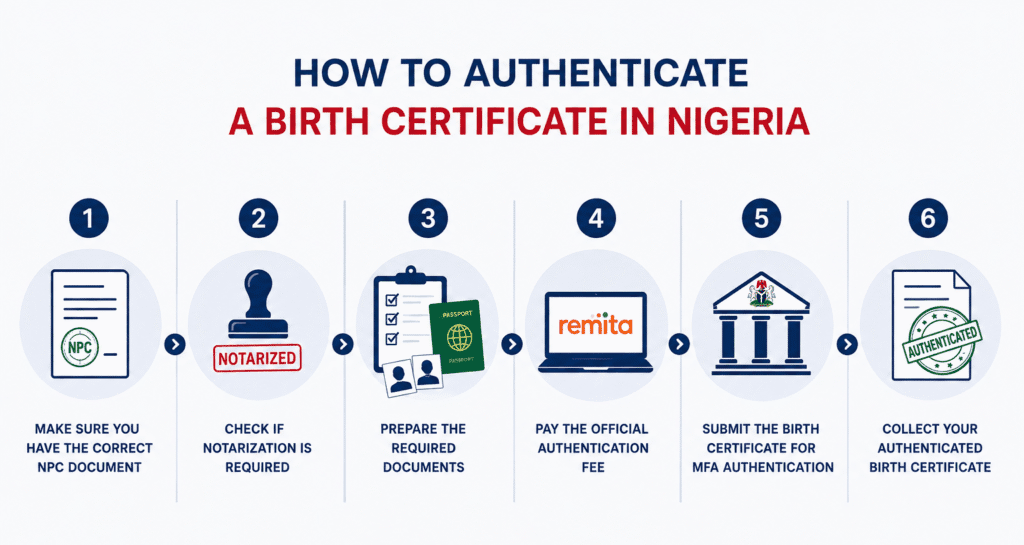
1. Make Sure You Have the Correct NPC Document
First, confirm you actually have a birth certificate issued by the National Population Commission, not a hospital-issued notification of birth or a local government slip. The MFA will not authenticate documents that didn’t come from the NPC. If you were born before Nigerian formal registration was in place in your state, you’ll need to get an NPC Attestation of Birth instead.
2. Check If Notarization Is Required
For most personal documents like a birth certificate, the NPC-issued document is accepted directly, but some applicants are asked to have it notarized by a Nigerian Notary Public first, especially if there’s an accompanying affidavit or the destination country specifically asks for it.
3. Prepare the Required Documents
Before you head to Abuja for authentication, gather all the necessary documents and make sure they are all in good condition.
4. Pay the Official Authentication Fee
Go to Remita.net and select “Pay Federal Government of Nigeria.” Under “Name of MDA,” type Ministry of Foreign Affairs. Select “Document Authentication” as the service/purpose.
You will be directed to the payment page. Print the Remita Retrieval Reference (RRR) and the successful payment receipt. You must bring the physical receipt to the MFA.
5. Submit the Birth Certificate for MFA Authentication
Head to the Legal Services Division at the MFA headquarters in Abuja with your original document, your photocopies, and your proof of payment. An officer reviews everything for completeness, and if it all checks out, your document is accepted for processing.
6. Collect Your Authenticated Birth Certificate
Processing typically takes about 3 to 7 working days, though it can stretch longer if the office is backed up or if anything about your document needs extra verification. Once it’s ready, you return to collect your certificate, now bearing the MFA’s official stamp and signature.
Cost of birth certificate authentication in Nigeria?
Authenticating a birth certificate in Nigeria typically costs around ₦15,000, though the exact fee can vary depending on whether you are getting it yourself or using an agency, and the processing time.
How do I Verify a Nigerian Birth Certificate?
Birth certificate verification in Nigeria is done by contacting the National Population Commission (NPC) office at:
- Address: No. 1 Masaka Close, Off Olusegun Obasanjo Way, Wuse Zone 7, Abuja.
- Email: info@nationalpopulation.gov.ng
- Phone: +234 (0)7000 236 787
To confirm the certificate number and details from their records.
Source: National Population Commission
Frequently Asked Questions
You can authenticate your birth certificate at the Ministry of Foreign Affairs in Abuja, located at Tafawa Balewa House, Central Business District. If you’re outside Abuja, you can use accredited agents to handle it.
An NPC attestation of birth is a document the NPC issues to adults who don’t have a standard birth certificate, based on a parent or relative’s sworn testimony confirming the person’s date and place of birth.
A birth attestation is given by the National Population Commission to someone without a standard birth certificate, while birth certificate authentication is a separate step where the Ministry of Foreign Affairs confirms that the already-issued birth certificate or attestation is genuine for use abroad.
No, you can only authenticate your birth certificate at the Ministry of Foreign Affairs in Abuja. So applicants in Lagos typically go through Abuja via courier or an accredited agent.
Conclusion
Authenticating your birth certificate doesn’t have to be stressful; all you have to do is follow the correct steps, whether it’s an NPC birth certificate or an NPC attestation of birth.
If you’d rather skip the trip to Abuja, reach out to a document agency to handle your birth certificate authentication from start to finish.
Get your birth certificate authenticated