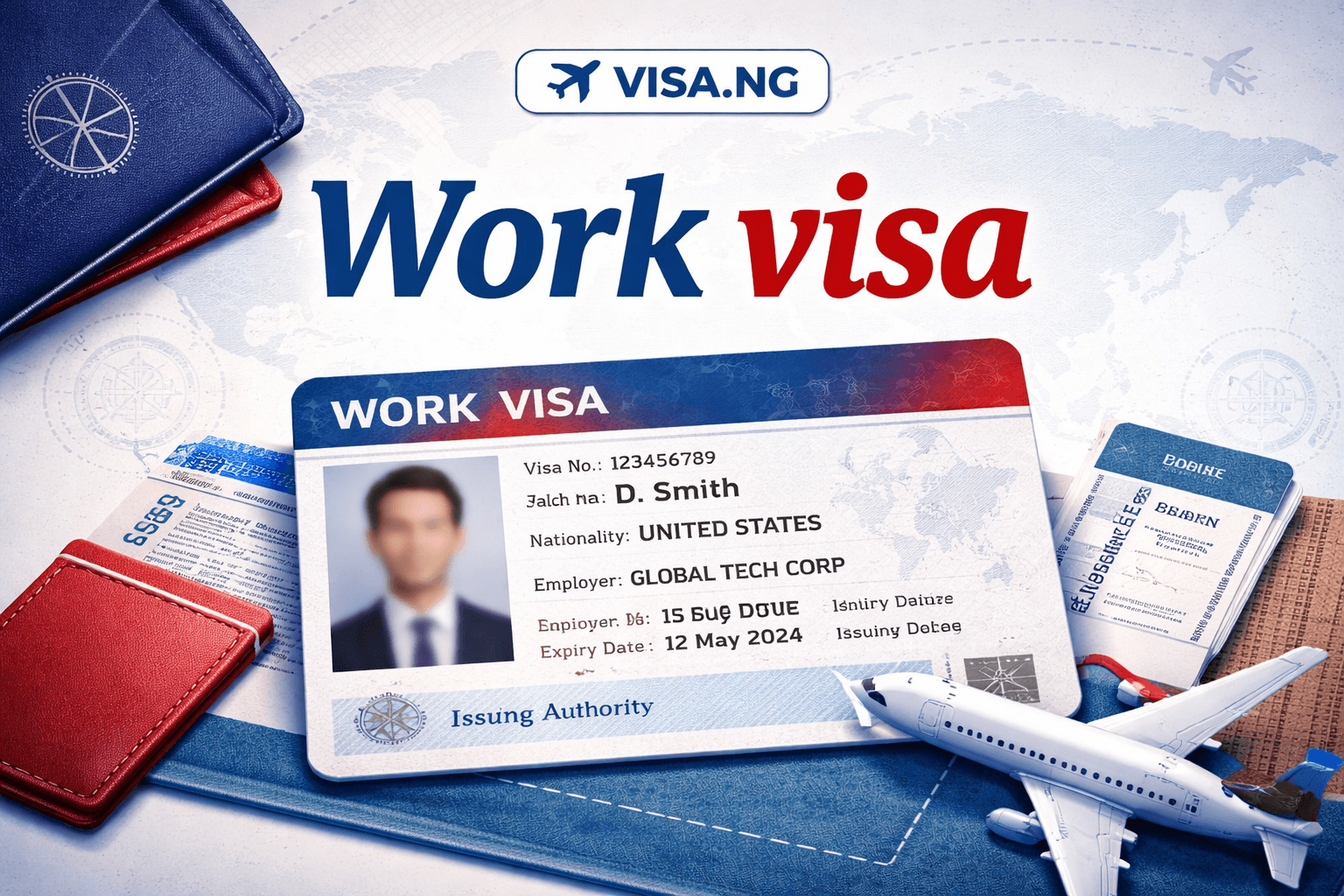
Before any individual can legally work in another country, he or she needs to be granted access to that country. That access comes in the form of a work visa.
A work visa is an official document issued by a country’s government that allows a foreign national to enter and work there legally for a specific job and period of time.
In this guide, you will learn what a work visa is, the types of work visas available, the documents required, and exactly how to apply for a work visa as a Nigerian.
Key takeaways
- A work visa is your legal pass to enter and work in another country; without it, you cannot work there, no matter how good your job offer is.
- In some countries, your employer must file official paperwork with their government before you can even begin your own application.
- Most work visa rejections are not bad luck; they come down to missing documents, an unlicensed sponsor, or picking the wrong visa category, all mistakes you can avoid.
What is a work visa?
A work visa is an official document issued by the government of a country that gives a foreigner the legal right to enter the country and work for a specific period of time.
A work visa can be extended and renewed for applicants who meet all requirements, and a work visa can also be revoked when the applicant breaks the country’s rules or no longer qualifies for a work visa.
The benefits of a work visa range from opening the door to better career opportunities, higher earnings, international work experience, and, in many cases, a pathway to permanent residency abroad.
A lot of Nigerians have become citizens of other countries from the permanent residency they obtained while on a work visa.
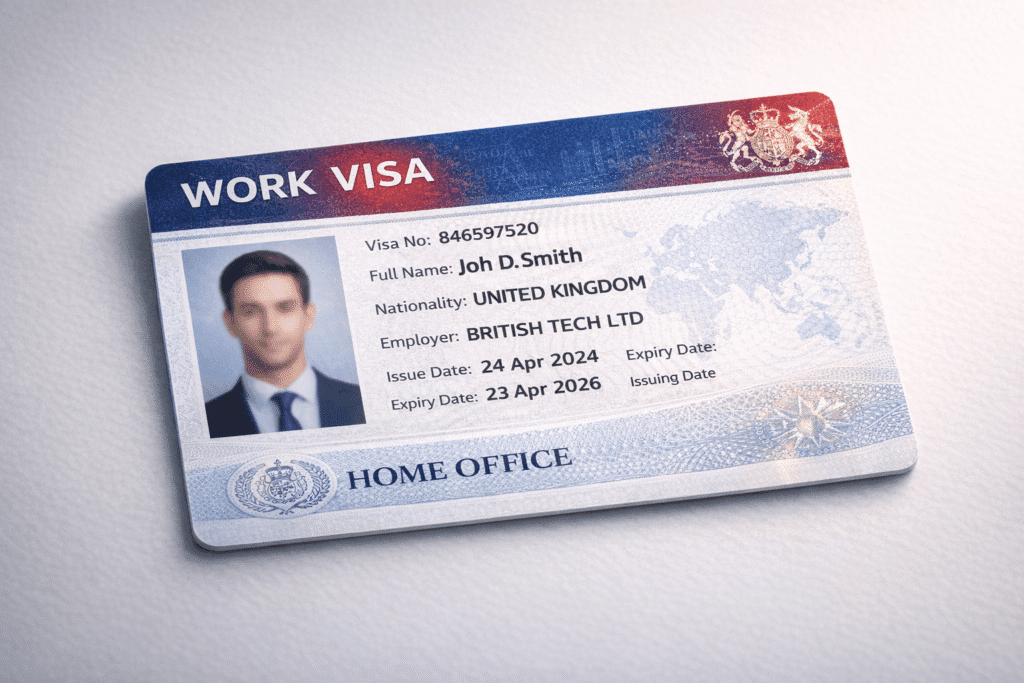
A work visa is not the same document as a work permit. A work visa can not replace a work permit, except in countries where you don’t need a work permit.
NOTE:
A work visa is temporary and not permanent.
Types of work visas
Work visa types vary with countries; it can be a temporary work visa, a general work visa, a freelance work visa, a skill work visa, or other types of work visas. Below are the explanation to this various types of work visas:
- Temporary work visa: it is for a fixed time, usually between 90 days and 2 years. It is meant for short-term work, project-based work, or seasonal work.
- Employer-sponsored work visa: This is when an employer offers you a job and sponsors your work visa application on your behalf. The visa is tied to that specific employer, meaning if you change jobs, you may need to apply for a new visa.
- Investor/ entrepreneurial visa: For individuals willing to invest significant capital into the host country’s economy to create jobs.
- Self-employment or freelance work visa: This type of work visa is for individuals who want to work independently, by running a business, freelancing, or even offering professional services, without being employed by a local company. Not all countries offer this.
- Student and exchange work visa: This visa allows foreign students or exchange program participants to work legally in a country where they are studying or completing an exchange program.
- Open work visa: This visa allows you to work for any employer in the country without being tied to a specific job or company. It gives the holder full flexibility in the labour market.
- Critical skills employment visa: This visa is for highly skilled professionals, such as ICT professionals and engineers, or any other occupations listed on the Critical Skills Occupations List.
- Dependant/partner/spouse employment visa: This allows the dependants, spouses, and recognised partners of critical skills employment visa holders or certain researchers to legally work in the country. This is common in countries like Ireland.
- Intra-company transfer employment visa: This work visa is tied to the company rather than the individual’s role. It is issued to employees of multinational companies who are being relocated from one country branch to another.
- General employment visa: This covers a broad range of occupations unless the occupation has been listed as ineligible.
- Reactivation employment visa: This allows individuals who previously held a valid visa but fell out of the system through no fault of their own or experienced workplace exploitation to work legally again.
- Sport and cultural work visa: This is issued to foreign nationals who are coming to a country specifically to work in the fields of sport, entertainment, music, film, theatre, or the arts.
Get your work permit
General requirements for a work visa
The general requirement for a work visa is a combination of personal identification, employer-backed documents, and supporting documents like:
- Valid international passport (with at least 6 months’ validity)
- Recent passport-sized photographs
- Proof of current legal status (e.g., existing visa or residence visa)
- Signed employment contract or job offer letter/ Letter of sponsorship from the employer
- Employer’s business registration certificate, tax identification, or compliance documents
- Academic certificates (degree, diploma, or equivalent)
- Professional licences or certifications (for regulated occupations)
- Translated copies of foreign qualifications (if applicable)
- Reference letters from previous employers
- Proof of income or salary (pay slips or bank statements)
- Employer’s proof of ability to pay the offered salary
- Supporting documents ( like Proof of accommodation in the destination country)
- Health and vaccination report ( if applicable)
- Completed work visa application form
How to Apply for a Work Visa
The process for applying for a work visa varies by country, but the core steps applied universally usually start with confirming your eligibility, getting a job, gathering your documents, notifying your employer to file a petition, filling the application form, paying necessary fees, submitting the application, attending an interview, and waiting for a response:
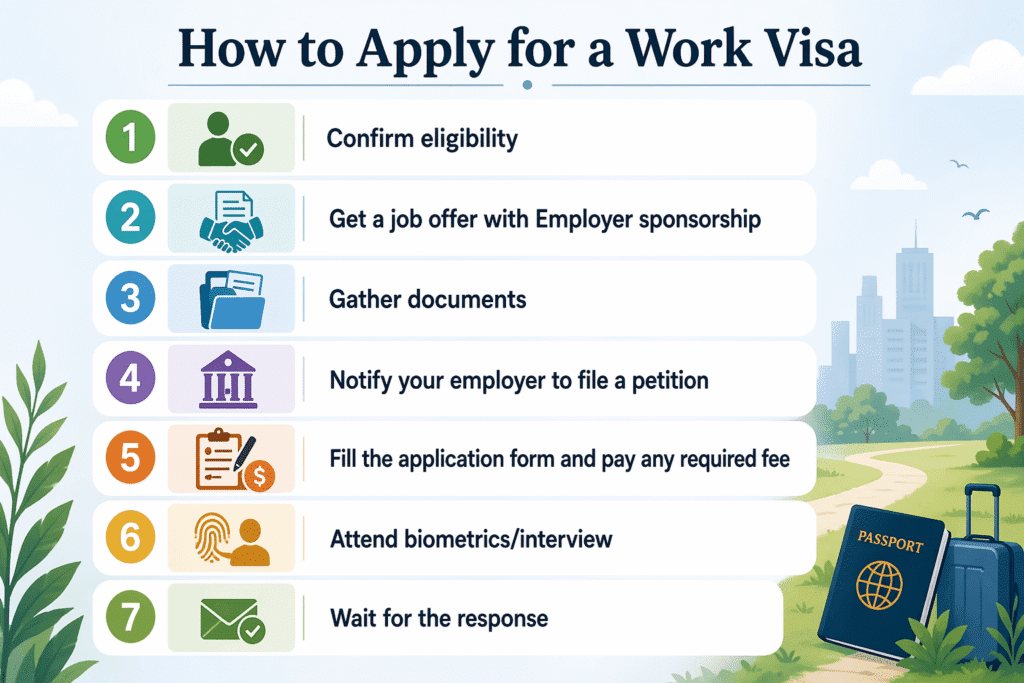
- Confirm eligibility: Check the destination country’s eligibility requirements, and confirm your job offer qualifies for a work visa.
- Get a job offer with Employer sponsorship: Secure a valid job offer from a licensed employer that is approved to sponsor foreign workers.
- Gather documents: Gather all necessary documents and supporting documents like your passport, health insurance, employment contract, qualification, etc.
- Notify your employer to file a petition: For some countries, you cannot apply for a work visa on your own. Your employer must first notify or seek approval from their government before you can proceed with your own application.
- Fill the application form and pay any required fee: Complete the official application form accurately, then pay the required fee through the approved payment channel and keep your receipt.
- Submit application: submit your completed form to the right place. For example: You can submit it online at gov.uk
- Attend biometrics/interview: if required by your destination country, show up for any scheduled biometric appointment or interview with your original documents.
- Wait for the response: Processing can take weeks or months. Track your application status where possible and wait patiently.
Popular Countries and Their Work Visa Requirements for Nigerians
Every country has its own work visa requirements, age limits, and processing times. Here is the necessary information you should know for a few countries:
Germany work visa: what you should know
- Types of German work visa: Qualified Employment visa, EU Blue Card visa, Professionally Experienced Worker visa, Self-Employment and Freelance visa, Researcher visa, Job Seeker Visa & Opportunity Card (Chancenkarte) visa.
- German work visa requirements: A valid job offer from a German employer, recognised qualifications comparable to German standards, Financial proof that you can sustain yourself, Travel insurance coverage, and language proficiency.
- Age limit: Germany does not have a specific work visa age limit, but you must be at least 18 years old to apply for a German work visa because you are treated as an adult employee.
- Processing time and validity period: it takes 6-12 weeks to get a work visa after application, and the work visa itself is normally valid for the duration of your job contract, often 1 – 4 years.
UK work visa: what you should know
- Types of UK work visa: Skilled Worker Visa, Health and Care Worker Visa, Graduate Visa, Global Talent Visa, Global Business Mobility Visa, Temporary or Seasonal Work visa, Business and Investment, Scale-Up Worker Visa.
- UK work visa requirements: Job offer and sponsorship from a licensed UK employer, proficiency in English language, a salary that meets the going rate for that role, financial proof, a clean criminal and immigration history
- Age limit: The UK does not have a specific work visa age limit, but you must be at least 18 years old to apply for a UK work visa.
- Processing time and validity period: it takes 3-9 weeks to get a work visa after application, and the work visa itself is usually granted for the length of your employment on the Certificate of Sponsorship, up to a maximum of 5 years. Employers commonly sponsor for 1 – 3.
United Arab Emirates work visa: what you should know
- Types of UAE work visa: Standard employment visa, golden visa, green visa, mission work visa, domestic worker visa, temporary work visa, part-time work visa, juvenile work visa.
- UAE work visa requirements: a confirmed job offer from a licensed UAE employer, sign a compliant employment contract, provide attested educational certificates, pass a medical examination at a government‑approved clinic, and then apply for a residence visa and Emirates ID within the allowed time after arrival.
- UAE age limit: You must be at least 18 years old to apply for a UAE work visa, and 60 is considered the retirement age. UAE law allows juveniles aged 15–18 to work only under a special Juvenile Work visa (summer jobs, internships, part‑time training roles)
- Processing time and validity period: it takes 2-4 weeks to get a work visa after application, and the work visa itself is usually granted for 2 years for standard employment visas and can go up to 10 years for a golden visa.
What Is Work Visa Employer Sponsorship?
Work visa employer sponsorship is a system that usually requires an employer to hold a sponsor licence to hire someone from outside the country, taking responsibility for them to work in the host country. It provides a structured path for employees to work legally in another country.
To become a sponsor, a business must
- Check its eligibility,
- ensure the job is suitable for sponsorship,
- Choose the appropriate licence type if they don’t have one already.
- and then apply online while paying a fee.
Immigration officers may visit the business to verify its suitability.
Once a licence is granted, the employer can issue certificates of sponsorship for suitable roles to foreigners. Many Nigerians secure their work visa through a company sponsor.
Common Reasons why a work visa is denied
Work visa applications are commonly denied due to incomplete documentation, an expired passport, your employer not licensed to sponsor, failure to meet minimum qualifications, a criminal record, applying under the wrong visa category, or failure to meet requirements:
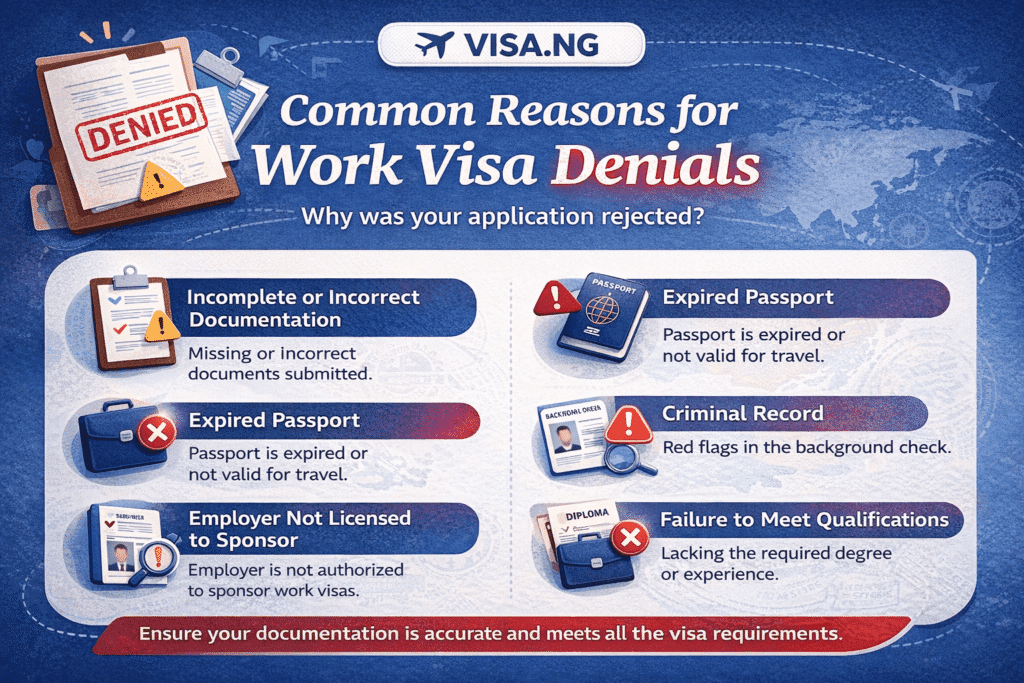
- Incomplete or Incorrect Documentation: Every document is important; missing a required document or submitting one with errors is one of the top reasons for denial.
- Expired Passport: Most countries require that your passport remain valid for at least six months beyond your intended stay.
- Employer Is Not Licensed to Sponsor: If your employer does not hold the required licence or has not completed the necessary petition process, your application will be denied.
- Criminal Record: Any red flags in your background check can lead to a denial.
- Applying for the Wrong Visa Category: Each visa has specific conditions, and applying for one that does not match your job type or situation will result in rejection.
- Failure to Meet Minimum Qualifications: If your qualifications do not match what the visa demands, whether that is a degree, years of experience, or a professional licence, your application will not be approved.
Frequently Asked Questions
Yes, fees are required for processing the application.
A work visa’s validity varies with the different countries and work visa types.
A work visa can either be a non-immigrant temporary visa or an immigrant permanent visa, depending on the type and purpose of employment.
No, a work visa is a temporary visa for specific employment, while a green card is permanent residency.
Work visas are obtained through the target country’s embassy or immigration authority.
Conclusion
A work visa is a government-issued document that allows a foreigner to enter and work in the country. Each country has different types of work visas that fit applicants’ situations.
Many Nigerians secure their work visa through a company sponsor, where an employer abroad takes responsibility for their application and work authorization.
For a smooth application, let Visa.NG handles the hard part, from finding a sponsored employer to managing your entire work visa application process.
Get your work permit