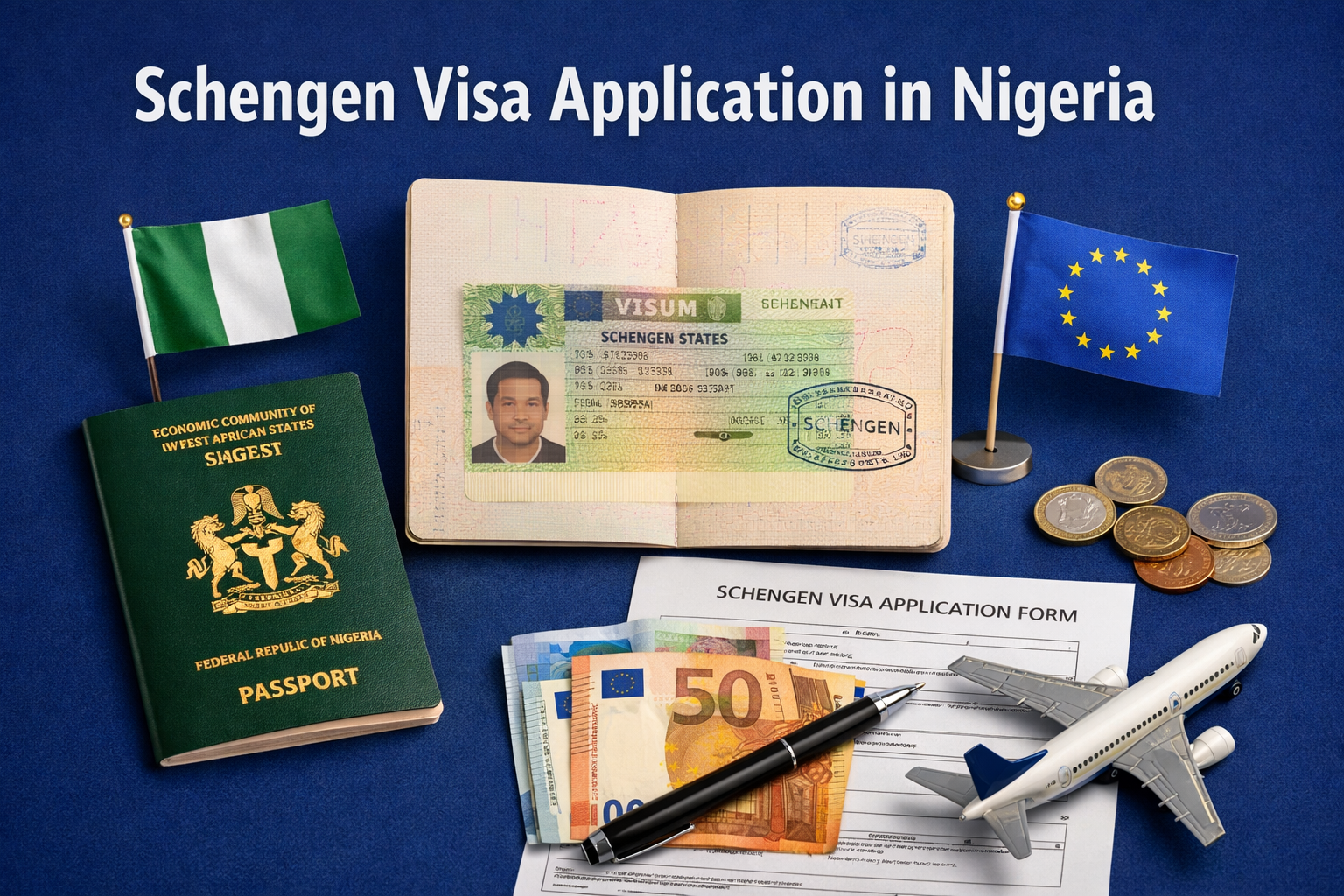
The Schengen Area represents one of the world’s greatest travel opportunities for Nigerians, spanning 29 European countries with a single permit. To get this permit, you need to apply for a Schengen visa.
In this article, you will learn the process of the Schengen visa application in Nigeria, the exact document checklist required for 2026, and updated visa fees.
Key takeaway
-
The Schengen Zone covers 29 European countries, where a Type C visa grants you access to all member states for up to 90 days within any 180-day period.
-
Schengen visa application in Nigeria requires booking a VFS Global appointment at least 2 months in advance, submitting biometrics in Lagos or Abuja, and waiting up to 15–45 days for a decision.
-
Schengen visa application documents required include a valid passport, biometric photos, a round-trip flight reservation, hotel bookings, 3–6 months of bank statements, and Schengen travel insurance with at least €30,000 coverage.
-
The total Schengen visa application cost is €90 for adults plus an additional VFS service fee of roughly ₦25,000–₦40,000, and all fees are non-refundable even if your application is rejected.
- Schengen visa application forms are always free and must be obtained from official portals, VFS Global, TLScontact, or BLS International, depending on your destination country, and some countries, like France and Germany, require digital completion before printing.
The Step-by-Step Process of Schengen visa application in Nigeria.
Schengen visa application in Nigeria requires precision and early planning. Follow these steps to navigate the process at the VFS Global centers in Lagos or Abuja.
- Identify Your Destination and Visa Type: Determine which Schengen country is your primary destination (where you will spend the most nights). If you are spending an equal amount of time in multiple countries, apply through the embassy of your first point of entry. Most travelers require a Uniform Schengen Visa (Type C) for tourism, business, or family visits.
- Book an Appointment via VFS Global: In Nigeria, most Schengen member states (like France, Italy, and Spain) outsource their intake to VFS Global. Create an account on their portal to secure a date. Note: Appointments are in high demand; it is best to book at least 2 months before your planned travel date.
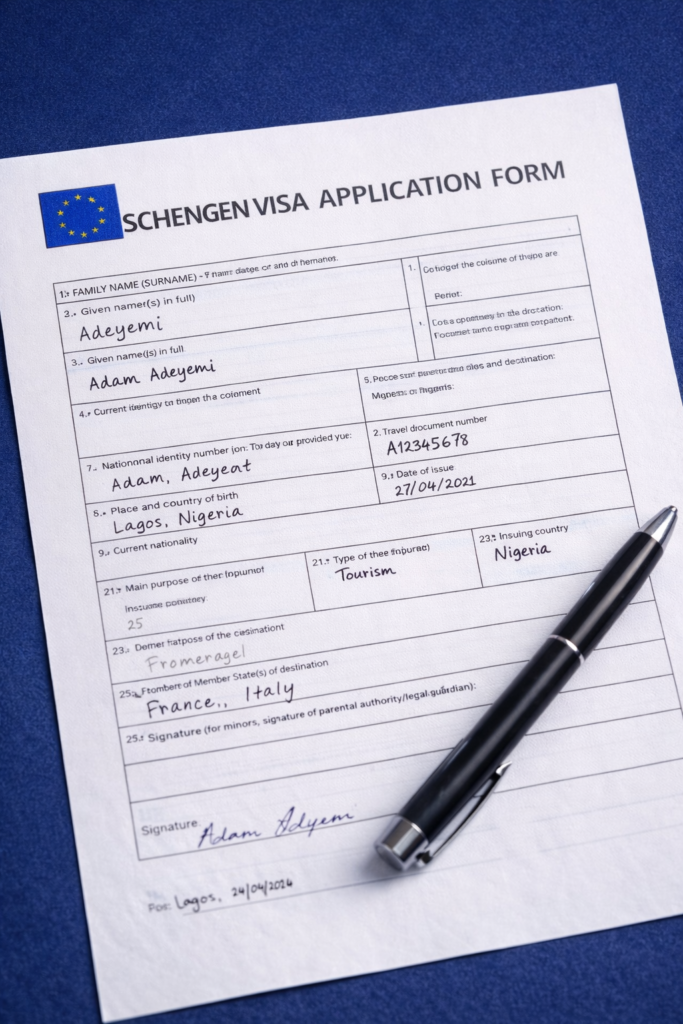
- Complete the Visa Application Form: Download and fill out the official Schengen Visa Application Form. Ensure every detail matches your international passport exactly. Many countries now require you to complete this form online through portals like France-Visas or the German Videx system before printing.
- Gather Your Supporting Documents: Prepare your “rejection-proof” file. At a minimum, you will need:
-
- A valid International Passport (issued within the last 10 years with 2 blank pages).
- Two recent passport photographs meeting Schengen biometric standards.
- Schengen Travel Insurance with minimum €30,000 coverage.
- Proof of Funds: Personal bank statements from the last 3–6 months.
- Flight Itinerary: A round-trip flight reservation (do not pay for the full ticket until the visa is approved).
- Proof of Accommodation: Hotel bookings or an official invitation letter from a host.
-
- Pay the Visa and Service Fees: The standard Schengen visa fee is €90 for adults and €45 for children (6-12). In Nigeria, this is paid in Naira at the bank rate determined by the embassy. You will also pay a separate VFS service fee (usually around ₦25,000 – ₦40,000) when submitting.
- Attend Your Appointment and Provide Biometrics: Visit the VFS center in Lagos (Manor Hall) or Abuja (Sterling Bank Plaza) for your interview. You will submit your physical file and have your fingerprints and photograph captured. Dress professionally and be prepared to answer basic questions about your itinerary and ties to Nigeria.
- Track Your Application and Collect Your Passport: Processing typically takes 15 calendar days, though it can extend to 45 days for Nigerians during peak seasons. Use the VFS tracking tool with your reference number. Once a decision is made, you can collect your passport in person or opt for courier delivery.
Where to obtain your Schengen visa application form in Nigeria.
In 2026, the Schengen visa application form in Nigeria will be free of charge and must be obtained directly from the official websites of the authorized visa processing partners or the specific embassy of your main destination.
You can obtain the form through the following official channels, based on the country you are visiting:
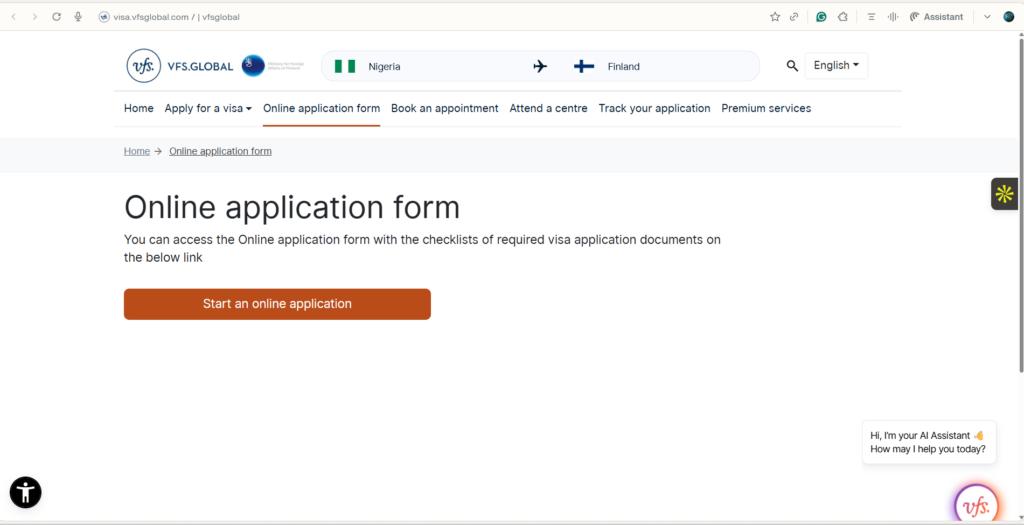
- Official Outsourced Visa Centers: Most Schengen countries use these third-party services to handle applications in Lagos and Abuja. You can download the forms or fill them out online on their portals:
- VFS Global: Handles applications for countries including Germany, Austria, Italy, the Netherlands, Sweden, Norway, and Iceland.
- Visit the VFS Global Nigeria portal and select your destination country to access the specific form.
- TLScontact: Manages applications for France and Belgium.
- Create an account on the TLScontact Nigeria website to access and print your completed form.
- BLS International: Exclusively handles Spain visa applications in Nigeria.
- Download the form for free from the BLS Spain Visa Nigeria website.
- VFS Global: Handles applications for countries including Germany, Austria, Italy, the Netherlands, Sweden, Norway, and Iceland.
- Embassy Online Portals: Some countries require you to fill out a digital form on their dedicated national systems before printing it for your appointment:
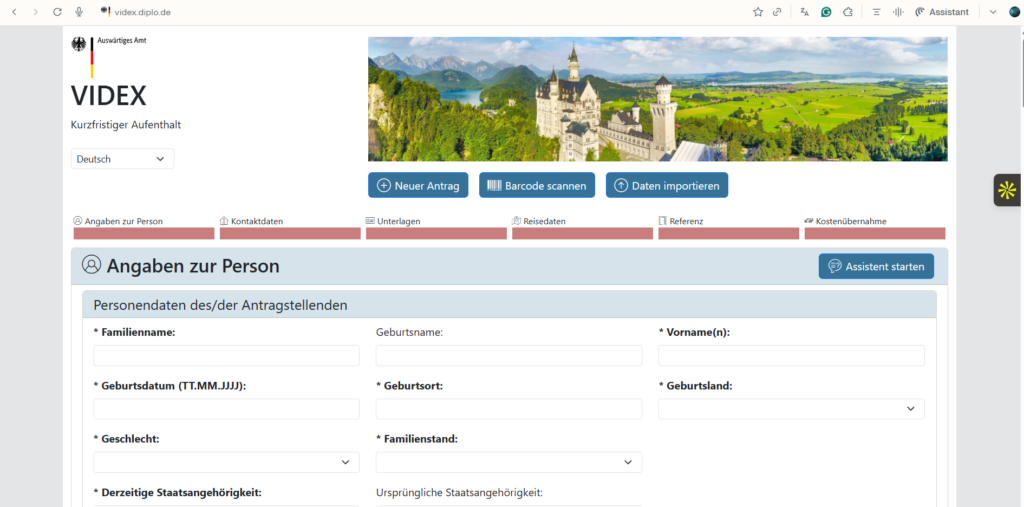
- Germany: Use the VIDEX portal to complete your application digitally.
- France: All applicants must first register on France-Visas to generate their application form and registration receipt.
- Switzerland: Forms can be downloaded from the Swiss Federal Office for Migration (SEM) or through VFS.
Important Notes for 2026
- Cost: Never pay for an application form; they are always free from official sources.
- Submission: While you can download the form anywhere, you must submit it in person at the designated visa application centre (VAC) in Lagos or Abuja, along with your biometric data.
- Completeness: Ensure the form is filled in block capitals with black ink if completing a physical copy.
List of Schengen visa application documents required for a Schengen visa.
Here are some Schengen visa application documents required when applying for a Schengen visa:
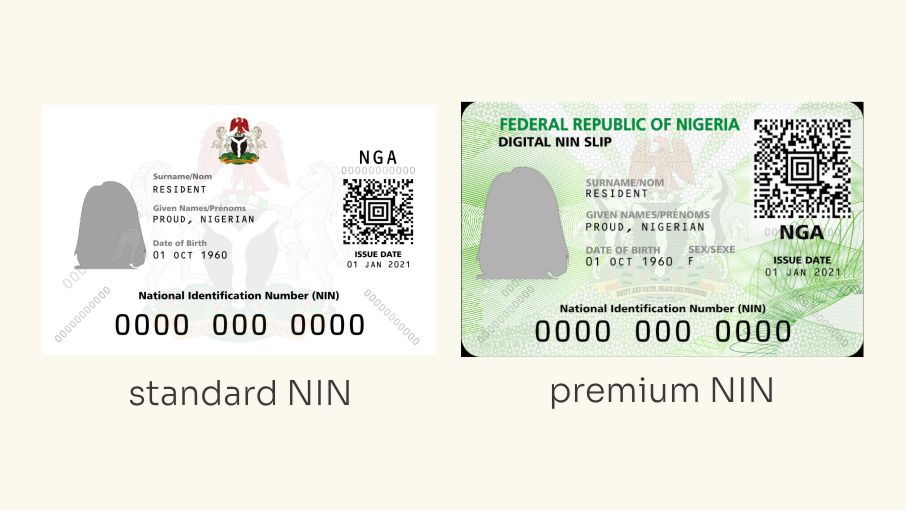
- National ID: Valid National ID card
- Proof of Employment: Employment letter
- Original Tax Clearance Certificate and certificate of Business Incorporation for business or women.
- Proof of funds: Proof of financial capacity to take care of the trip.
- Residence permit: Documents for non-Nigerians.
What is a Schengen Visa Application letter?
A Schengen visa application letter (or cover letter) is a formal, personal document addressed to the embassy or consulate, explaining the purpose of your trip, itinerary, and intent to return home. It acts as an introduction to your application, clarifying details and strengthening your case to visa officers.
What to Include in the Letter.
- Opening: Name, purpose of visit, and passport number.
- Body: Detailed itinerary, financial status, and ties to home country.
- Closing: A brief summary, expression of gratitude for review, and signature.
What is the Schengen visa application cost?
As of early 2026, the standard application fee for a short-stay Schengen visa (Type C) is €90 for adults.
The fee varies depending on the applicant’s age and nationality:
- Adults (12 years and older): €90.
- Children (6 to 11 years): €45.
- Children (under 6 years): Free of charge.
Important Additional Schengen visa application Costs
When budgeting for Schengen visa application costs, keep in mind that the total cost is often higher than the base fee:
- Service Fees: If you apply through a third-party center like VFS Global or TLScontact, you will pay an additional service charge, typically ranging from €30 to €45.
- Travel Insurance: Mandatory medical insurance is required for all applicants and is a separate cost.
- Non-Refundable: Fees are paid at the time of application and are not refundable, even if your visa is rejected.
Understanding the Schengen region and the agreement.
To apply successfully, you first need to understand the framework behind the visa.
The Schengen Agreement
Signed in 1985 in the small village of Schengen, Luxembourg, this landmark agreement created a territory where internal borders were abolished. For travelers, it transformed a collection of individual nations into a single “Schengen Zone.”
The Schengen Region Today
The region currently consists of 29 European countries that have officially abolished passports and all other types of border control at their mutual borders.
- One Visa, Many Borders: As a Nigerian passport holder, a Schengen visa granted by one member state (e.g., France) allows you to travel to any of the other 28 member states (e.g., Germany, Italy, or Spain) without needing separate visas.
- The Recent Expansion: As of 2025, Bulgaria and Romania have fully joined the zone, meaning your Schengen visa now covers more ground than ever before.
- Non-EU Members: It is important to note that while most Schengen countries are in the European Union (EU), some non-EU countries like Switzerland, Norway, and Iceland are also part of the Schengen region.
The 29 Schengen Countries
As of 2026, the Schengen Area includes the following nations:
- Central & Western Europe: Austria, Belgium, France, Germany, Liechtenstein, Luxembourg, Monaco (de facto), Netherlands, Switzerland.
- Southern Europe: Croatia, Greece, Italy, Malta, Portugal, San Marino (de facto), Spain, Vatican City (de facto).
- Northern Europe: Denmark, Estonia, Finland, Iceland, Latvia, Lithuania, Norway, Sweden.
- Eastern Europe: Bulgaria, the Czech Republic, Hungary, Poland, Romania, Slovakia, and Slovenia.
Note: Bulgaria and Romania are the most recent full members, having eliminated all land and air border checks.

What is the Schengen Agreement?
The Schengen Agreement is a historic treaty signed in 1985 that abolished internal borders between participating European countries.
Its primary goal is to facilitate the “Four Freedoms”: the free movement of people, goods, services, and capital. For a traveler, this means that once you enter the “Schengen Zone,” you are treated as if you are in one single country. There are no passport checks when driving from France to Germany or flying from Italy to Greece.
How the Schengen Visa Works
For Nigerian passport holders, the Schengen Visa (Short-stay Type C) acts as a universal entry permit. Here is the operational logic:
- The 90/180 Rule: You are permitted to stay for up to 90 days within any 180-day period. This is a “rolling” window, meaning you must look back at the last 180 days to ensure you haven’t exceeded your limit.
- The “Main Destination” Rule: You cannot just apply at any embassy. You must apply at the consulate of the country where you will spend the most time. If your time is split equally, you apply to the country of first entry.
- Entry Types:
- Single Entry: You enter the zone once. If you leave (e.g., fly to London), you cannot go back.
- Multiple Entry: You can move in and out of the zone (e.g., Lagos → Paris → London → Rome → Lagos) as long as your total days inside Europe stay under 90.
- Uniform Requirements: Regardless of which country you apply to, you must provide Schengen-compliant travel insurance (minimum €30,000 coverage), proof of accommodation, and evidence of “sufficient means of subsistence” (money to cover your stay).
Pro-Tip for Nigerians:
In 2026, the Entry/Exit System (EES) will replace physical passport stamping with digital biometric tracking at all external borders to monitor stays more accurately.
Frequently Asked Questions
- The standard visa fee for adults is €90 (approximately ₦148,000 – ₦165,000, depending on the daily exchange rate).
- Children (6–12 years): €45.
- Children (under 6 years): Free.
- Service Fees: You must also pay a mandatory service charge to the application center (VFS Global or TLScontact), typically ranging from ₦15,000 to ₦35,000.
- The official processing time is 15 calendar days once your application reaches the embassy.
- Peak Season/Complex Cases: Can extend to 30 or even 45 days.
- Total Time: Factor in an additional 2–6 weeks to secure an appointment slot before submission.
While requirements vary slightly by country, the standard checklist includes:
- Application Form: Fully completed and signed.
- Passport: Valid for at least 3 months beyond your stay with at least 2 blank pages.
- Photos: Two recent passport-sized photos meeting Schengen standards.
- Flight & Hotel Proof: Confirmed round-trip flight reservations and hotel bookings for the entire duration.
- Travel Insurance: Minimum coverage of €30,000 for medical emergencies.
- Financial Proof: Personal bank statements from the last 3–6 months.
- Employment Proof: A letter from your employer, payslips, or business registration documents if self-employed.
- Cover Letter: Explaining the purpose and itinerary of your trip.
Statistically, Iceland, Switzerland, and Slovakia are often cited as having higher approval rates for Nigerian applicants. However, you must apply to the country that is your primary destination or your first point of entry if spending equal time in multiple countries.
Conclusion
Schengen visa application in Nigeria is a process that demands preparation and adherence to embassy guidelines.
While rejection rates for Nigerian applicants have historically been high (averaging around 42% to 46% in recent years), most denials come from preventable errors.
So be prepared before applying, or you can reach out to Visa NG to help you get your Schengen Visa.