Somewhere in the middle of your visa application, university admission, or business contract, you were asked to notarize a document, and you had no idea what that meant. You are not alone; a lot of Nigerians get confused about it too.
Notarization of documents in Nigeria is simply the process by which a certified legal officer, called a notary public, verifies that your document is authentic and legally valid. That simple stamp and signature can end up being what stands between your document being accepted or rejected.
In this guide, you’ll learn what notarization of documents means, how much it costs, and how you can get your document notarized step by step without the stress.
Key Takeaways
- Notarization is when a notary public confirms that your document is real and properly signed, which makes it legally valid.
- Only a licensed notary public, who is a senior lawyer appointed by the Chief Justice of Nigeria, can notarize your document, so you can’t do it yourself.
- You can get your document notarized in person at a notary’s office or online, and either way, you must show a valid ID and sign in front of the notary.
- There is no fixed price, but agencies charge about ₦15,000 per page, and it takes 10 to 30 minutes online or 1 to 3 hours in person.
Notarized Documents Meaning
A notarized document in Nigeria is one that has undergone notarization and now carries the seal and signature of a Notary Public. Once your document carries that seal, it is considered legally valid and trustworthy.
Sample of a Notarized Document in Nigeria
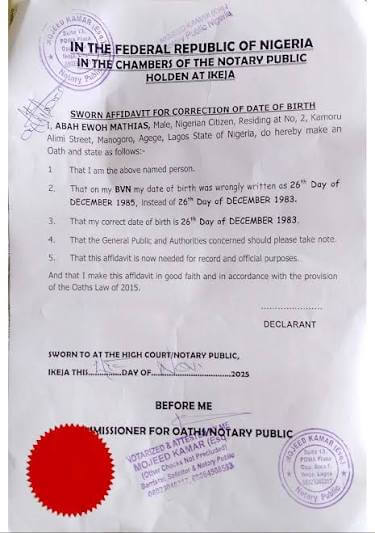
A notarized document in Nigeria should include information like:
- Title of the document
- Full name and details of the person making the declaration
- Clear statement or purpose of the document
- The recipient, if necessary
- Relevant facts or information being declared
- Signature of the person making the declaration
- Notary Public’s signature
- Notary Public’s stamp or seal
- Date of notarisation
- Notary Public’s name and professional details
Note: The document must be signed in the presence of the Notary Public, who then verifies the signature and notarises the document.
What is a notarized letter?
A notarized letter is a letter or statement that someone has personally written, like an affidavit, a sponsor letter, or a consent letter, that a Notary Public has witnessed, stamped, and signed to confirm that the person who signed it did so willingly and is who they claim to be.
A notarized letter certifies your identity as the person making a personal statement or declaration. It can also be referred to as a notarized document.
You’ll typically be asked for a notarized letter in any of these situations.
- You will need a notarized consent letter for a minor travelling abroad without one parent
- You will need a notarized affidavit of support for a visa or admission application
- You will need a notarized invitation letter for a visa applicant
- You will need a notarized authorization letter for a business transaction or third-party representation.
Who Can Notarize a Document in Nigeria?
In Nigeria, documents are notarised by a Notary Public. A notary is a public official authorized to perform legal acts, such as witnessing signatures and verifying the authenticity of documents.
In Nigeria, a Notary Public is someone who must have met these criteria:
- A Practising lawyer called to the Bar for at least seven years, as required under the Notaries Public Act 2023.
- Appointed by the, by the Chief Justice of Nigeria.
- Registered with the Supreme Court
Source: The Society of Notary Public.
Documents That Commonly Require Notarization
Documents that require notarization include:
- Affidavits and statutory declarations.
- Powers of Attorney.
- Biodata pages of international passports.
- Birth certificates, Marriage certificates, and police clearance certificates.
- Single status certificate
- Bank statement
- Driver’s licenses.
- Proof of address or identity.
- Consent letters.
- Residency permits and visa applications
- Business and Corporate Documents
- Property and Financial Documents
- Professional Licenses
- Educational certificates, degrees, diplomas, and many other documents
Requirements For Notarization in Nigeria
- You must provide valid proof of identity for verification.
- You must appear in person before the Notary or via real-time audio-visual communication for online services.
- For physical notarisation, the document must be signed only in the presence of the Notary Public.
- All documents must be filled out, with no blank spaces, before signing.
- You must demonstrate that you understand the contents of the document you are signing.
- The official must be a senior practising lawyer appointed by the Chief Justice of Nigeria.
- The Notary must affix their official stamp or seal and their signature to the document.
- The document must clearly state where and when the notarization occurred.
- You must pay the required service fee.
How To Notarize a Document In Nigeria
There are two ways to notarize a document in Nigeria: you can either visit a licensed Notary Public in person at their office or law firm to get your document certified, or you can get your document certified by a licensed Notary Public over the internet, with no office visit required.
How To Notarize a Document Physically
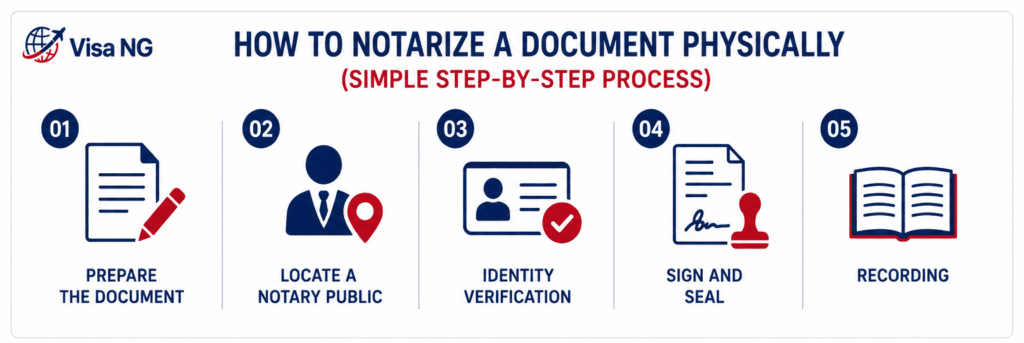
- Prepare the document: Ensure your document is complete and accurate. Do not sign the document yet; it must be signed in the physical presence of the Notary Public.
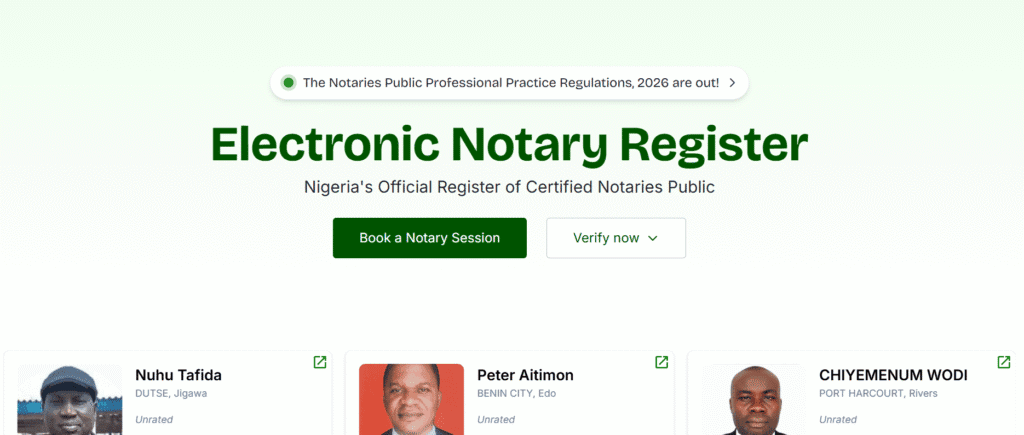
- Locate a Notary Public: Find a licensed Notary Public physically or you can use the Notary register to find a notary public near you.
- Identity Verification: Present a valid form of identification to the Notary. The Notary must confirm your identity and ensure you fully understand the contents of the document you are about to sign.
- Sign and Seal: You will sign the document while the Notary watches. The Notary will then affix their official seal or stamp and their signature.
- Recording: The Notary will record the transaction in a permanent register they are required to maintain.
How to Notarize a Document Online in Nigeria
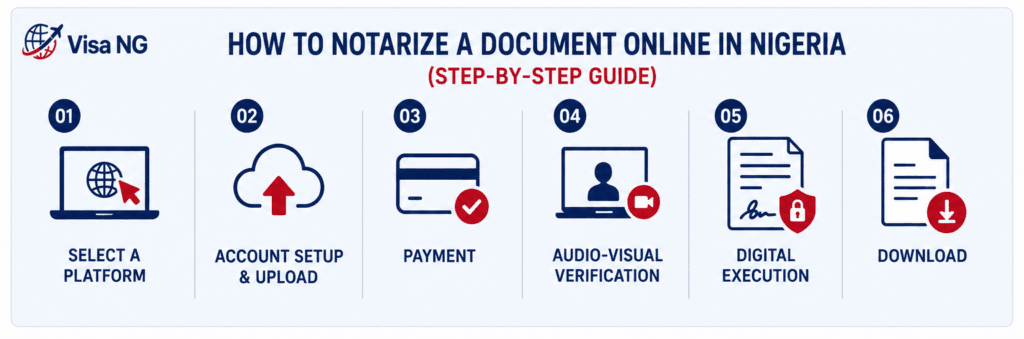
- Select a Platform: Visit the Electronic Notary Registry, which is the official site for online notarization in Nigeria
- Account Setup & Upload: Create an account, select your document type (e.g., Power of Attorney, Affidavit, or Educational Certificate), and upload the file.
- Payment: Complete a secure online payment; payment varies with the platform and the type of document you want to notarize.
- Audio-Visual Verification: You must participate in a real-time audio-visual session with the Notary. This system must be clear enough for both parties to see and hear each other, and it must include two-factor identification to confirm your identity.
- Digital Execution: The Notary reviews the document digitally and applies a secure electronic signature and digital seal. They also prepare an electronic notarial certificate to attach to the document.
- Download: Once approved, you can download the notarised document as a PDF, which is court-recognised and legally valid across Nigeria
How Much Does It Cost to Notarize a Document in Nigeria?
Regardless of the route you choose, notarization doesn’t come with a fixed price. The cost typically depends on the type of document and the notary public handling it. But you can expect a flat rate of ₦15,000 per page.
How Long Does Notarization of Documents in Nigeria Take
If your documents are ready and you have a stable internet connection, it takes 10 to 30 minutes to notarize your documents online and 1 to 3 hours to notarize them in person at a notary public’s office.
Frequently Asked Questions
To notarize a document means to have a licensed Notary Public verify your identity and confirm that you signed the document willingly, then apply their official seal and signature to certify it as authentic and legally valid.
No, you can not. Your document can only be notarized by a licensed Notary Public.
A Notary Public in Nigeria is a senior legal practitioner who has been called to the Bar for at least seven years and has been appointed by the Chief Justice of Nigeria to authenticate documents and identities.
Only a licensed Notary Public, either through a private legal practice or a licensed online notarization platform, can notarize a document in Nigeria.
You can either get your document notarized physically at a Notary Public’s office/law firm, or online through a licensed platform.
Conclusion
To prove the authenticity of a document, it has to be notarized by a notary public. You can notarize a document online or through physical law practitioners.
To use any document for a visa application, it must be notarized. To get all your documents notarized without stress, reach out to a travel agency.