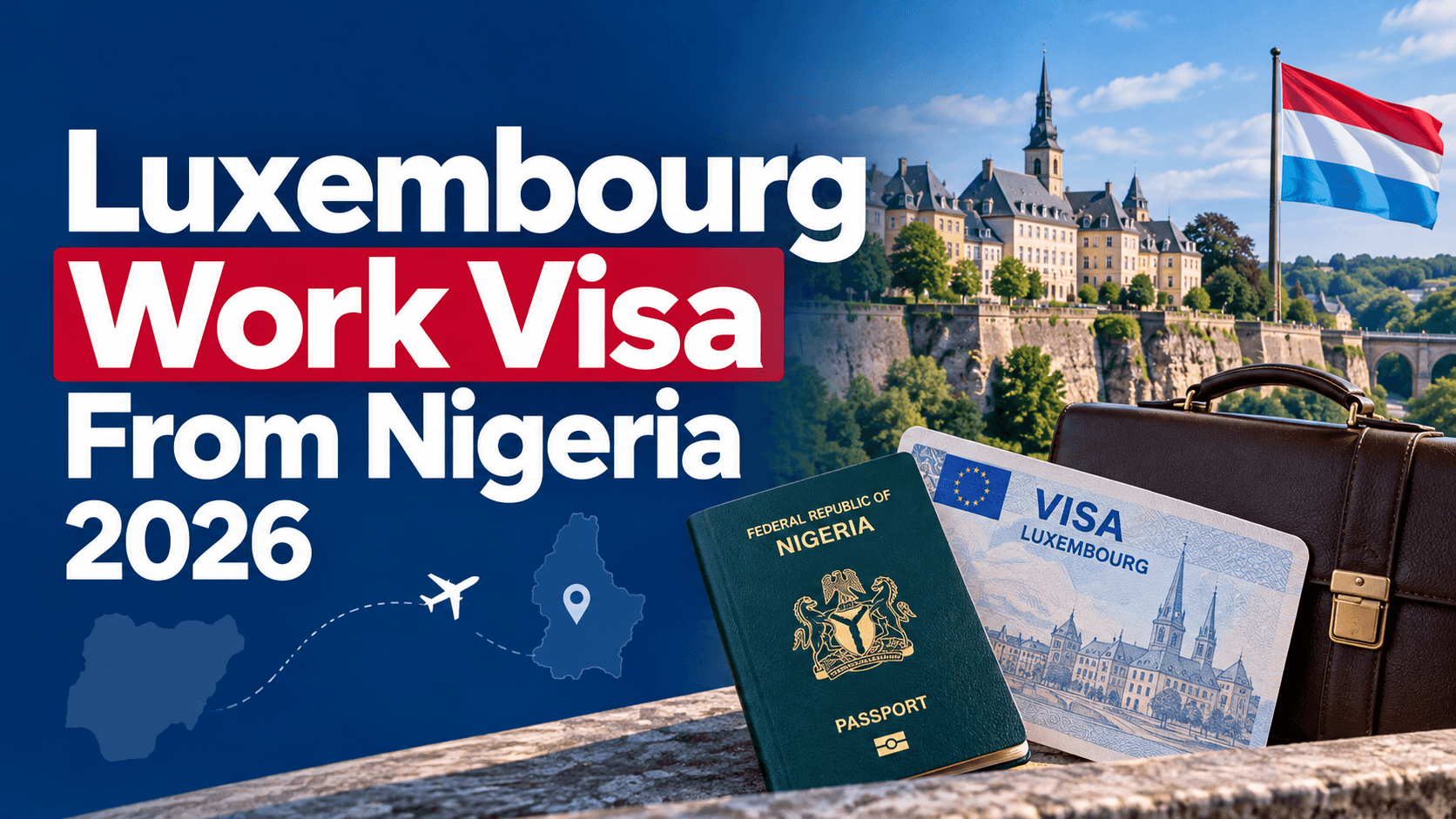
If you’re a Nigerian planning to move to Luxembourg for work, you can’t simply book a flight and start work; you need a Luxembourg work visa first, and for most people, that process begins long before you even set foot in the country.
For the standard salaried-worker route, you’ll need a job offer first and a Temporary Authorisation to Stay before applying for the Type D (long-stay) national visa. Luxembourg does not have an embassy in Nigeria; you must submit your work visa applications through TLScontact.
This guide breaks the entire process down step-by-step, from the work permit process, required documents, TLScontact application, fees, down to the processing times.
Key Takeaways
- You need a signed job offer from a Luxembourg employer before you can apply, so you can’t move first and look for work later.
- The process has three stages: your employer declares the job to ADEM, you get a Temporary Authorisation to Stay, and then you apply for the Type D visa.
- Luxembourg has no embassy in Nigeria, so you must apply in person at TLScontact in Abuja or Lagos and pay the €80 visa fee plus the €36.30 service fee.
- Plan for several months from job offer to arrival, because the Temporary Authorisation to Stay is the slowest stage and can take up to three months.
Do Nigerians Need a Work Visa to Work in Luxembourg?
Yes. Nigerians need a work visa to work in Luxembourg. Since Nigeria is not part of the EU/EEA, as a Nigerian, you will need immigration approval and a visa before you can live and work legally in Luxembourg.
Do You Need a Job Offer Before Applying?
If you’re wondering, “Do I need a job for a Luxembourg work visa?” the answer is yes. You must have a job offer and a signed contract before you apply. This applies to both the standard salaried-worker route and the EU Blue Card.
Your employer has to start the approval process for you while you’re still in Nigeria. You can’t come to Luxembourg first and look for a job later. Without an employer and a contract, the authorities have no reason to give you a Luxembourg work visa.
How the Luxembourg Work Authorisation Process Works
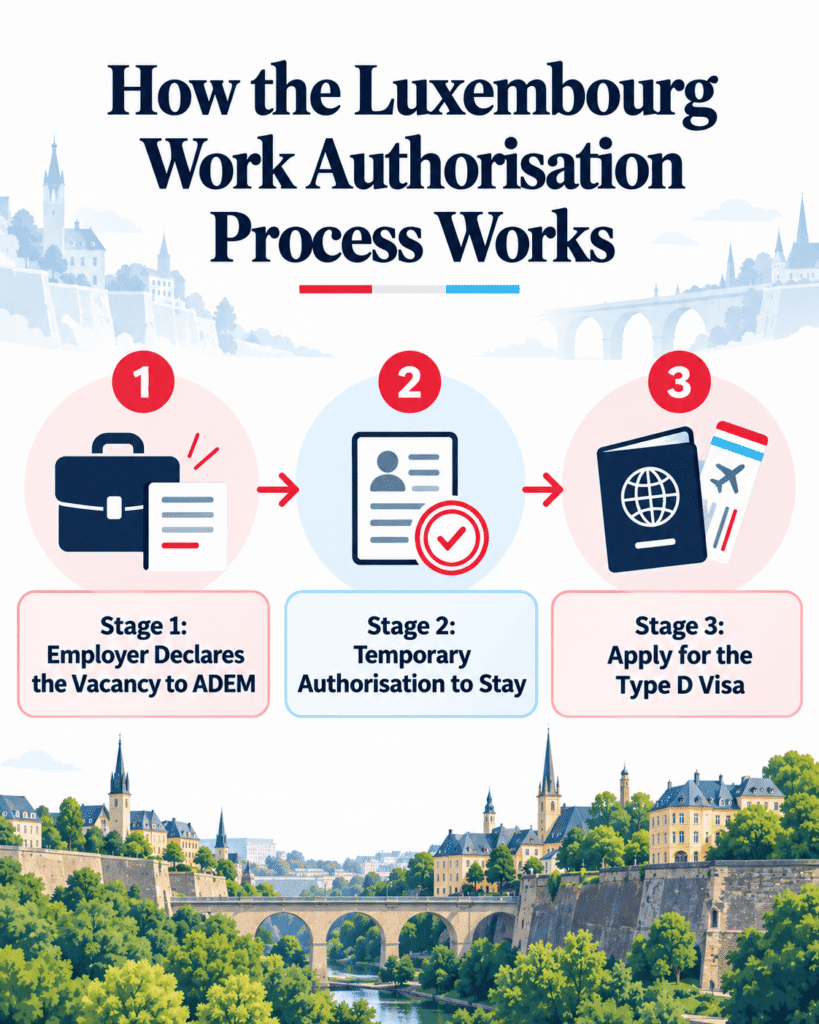
Stage 1: Employer Declares the Vacancy to ADEM
Before offering you the job, your future employer must declare the job vacancy to ADEM, Luxembourg’s National Employment Agency. This gives local and EU/EEA jobseekers a fair first chance of getting the job, and the declaration must be filed at least 3 working days before the job is advertised anywhere else.
The vacancy stays open on ADEM’s system for up to 2 months. If no suitable local or EU candidate is found after about 3 weeks, the employer can ask ADEM’s director for a certificate to hire a third-country national. Highly qualified roles under the EU Blue Card route do not need this test.
Stage 2: Temporary Authorisation to Stay
Once your employer has the ADEM certificate and you have both signed the employment contract, you apply for the Temporary Authorisation to Stay (“autorisation de séjour temporaire”) through the Ministry of Home Affairs’ General Department of Immigration. Your employer can submit it for you, but the authorisation is issued in your name.
This authorisation is not a second permit after a work permit; it is the work permit approval for salaried workers. You must apply and be approved before travelling. Once approved, it is valid for 90 days, and Nigerians must use that window to apply for the Type D visa.
Stage 3: Apply for the Type D Visa
You can only apply for the Type D national visa after your Temporary Authorisation to Stay is approved. Luxembourg does not have an embassy in Nigeria; all applications go through TLScontact in Abuja or Lagos. TLScontact acts for the Belgian Embassy in Abuja, which represents Luxembourg’s consulate in Nigeria.
Luxembourg Work Visa Requirements for Nigerian
Here’s what’s needed at each stage of the process
Documents Needed for Temporary Authorisation to Stay
- Copy of your valid passport (all pages)
- Extract from your criminal record, or a sworn affidavit where this isn’t available
- Curriculum vitae (CV)
- Copies of your diplomas or professional qualification certificates
- Signed employment contract (compliant with Luxembourg labour law), dated and signed by both you and your employer
- Original certificate from ADEM authorising your employer to hire a third-country national
- Power of attorney, if your employer or another party is submitting the application on your behalf
Documents Needed for Luxembourg Work Visa
After your Temporary Authorisation to Stay is approved, you’ll generally need the following to apply for the Type D visa:
- Completed and signed national (long-stay) visa application form
- One recent passport-style photograph
- Valid international passport (issued within the last 10 years, valid for at least 6 months beyond your intended stay, with at least 2 blank pages)
- Copies of any previous Schengen visas from the last 3 years, if applicable
- Copy of your approved Temporary Authorisation to Stay
- Proof of travel/health insurance covering at least the first few months (this may be waived if your employer already provides health coverage)
- Proof of travel arrangements (flight booking or reservation)
- Payment of the applicable visa fee and TLScontact service fee
Get a Luxembourg work visa
Types of Luxembourg Work Visa Routes
|
Route |
Who It’s For |
|
Standard Salaried Worker |
Nigerians with a signed job offer for an ordinary role; subject to the ADEM labour market test unless an exemption applies |
|
EU Blue Card |
Highly qualified professionals with a university degree (or equivalent experience) and a qualifying salary threshold; exempt from the local labour market test |
|
Other Employment (self-employed, posted worker, seasonal) |
Nigerians setting up as independent professionals, being posted by a non-EU employer, or taking seasonal work; each has its own separate authorisation category |
Standard Salaried Worker
This is the route for most Nigerians relocating for a regular job like hospitality, logistics, healthcare support, and similar sectors. It follows the full ADEM-to-visa process described above, and the first residence permit issued is typically valid for one year, tied to a specific profession and employer for that period.
EU Blue Card
Designed for highly skilled professionals, the EU Blue Card requires a university degree or equivalent professional experience and a job offer meeting a minimum salary threshold set annually by Luxembourg. Because it targets in-demand skilled roles, EU Blue Card applicants skip the labour market test, which can shorten the overall timeline.
Other Employment Routes
If you’re not entering under a standard employment contract, you may fall under a different category, for example, self-employed/independent worker status, or being posted to Luxembourg by an employer based outside the EU. Each of these has its own specific document list and process, though all still require a Temporary Authorisation to Stay before a Type D visa.
How to Apply for a Luxembourg Work Visa From Nigeria
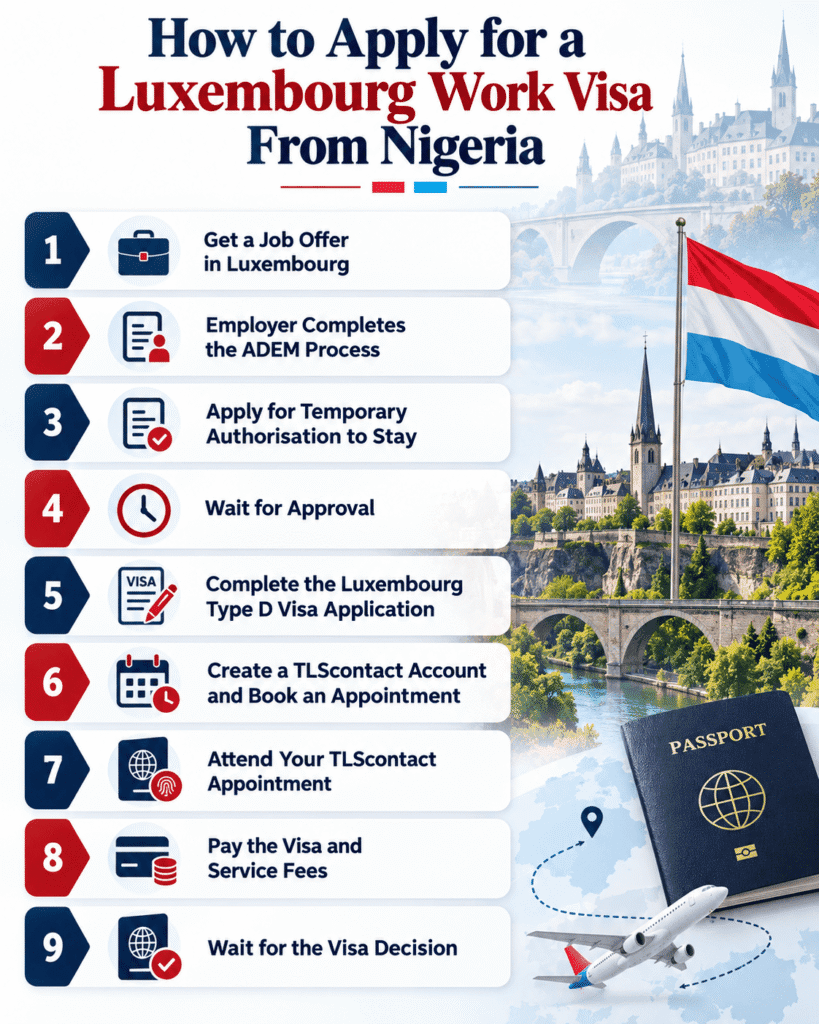
- Get a Job Offer in Luxembourg. Secure a job offer or employment contract from a Luxembourg-based employer.
- Employer Completes the ADEM Process. Your employer declares the vacancy and, if needed, obtains the certificate to hire a third-country national.
- Apply for Temporary Authorisation to Stay. Submit your application (personally or via your employer as your representative) to the General Department of Immigration in Luxembourg.
- Wait for Approval. This step can take some time; plan for at least a couple of months and avoid booking a firm arrival date until you have the approval in hand.
- Complete the Luxembourg Type D Visa Application. Fill in the official national visa application form once your authorisation is approved.
- Create a TLScontact Account and Book an Appointment. Register on the relevant Visa on Web/TLScontact platform and schedule your biometrics appointment.
- Attend Your TLScontact Appointment. Submit your documents, give biometric data (fingerprints and photo), and answer questions about your employment and travel plans.
- Pay the Visa and Service Fees. Settle the consular visa fee and the TLScontact service fee, both non-refundable regardless of the outcome.
- Wait for the Visa Decision. Once approved, your passport is returned with the Type D visa affixed, and you can make travel arrangements to Luxembourg.
Luxembourg Work Visa Application Form
The work visa itself is a Type D national visa. Applicants should use the national visa application form, and it should be completed electronically. Printed blank copies from other sources are treated only as samples and will not be accepted for submission.
Can You Apply for a Luxembourg Work Visa Online?
Not entirely. The Luxembourg work visa process is not fully online. Some parts involve online forms and account registration, but you must still complete key steps in person. In practice, this means:
- You compile and submit the Temporary Authorisation to Stay application documents (by post or through a representative) to Luxembourg’s immigration authorities. This part has no in-person requirement in Nigeria, since it’s handled directly with Luxembourg.
- The Type D visa application form is filled out electronically via the official platform.
- However, you must physically attend a TLScontact appointment in Nigeria to submit your original documents, give biometric data, and pay the visa fee in person. This cannot be done remotely.
Where to Submit a Luxembourg Work Visa in Nigeria
Luxembourg has no embassy or consulate in Nigeria, so visa applications are handled by TLScontact on behalf of the Belgian Embassy in Abuja, which represents Luxembourg’s consular interests locally. You can submit your application at either of these centres:
Address: Third Floor, Murkhtar El-Yakub Place, beside Metro Plaza, Plot 1129 Zakariya Maimalari Street, Central Business District, Abuja, Nigeria
TLScontact Lagos (Victoria Island)
Address: Fourth Floor, Ivie House, 4/6 Ajose Adeogun Street, Victoria Island, Lagos, Nigeria
Both centres accept appointments Monday to Friday, typically between 8:00 am and 1:00 pm, and appointments must be booked in advance.
How Much Is a Luxembourg Work Visa in Nigeria
The Luxembourg work visa price covers mandatory government fees and administrative expenses. For applicants in Nigeria, two charges apply at the application stage: the official consular visa fee and the TLScontact service fee.
Mandatory fees
|
Application Stage |
Amount (EUR) |
Approx. Amount (NGN)* |
Who Pays / Notes |
|
Temporary Authorization to Stay |
Free |
Free |
Filed by your employer with the Immigration Directorate |
|
Long-stay (Type D) visa fee |
€80 |
₦115,000 – ₦125,000 |
Paid by you at your appointment |
|
TLScontact service fee |
€36.30 |
₦60,440 |
Paid by you at the visa application centre |
|
Residence permit issuance |
€80 – €100 |
₦120,000 – ₦155,000 |
Paid on arrival in Luxembourg for the biometric card |
How Much Money Is Required for a Luxembourg Work Visa?
Unlike a tourist visa, where proof of funds is needed, you do not need proof of funds for a work visa. The long-stay work visa route is judged mainly on whether your application meets the actual requirements: a valid job offer or employment contract, the correct employer and ADEM documents, an approved Temporary Authorisation to Stay, a properly completed Type D visa application, and proof that you meet the official conditions for entry.
Luxembourg Work Visa Processing Time
Processing time varies by stage:
- ADEM / employment processing: The labour market test typically runs about 3 weeks before your employer can request the certificate to hire a third-country national, assuming no suitable local or EU candidate is found.
- Temporary Authorisation to Stay: This is usually the longest stage. Under Luxembourg’s general rule, the authorities have three months to decide. If there is no decision by then, you can treat the request as rejected and take your case to the administrative tribunal. Some categories run longer, such as four months for certain part-time salaried applications, and this deadline can be extended. EU Blue Card applications are the exception, with a 90-day limit.
- Type D visa: Once your authorisation to stay is approved, the visa itself is generally processed within a few weeks, though this can vary with application volume and any additional checks.
What Happens After Arriving in Luxembourg?
Once you arrive in Luxembourg on your Type D visa, there are a few mandatory steps to complete, generally within the first few days:
- Declare your arrival at the local commune (municipal administration) where you intend to live; this must be done within 3 working days of arrival.
- Undergo the required medical examination, which checks that you meet the health conditions for residence.
- Apply for your residence permit with the immigration authorities, generally within 3 months of entering the country. This is the card that lets you legally remain and work in Luxembourg.
Source: Guichet.lu
Mistakes to Avoid When Applying for a Luxembourg Work Visa
- Submitting the Temporary Authorisation to Stay application from within Luxembourg instead of before travelling; this is automatically inadmissible.
- Incomplete or missing ADEM documentation, especially the original certificate authorising the employer to hire a third-country national.
- An employment contract that doesn’t meet Luxembourg labour law requirements or wasn’t signed by both parties.
- Missing or expired travel/health insurance for the visa stage.
- A passport with insufficient validity or blank pages.
- Using an outdated or incorrectly filled application form instead of the current official one.
- Falling for scam “agents” or fake portals claiming to fast-track Luxembourg work visas. Luxembourg’s authorities have repeatedly warned that all applications must go through TLScontact, with no shortcuts available.
Frequently Asked Questions
Yes, Luxembourg gives work visas to non-EU/EEA nationals, including Nigerians. You can obtain a Luxembourg work visa after securing a job offer and going through the Temporary Authorisation to Stay process.
You apply for a Luxembourg work visa by securing a job offer; your employer then completes the ADEM labour market test; you apply for the Temporary Authorisation to Stay, and once approved, you submit your Type D visa application through TLScontact in Abuja or Lagos.
Yes, for the standard salaried-worker route and the EU Blue Card, a signed job offer or employment contract from a Luxembourg employer is required before the immigration process can begin.
No. Luxembourg work visa applications in Nigeria are handled by TLScontact, not VFS Global. TLScontact is the appointed partner for the Belgian Embassy in Abuja, which represents Luxembourg’s consular services locally.
Conclusion
Getting a Luxembourg work visa from Nigeria starts with a genuine job offer, then moves through your employer’s ADEM clearance, then your Temporary Authorisation to Stay, and ends with your Type D visa application at TLScontact. Each stage depends on the one before it, so rushing or skipping a step is a big risk.
Start early, and apply only through official channels, or you can employ the services of a verified visa agency to assist with your Luxembourg work visa application.
Get professional guidance for your Luxembourg visa application