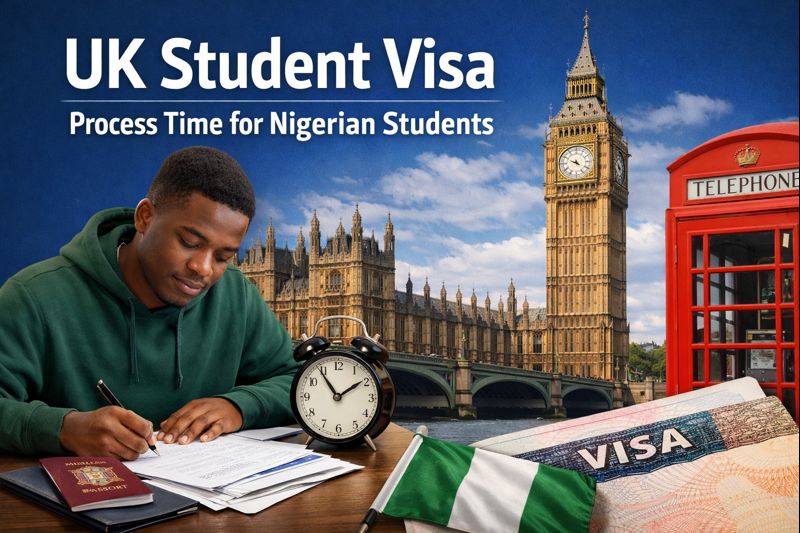
UK student visa process time matters to foreign students like Nigerian students because they need the timeline to plan their travel, accommodation, and get to the UK before the school start dates.
Key takeaway:
- The UK student visa process time is 3 weeks for a standard visa application, 5 working days for a priority visa application, and 1 day for a super priority visa application.
- The total cost for the UK student visa application is ₦1,003,000 visa fee + ₦1,500,000/year health surcharge + ₦183,000 Tuberculosis test + optional TLScontact services cost.
- You need financial proof of £1,483/month (London) or £1,136/month (outside London) living expenses for up to 9 months, held for 28 consecutive days for a successful UK student visa application.
- You must have documents like a valid passport, a CAS number, proof of funds, academic documents, and English language evidence to qualify for a UK student visa.
- The most common reasons why the UK student visa process time increases are incomplete financial proof, CAS mismatches, missing documents, and peak season backlogs.
- After the completion of the UK student visa, you can stay in the UK using a graduate visa for 2 years (or 3 years for PhD holders)
UK student visa processing time in Nigeria
UK student visa processing time in Nigeria is 3 weeks from biometrics. Your UK student visa processing time ends when you receive an email telling you about your visa decision.
Note:
The earliest you can apply for a visa is 6 months before you start your course.
The UK student visa process time starts from either:
- The day of your appointment, if you prove your identity in person or
- The working day after you finish uploading your documents, if you use the ‘UK Immigration: ID Check’ app
When can a Nigerian apply for a student visa?
The earliest you can apply for a UK student visa from Nigeria is 6 months before you start your course.
If you are a Nigerian living in the UK, the earliest you can apply for a UK student visa is 3 months before you start your course.
If you want to reduce your UK student visa process time, then you can pay for a priority service or a super priority service.
UK student visa priority processing time in Nigeria
The UK student visa priority processing time in Nigeria is 5 working days. You will need to pay £500 in addition to the visa application fee to apply for a priority service.
UK student visa super priority processing time in Nigeria
The UK student visa super priority processing time in Nigeria is 1 working day. You can apply for super priority service with an extra fee of £1000.
If you use the ‘UK Immigration: ID Check’ app
You will usually get a decision:
- by the end of the next working day if you finish uploading your documents on a weekday.
- 2 working days after you finish uploading your documents, if you upload them on a weekend or a bank holiday.
Note:
If your visa decision takes longer after paying for priority service, you will not usually get your money back except you meet certain criteria. Find out about getting a refund of your priority service fee.
What Factors Affect the UK student visa process time?
There are some factors that can delay the UK student visa process time, they are:
- Peak Seasons: Visa applications increase from June to September, extending standard processing from 3 to 6 weeks due to high volumes. Submitting your visa application early (8-10 weeks before the course start) avoids visa backlogs.
- Document Issues: Incomplete visa forms, incomplete financial proof, or unclear bank statements can cause the need for extra verification, increasing the time it would take to get a visa. Errors in CAS details or English proficiency evidence can also slow down getting a visa feedback.
Additional Checks:
Additional checks, like credibility interviews, criminal record verifications, or bank authenticity probes, always increase visa processing time. Complex cases require investigations, further delaying visa decisions.
When can a Nigerian apply for a UK student visa?
A Nigerian can apply for a UK Student visa if they are at least 16 years of age and they:
- have been offered a place on a course by a licensed student sponsor.
- have enough money to support yourself and pay for your course – the amount will vary depending on your circumstances.
- can speak, read, write, and understand English
- Have consent from your parents if you’re 16 or 17 – you’ll need evidence of this when you apply.
When can a Nigerian apply for a UK child student visa?
A Nigerian can apply for a Child Student visa if they are between 4 and 17 years old and want to study at an independent school in the UK.
You must:
- have an unconditional offer of a place on a course at an independent school
- have a suitable place to live in the UK
- be able to show you will have access to enough money to support you in the UK and pay for your course
- have the consent of your parent or legal guardian to study and live in the UK – you’ll need to prove this when you apply.
How long can a Nigerian stay in the UK with a UK student visa?
If you are 18 or over and your course is at degree level, you can usually stay in the UK for up to 5 years. If it’s below degree level, you can usually stay in the UK for up to 2 years.
How to stay longer in the UK after an expired UK visa
You may be able to extend your stay in the UK after your UK student visa expires by;
- Extend your visa if you’re eligible, for example, to continue your studies in the UK.
- Switch to a Graduate visa.
A Graduate visa will allow you to stay in the UK after successfully completing your course for:
- 2 years if you apply on or before 31 December 2026
- 18 months if you apply on or after 1 January 2027
It will allow you to stay for 3 years if you have completed a PhD or other doctoral qualification.
Get your visa in 2 weeks with no down payment.
When can a Nigerian travel to the UK with a UK student visa
You can arrive before your course starts. This can be either:
- up to 1 week before, if your course lasts 6 months or less
- up to 1 month before, if your course lasts more than 6 months
You must not travel to the UK before the start date given on your visa, no matter when your course starts.
UK student visa fees
It costs ₦1,003,000 (£524) to apply for a UK Student visa from Nigeria.
What a Nigerian can and cannot do in the UK with a UK student visa.
You can:
- study
- work as a student union sabbatical officer
You may be able to work – how much depends on what you’re studying and whether you’re working in or out of term-time.
You cannot:
- claim public funds (benefits) and pensions.
- work in certain jobs, for example, as a professional sportsperson or sports coach,
- or be self-employed.
- study at an academy or a local authority-funded school (also known as a maintained school).
If your application is successful, you will be told what you can and cannot do on a Student visa.
UK student visa process in Nigeria overview
Step-by-step process
- Get your Conditional/Unconditional Offer:
- Unconditional Offer: This means that you have been given admission, and there are no other terms to meet
- Conditional offer: This means that you have been given admission and there are still some conditions to meet, such as submitting final academic results, passing required exams, and providing proof of English proficiency. After you have completed all these things, your admission becomes Conditional. Pay any required deposit/tuition to become eligible for CAS.
- Receive your CAS (Confirmation of Acceptance for Studies):
- CAS: CAS is an official reference number from a UK school that proves you have been accepted and are allowed to apply for a student visa. The university generates a CAS number with your course details and fees paid/owed. Verify every detail on your CAS (name, date of birth, course title, fees) before applying; errors can delay visas.
- Prepare your documents:
- See the Documents checklist on the official UK immigration website.
- Ensure proof of funds meets the maintenance requirements for you for 9 months. Take a tuberculosis test at an approved clinic and get the certificate.
- Apply online & pay fees:
- Complete the Student Visa application form online.
- Pay the visa fee ₦1,003,000 (£524) and the Immigration Health Surcharge (IHS) for the full course length (student rate per year; confirm current rate).
- Choose standard, Priority, or Super Priority UK visa processing.
- Book TLScontact biometrics (Lagos/Abuja) and attend.
- TLS contact is a private company that works with countries to collect your biometrics ( photos and fingerprints) and return them to the country’s immigration.
- Book a biometrics appointment (fingerprints, photo) at TLScontact.
- Bring your passport, appointment letter, and required documents.
- You may submit supporting evidence digitally or via scanning services; follow TLScontact instructions.
- Decision waiting period:
- After biometrics, your application is assessed.
- You will receive a decision by email/SMS, your passport could be returned with a vignette, which is a sticker visa, or you can log into your profile on the official website to check digitally (The UK is moving to a digital status).
- If approved:
- Collect passport/eVisa and confirm what to do next for your studies, such as paying the outstanding remaining fee, accepting the offer, etc
- Check vignette/eVisa details for name, dates, and university.
- Inform your university, arrange accommodation, and book travel.
Start preparing early: aim to complete biometrics 8 –12 weeks before your course start date.
Allow extra time for important documents and tests, such as CAS issuance, bank statements, and any tuberculosis (TB) test if required.
You can learn how to apply visa.
Documents needed for a UK student visa
The documents needed for a successful UK student visa application are divided into core documents and extra documents.
Core documents needed for a UK student visa
- Valid Passport: valid for at least six months beyond the time of your stay, with blank pages.
- CAS number/letter from your university
- Proof of funds (tuition + maintenance) held for the required period (bank statements, bank letter, or approved financial evidence)
- Tuition receipts (if you paid a deposit/tuition already)
- Academic documents (transcripts, certificates referenced in CAS)
- English language evidence (if applicable)
- TB test certificate (if required)
- Parental consent & birth certificate (if under 18)
- Proof of relationship for dependants (marriage/birth certificates)
Helpful extras documents needed for a UK student visa
- Accommodation booking or plan
- Travel history documents (previous visas)
- Sponsorship/Affidavit if someone funds you (evidence of relationship + sponsor’s bank docs)
Note:
Ensure all your documents match your CAS and are consistent across names, amounts, and dates.
How long does each stage take?
|
Stage |
Typical timeframe |
|
Deposit paid → CAS issued |
1–4+ weeks (varies by school & season) |
|
Gather documents and proof of funds |
2–4 weeks (depends on bank statement period) |
|
Online form & fee payments |
1–2 days |
|
TLScontact appointment wait |
3–10+ days in peak periods |
|
Decision after biometrics |
Standard ~3–6 weeks |
|
Decision after biometrics – Priority |
5–10 working days |
|
Decision after biometrics —Super Priority |
1–2 working days |
|
Peak season caution |
June–September can stretch timelines. Book early. |
Priority visa processing vs super priority visa processing
Priority
Who it suits: Applicants with tight timelines who still have a week or two buffer.
Pros: Faster than standard, lower cost than super priority.
Cons: Not always available; still not guaranteed that complex cases can take longer.
Super Priority
Who it suits: Ultra-urgent cases.
Pros: Fastest decision (often next working day after biometrics).
Cons: The Highest fee; appointment slots can be limited.
Availability and exact speeds can change; check what’s offered in Nigeria at the time you apply.
Common UK student visa process delays and how to avoid them
- Proof of funds issues: You need to show a bank statement of at least 3 months from your bank, which must be a recognised bank, and your balance must not go below a certain amount to prove that you have the financial capability to sponsor your trip
- CAS mismatches: Name, course, or fee details don’t match documents. Verify your CAS line-by-line before applying.
- Missing/unclear documents: Poor scans, untranslated documents (where needed), or expired tuberculosis certificate. Use clear scans, translate your documents where needed, and check document validity dates.
- Peak-season bottlenecks: During this period, especially May to September, there are so many applicants that it’s hard to get a decision. You need to apply early; consider Priority/Super Priority if you are running out of time.
UK student visa processing costs
- Visa application fee: ₦1,003,000 (£524).
- Immigration Health Surcharge (IHS): ₦1,500,000 {£776} per year of visa duration (or ₦745,000 {£388} pro-rated for partial years under 6 months).
- TLScontact services (optional): Scanning, courier returns, prime time, etc.
- Tuberculosis test (if required): Paid at an approved clinic ₦183,000 {£95}.
Financial Requirements and What to Do Before & After Arrival in the UK for studies.
Maintenance funds: Tuition balance + living costs per month (for required months); confirm the current amounts for your study location.
Maintenance funds (not fees) require proof of £1,483/month in London or £1,136 outside for up to 9 months.
Important:
Fees and financial thresholds change. Always confirm current figures on official UK pages before paying.
At the border: Carry your CAS, university letter, accommodation proof, and financial evidence in your hand luggage.
After arrival: Attend registration/induction, finalise accommodation, and keep your contact details updated with your university.
Frequently asked questions
No, standard processing takes 3 weeks (15 working days). Priority services can reduce this to 5-10 days, but cost more.
Yes. standard processing time is 3 weeks (15 working days), though some applications may take longer during peak periods or if additional checks are needed.
Not particularly easy, but achievable. You need proper financial evidence, a valid CAS, proof of sufficient funds, and complete documentation. Nigerian applications face higher scrutiny, so thorough preparation is essential.
The 28-day rule requires that bank statements or financial documents used to prove you have enough money must show the funds have been in your account for a consecutive 28-day period ending no more than 31 days before your visa application date. This prevents applicants from borrowing money temporarily just to meet financial requirements. The full amount must be continuously available throughout those 28 days.
CONCLUSION
There is no fixed UK student visa process time; it all depends on your preparation, patience, and understanding of the process.
Start preparing early, cross-check all your documents, provide the exact required documents, be honest and consistent with your UK student visa application, and you will get your visa approved in time.