Thousands of Nigerians have their documents rejected abroad, not because they are fake, but because they were never properly legalized. A missing stamp can cost you a visa, a job offer, or a university admission.
Legalization of documents in Nigeria is the official process that makes your Nigerian documents recognized in a foreign country, and because Nigeria is not a member of the Hague Apostille Convention, the process involves more steps than most people expect.
In this guide, you will learn what legalization of a document is, why legalization is important, and how it differs from apostille and notarization.
Key takeaways
- Legalization of documents in Nigeria is the official process that proves your Nigerian documents are genuine and gets them accepted by foreign governments, universities, and employers.
- Nigeria is not a member of the Hague Apostille Convention, Nigerian documents cannot be apostilled and must always go through the full consular legalization process regardless of the destination country.
- Notarization and legalization are not the same thing; notarization only verifies a document locally, while legalization is what makes that document valid and accepted in a foreign country.
- All legalized Nigerian documents must be translated into the language of the destination country by a recognized sworn or official translator before they can be submitted abroad.
What is legalization of documents?
Legalization of a document is the official process of verifying that a document issued in one country is real and valid so it can be accepted in another country.
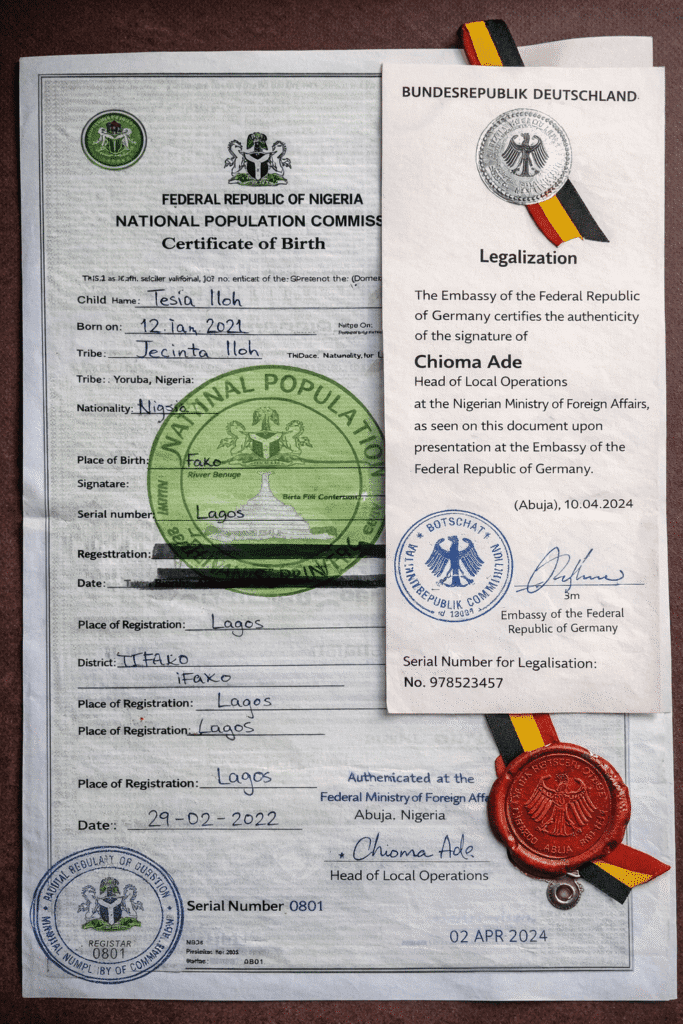
It connects different countries’ legal systems and gives foreign governments, universities, and employers confidence that your document is genuine and was issued by a trusted authority.
When you want to use a Nigerian document abroad, the foreign country needs proof that the document is genuine and was issued by a recognized authority in Nigeria.
Legalization provides proof by having the appropriate government offices verify and stamp the document at each stage of the process.
NOTE:
All legalized documents must be translated into the foreign country’s language by a recognized sworn or official translator.
Why is the legalization of documents important?
Legalization of documents is important because, without it, your documents have no legal standing in a foreign country. Foreign governments, universities, and employers will simply not accept them. Here is why it matters:
- Education: Legalization confirms to foreign universities that your diplomas and transcripts are official and genuine.
- Employment: It proves your professional licenses and police reports are authentic, so you can secure a job abroad.
- Personal and Family: This process makes your birth or marriage certificates valid for moving to another country or joining family members there.
- Business: It validates company papers and contracts so they can be legally recognised for international trade.
- General Legal: It acts as an official “stamp of approval” that tells foreign governments your documents are authentic and legally correct.
Understanding the two main legal systems of document legalization.
There are two legal systems for confirming the authenticity of a document to be used in a foreign country: the Apostille Convention (Hague Convention countries) and the Consular Legalization (Non-Hague Convention Countries )
- Apostille Convention (Hague Convention countries): This is a single-step process that speeds up your legalization process, established by the Hague Convention of 5 October 1961. A single certificate, known as an apostille, is affixed to the document by a designated authority, and this seal is recognised internationally by all other member countries. Nigeria is not a member country.
- Consular Legalization (Non-Hague Convention Countries): This is the longer, multi-step process used by countries that have not joined the Hague Convention, like Nigeria. It involves getting the document notarized by a Notary Public, authenticated by the Ministry of Foreign Affairs, and then legalized by the embassy of the destination country. Nigerian documents cannot be apostilled and must go through the full consular legalization process.
Get your document legalized
What type of Documents Are Eligible for Legalization?
The documents requiring legalisation are grouped into educational, employment, immigration/family and business documents:
- Educational Documents:
- Degree certificates and diplomas.
- Academic transcripts and result statements.
- Secondary school certificates, such as WAEC, NECO, and NABTEB.
- Professional certifications and licenses.
- Recommendation letters from academic institutions.
- Employment Documents
- Professional certificates and qualifications.
- Employment reference letters.
- Curriculum vitae (in certain cases).
- Police clearance or character certificates.
- Medical certificates.
- Immigration and Family Documents
- Birth certificates (must be issued by the National Population Commission).
- Marriage certificates.
- Divorce decrees.
- Death certificates.
- Affidavits and statutory declarations, including declarations of age or affidavits of spinsterhood/bachelorhood.
- International Passports.
- Commercial and Business Documents
- Certificates of Incorporation and company registration documents.
- Articles of incorporation.
- Business licenses.
- Tax clearance certificates.
- Commercial invoices and contracts
Who legalizes a document?
Legalization of a document is done by the embassy or consulate of the foreign country where the document will be used. This is the final step of making a document valid for international use.
The destination country embassy can only legalize your document after it has been notarized by a notary public and authenticated by the federal ministry of education(if applicable) and the ministry of foreign affairs(MFA).
Apostille vs Legalization: What’s the Difference?
The main difference between an apostille and legalization is that an apostille is a single-step process used between Hague Convention member countries, while legalization is a longer, multi-step process required for countries like Nigeria that are not members of the Hague Convention.
Apostille vs legalization
|
Feature |
Apostille |
legalization |
|
Used by |
Hague Convention countries |
Non-Hague Convention countries |
|
Steps involved |
Single step |
Multiple steps |
|
Time and efficiency |
quicker, simpler, and more streamlined |
slower and more complex due to the number of authorities involved |
|
Valid in |
All Hague Convention countries |
Only the country that legalized it |
Legalization vs Notarization: What’s the difference?
The main difference between legalization and notarization is that notarization is carried out by a Notary Public to verify the authenticity of a signature or document within a country, while legalization is the process of getting that same document accepted as valid in a foreign country.
Legalization vs Notarization
|
Feature |
Legalization |
Notarization |
|
What it does |
Makes a document valid in a foreign country |
Verifies a signature or document locally |
|
Who carries it out |
Ministry of Foreign Affairs and the embassy |
A Notary Public |
|
Where it is valid |
In the destination foreign country |
Within the issuing country |
Which Countries Require Legalization of Documents?
All countries require some form of document legalization, but the type of legalization required depends on whether the destination country is a member of the 1961 Hague Convention or not.
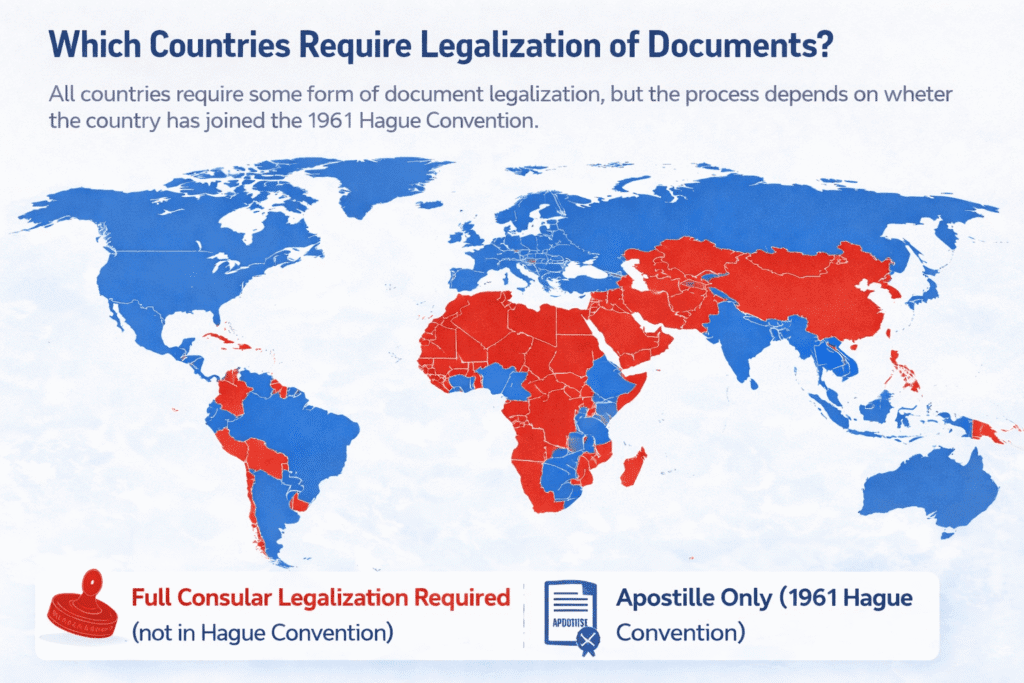
Examples of countries that require full consular legalization (Non-Hague Convention Countries): UAE, Saudi Arabia, Qatar, Kuwait, Bahrain, Oman, China, Vietnam, Thailand, Indonesia, Malaysia, Pakistan, Bangladesh, Myanmar, Nigeria, Ethiopia, Angola, Mozambique, Tanzania, Cameroon, Ghana, Ivory Coast, Senegal, Cuba, Haiti, Belarus, Papua New Guinea, and Fiji, among others.
Examples of Countries That Only Require Apostille (Hague Convention Countries): United Kingdom, United States, Canada, Germany, France, Italy, Spain, Portugal, Netherlands, Belgium, Switzerland, Australia, New Zealand, Japan, South Korea, Brazil, Mexico, Argentina, South Africa, Namibia, Botswana, Lesotho, and Mauritius, among others.
Note:
Regardless of which category your destination country falls into, Nigerian documents must always go through the full consular legalization process.
Frequently Asked Questions
Legalization itself does not expire, but the underlying document to which it was applied may have its own validity period, which can affect whether the legalization is still accepted abroad.
You can legalize a document for foreign use at the embassy of the country where you intend to use the document.
Legalization period varies with the embassy, but it usually takes between 7 -14 working days.
Conclusion
Without legalization your Nigerian documents will not be valid for use in a foreign country. Nigeria uses the full Consular Legalization because it is a non-Hague Convention country.
Legalization of Nigerian documents is a multiple-step process that can be tedious. For a stress-free and smooth legalization process, reach out to Visa.NG for assistance.
Get your document legalized