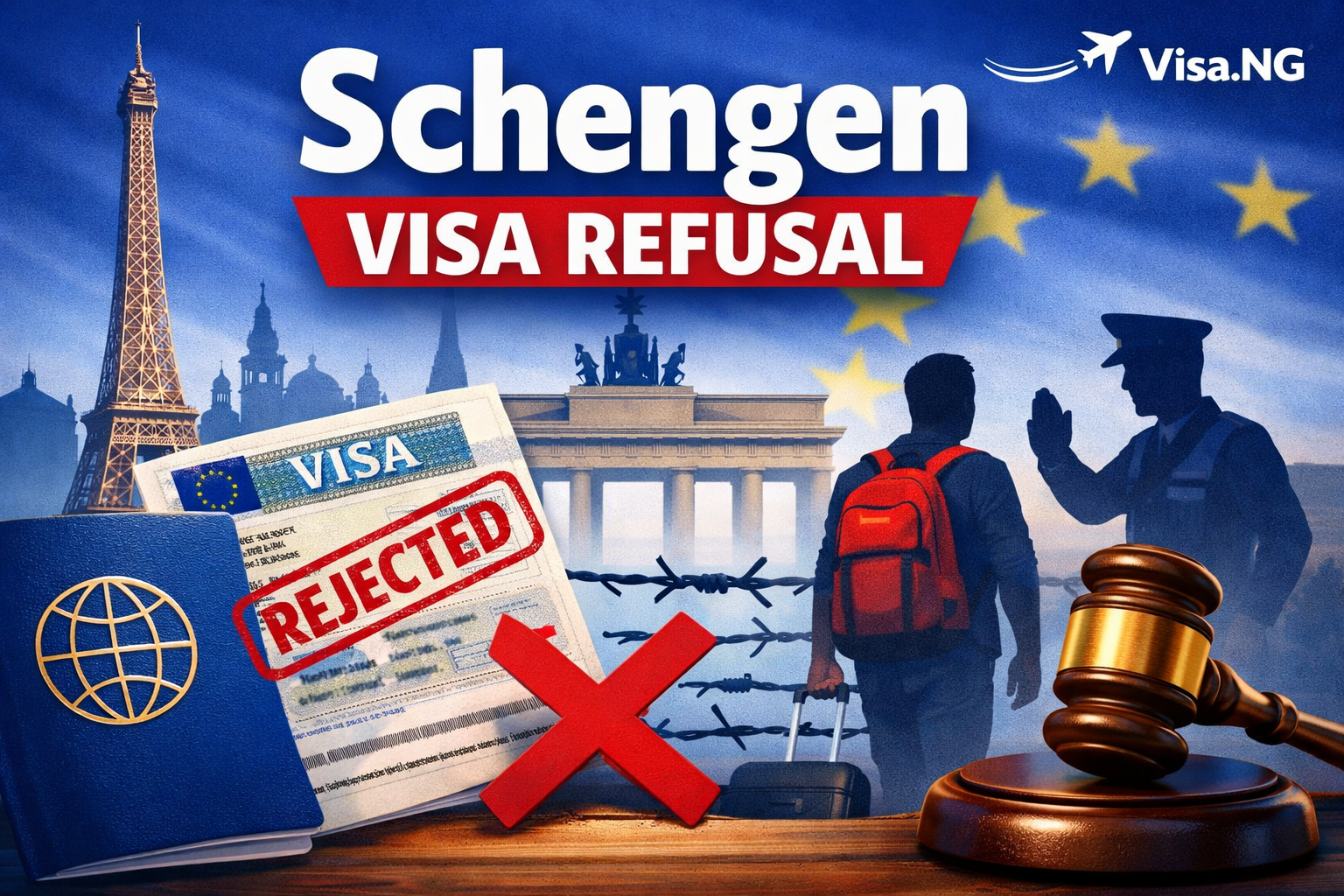
A Schengen visa refusal simply means the European embassy or consulate reviewing your Schengen visa application decided not to grant you the visa because something in it didn’t fully convince them or meet their requirements for approval.
Schengen visas are often rejected; in fact, Nigeria’s refusal rate is above 45%, among the highest in the world. You are not the only one going through this, and there’s a clear way forward from here.
In this guide, you will find out the common reasons most applications get refused, how to appeal a refusal, and what each refusal code means.
Key takeaways
- A Schengen visa refusal means a Schengen visa country’s embassy has rejected your visa application because you did not meet one or more of their requirements.
- Common reasons for Schengen visa refusal include weak financial proof, invalid travel insurance, mismatched documents, and no strong ties to your home country.
- Every Schengen visa refusal comes with a coded refusal letter that explains exactly why your application was rejected.
- After a Schengen visa refusal, you can appeal the decision or reapply immediately with a stronger, corrected application.
What are Schengen visa refusal reasons?
There are a lot of reasons that can lead to a Schengen visa refusal. While each refusal reason may be unique to each application, it does not mean it is uncommon. Here are some common reasons why your visa application might be refused
- Weak or unclear proof of funds: If your bank statement doesn’t show enough money to cover your stay, or a large sum of money is deposited in your account shortly before you applied with no explanation for where it came from. Embassies call this “funds parking,” and it is one of the fastest ways visas get refused.
- Insufficient proof you will return home: This is the single most common reason Nigerian applications are turned down. The consulate wants to see that you have a job, business, property, or family responsibilities pulling you back to Nigeria before your visa expires. If you fail to prove you will return home after the visa expires, then you will definitely be refused.
- Incomplete or inconsistent travel plans: If your flight dates, hotel bookings, and cover letter don’t match exactly, the officer reviewing your visa application will flag it. A day-by-day itinerary that doesn’t add up raises more questions than it answers.
- Non-compliant travel insurance: Your insurance policy must cover all Schengen countries, provide at least €30,000 in travel insurance coverage, and stay valid for your entire trip. If your insurance is anything less, the application will be refused on insurance grounds alone.
- Missing return flight booking: If you book only a one-way flight or forget to include proof of your return journey, you might get a refusal.
- A flag on the Schengen Information System (SIS). This applies if you have a previous overstay, deportation, or immigration issue, and it shows up in the shared EU database; you might be refused.
- Documents that don’t match: If your information doesn’t match or your names, dates, and addresses differ across your bank statement, invitation letter, and application form, it’ll make an officer doubt the whole application, leading to a refusal.
Sources: Article 32 REGULATION OF THE EUROPEAN PARLIAMENT, Visa code
Get your Schengen visa without refusal
How to appeal a Schengen visa refusal
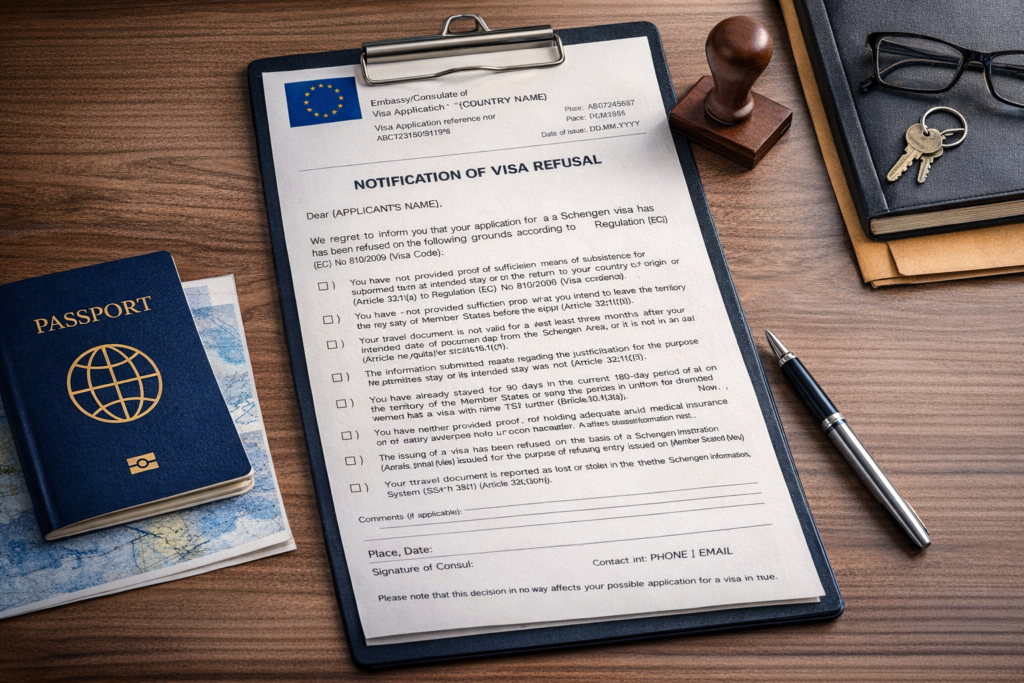
Under EU rules, consulates cannot refuse you without giving a reason. Every refusal comes with a standardised letter that spells out exactly which of these boxes was ticked, which means you already have the roadmap for what to fix.
Here’s exactly what to do next, step by step.
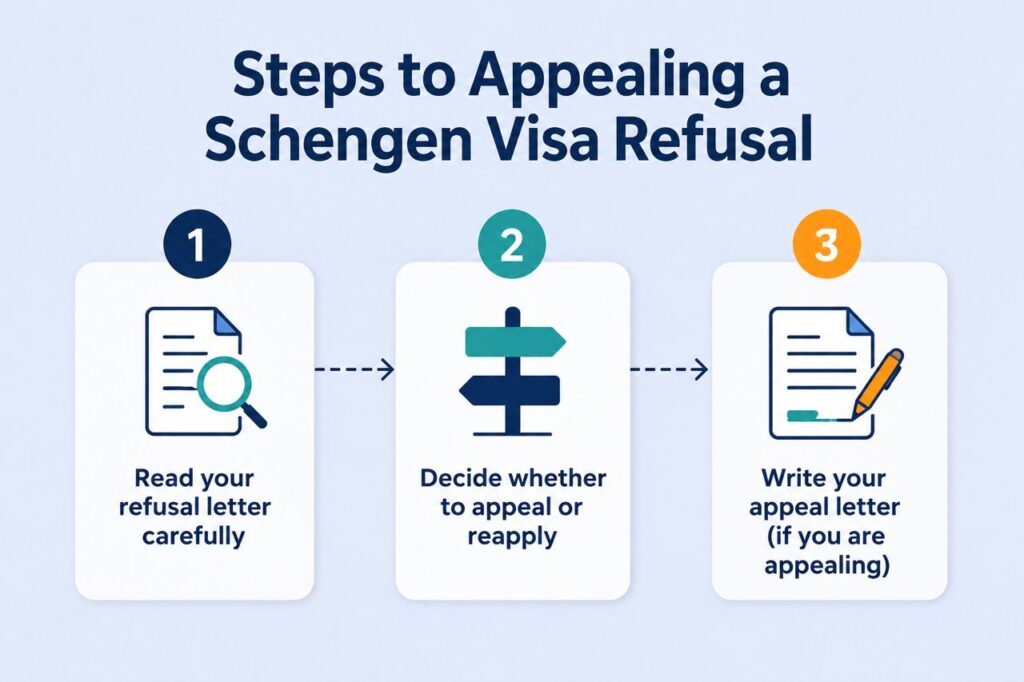
Step 1: Read your refusal letter carefully
Your letter will have one or more checked boxes explaining the refusal, plus a deadline for filing an appeal. This deadline is strict and varies by country.
For example, France, Spain, and Germany generally give you around 30 days, while Italy allows up to 60 days. If you miss it, you lose your right to appeal entirely, so take note of the date you receive the letter.
Step 2: Decide whether to appeal or reapply
This is the decision most people get wrong. An appeal will only make sense if you believe the consulate made a genuine factual error.
For example, if they ticked the “insufficient funds” box even though your bank statement clearly showed enough money. Then an appeal is worth filing because it avoids a new visa fee and forces the consulate to reconsider evidence they already had.
But if your refusal is due to inconsistent or missing documents, proof of funds, lack of strong ties to Nigeria, insurance, or a vague itinerary, reapplying with a stronger application would be more effective.
Step 3: Write your appeal letter (if you are appealing)
Write an appeal letter addressing the Schengen visa denial reason. Here’s exactly what your letter needs to cover, step by step:
How to structure/write a Schengen visa appeal letter
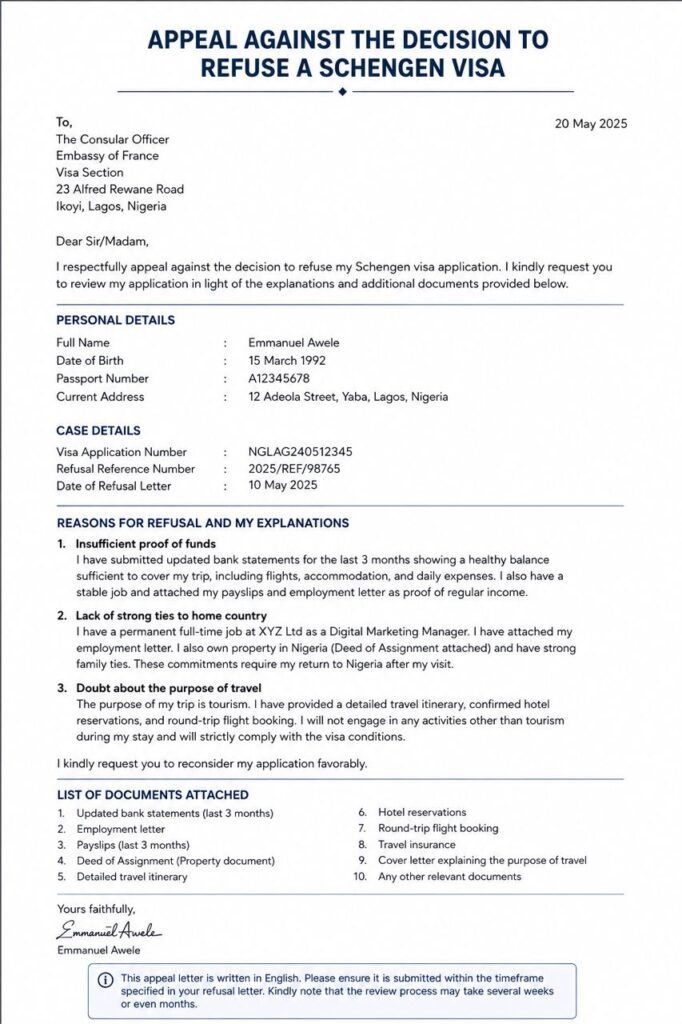
- Start with your personal details: It should carry your full name (first and last), date of birth, passport number, and current address.
- Add your case details: Include your visa application number and refusal reference number.
- State the date you got the refusal: State the actual date you received the refusal letter. This matters because most consulates give you a strict window to appeal, so this date matters.
- Give it a clear title: The title should state clearly that it is an “Appeal against the decision to refuse a Schengen visa.”
- Write a good argument: Go through the refusal letter and address every single reason the consulate gave, one by one. For each point, explain clearly why you think that reason should not stop you from getting the visa. Reference anything that strengthens your case here.
- List everything you’re attaching: Make a clear list of every document that’s coming with the letter as new evidence.
- Sign the letter: The appeal letter should carry your personal signature.
- Confirm the language: Before you submit, check with the consulate on what language they want the letter in. Most times it’s either English or the official language of the country you are applying to.
- Submit the appeal: Submit it within the timeframe allowed by the country, usually 15-30 days. Wait for the embassy to review your appeal; this can take months.
Schengen visa refusal codes and what they mean
Every Schengen refusal letter uses a set list of tick-box reasons; this list comes from EU rules, so it’s basically the same everywhere, though the exact wording or numbering might look a little different depending on which country’s embassy sent it. Below is a breakdown of what the most common ones actually mean.
|
Code |
What it says |
What it actually means |
|
1 |
You presented a passport or travel document that was fake, altered, or forged. |
Your travel document is not valid |
|
2 |
You did not clearly explain why you want to visit or what you plan to do during your stay. |
Insufficient proof of purpose of journey |
|
3 |
You could not show that you have enough money to cover your living expenses throughout your trip and your return to Nigeria. |
Insufficient means of subsistence |
|
4 |
You have already spent three months in the Schengen area within the last six months and have used up your allowed days. |
You’ve exhausted your permitted stay under the 90/180-day rule |
|
5 |
Your name appears in the Schengen Information System as someone who should be denied entry into the Schengen area. |
SIS alert |
|
6 |
One or more Schengen countries consider you a threat to public safety, national security, public health, or the diplomatic relations of a member state. |
You’re flagged as a security, health, or diplomatic risk |
|
7 |
You did not provide proof of valid travel medical insurance that meets the required Schengen standard. |
Insufficient proof of travel insurance |
|
8 |
The information you submitted to justify the purpose and conditions of your intended stay was not reliable. |
Information provided was unreliable |
|
9 |
Your intention to leave the Schengen area before your visa expires could not be confirmed. |
Insufficient proof of intention to return |
|
10 |
You did not provide sufficient proof that you were unable to apply for a visa in advance to justify applying at the border. |
No adequate justification for applying at the border instead of in advance |
|
11 |
The revocation of the visa was requested by you, the visa holder. |
Visa revoked at your own request |
Frequently Asked Questions
Yes, you can. You have a right to appeal, and the deadline for doing so is usually 30 to 60 days, depending on the country that refused you.
Yes, it does. Although it doesn’t automatically lead to another rejection, your refusal is stored in the Schengen Visa Information System (VIS) for five years, and consulates can see it when you apply again.
There’s no specific waiting period; you can reapply immediately once your documents are ready. What matters is that you don’t submit a second application with the same weaknesses; this can result in the same refusal, and repeated refusals make each future application harder.
Conclusion
A Schengen visa refusal can be very heartbreaking, but you can bounce back from it. Go through your refusal letter to know exactly what went wrong, decide if it’s worth appealing that one mistake, or better to just fix the problem and try again.
To save you from making the same mistake twice, reach out and work with a reliable visa processing agency.
Get your Schengen visa without refusal