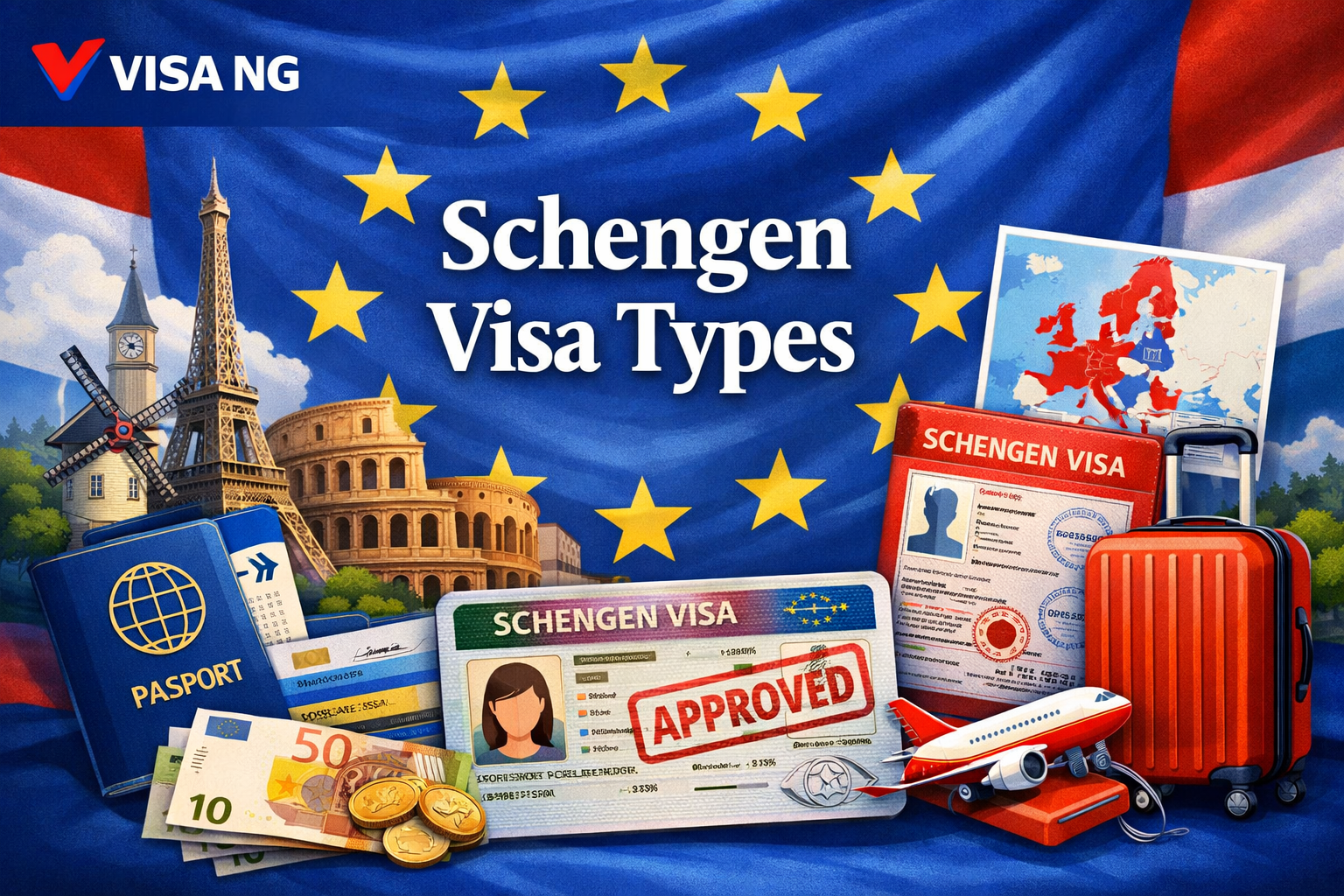
With the right visa, you can move freely across 29 countries with just one permit. That permit is called a Schengen visa. But not every traveller needs the same type. There are 3 Schengen visa types, and each one covers a different travel purpose.
In this article, you will learn about Schengen visa types, what each type covers, who it is for, and the different entry forms available.
Key Takeaways
- There are 3 Schengen visa types: Type A (airport transit), Type C (short stay), and Type D (long stay). Each one covers a different travel purpose.
- A Type A visa is required for Nigerians passing through a Schengen airport, even if you are not entering the country.
- A Type C visa allows you to stay in the Schengen area for up to 90 days within any 180 days. It is the most common Schengen visa type.
- A Type C visa can be issued as a single-entry, double-entry, or multiple-entry visa, depending on your travel plans.
- A Type D visa is for long stays beyond 90 days. It is tied to one specific country but allows short visits to other Schengen countries for up to 90 days within any 180 days.
- The Schengen area currently covers 29 European countries, meaning one visa gives you access to multiple countries.
A Schengen visa application from Nigeria costs €90 for adults plus an additional VFS service fee of roughly ₦25,000 to ₦40,000, and all fees are non-refundable even if your application is rejected.
Schengen visa types
There are 3 types of Schengen visa:
Airport Transit Visa (Type A): The Schengen visa A is a transit visa that can allow you to travel through the international transit area of an airport during a stopover or change of flight.
The Schengen type A visa does not allow holders to leave the international transit area of an airport. The Type A visa is required for Nigerian citizens.
Short-term visa (type C): The Schengen visa type C can allow you to travel and stay in the Schengen area for not more than 90 days. This is the most common Schengen visa type; it covers short visits.
The Schengen visa type C can be obtained in 3 forms.
Forms of obtaining a Schengen visa type C
- Single-entry Visa: It can allow you, its holder, to enter the Schengen area only once and stay up to 90 days in any 180 days. Once you leave, you cannot re-enter, regardless of the visa validity period left.
- Double-entry Visa: It can allow you to enter the Schengen area twice. You can exit and re-enter during the visa validity period. The duration of stay must not exceed 90 days in 180 days.
- Multiple-entry Visa: This visa provides flexibility; it enables unlimited entry to the Schengen area. A multiple-entry visa is valid for a maximum of five years; the duration of stay in the Schengen area must not exceed 90 days in 180 days.
The Schengen visa type C also has two less common subcategories worth knowing about.
- The Limited Territorial Validity (LTV) visa: It does not give you free movement across all 29 Schengen countries. It restricts you to specific countries only. It is usually issued in urgent or humanitarian situations, or when your travel document is not recognised by all Schengen member states.
- The External Border visa: It is issued directly at a border crossing when something unexpected happens, like a sudden medical emergency. It is only valid for a very short period and covers one or two countries at most.
What Can You Use a Schengen visa type C For?
Since the Schengen type C visa is a short-stay visa, it is ideal for:
- Tourism
- Family visit
- Business trips
- Sporting events
- Cultural events
- Short-term school programs (like a cooking course)
- Medical visit
Long-stay (type D): Schengen visa type D means a long-term visa that allows you to stay more than 90 days in a particular Schengen area. It is usually issued by an individual European country within the Schengen area.
The long stay visa is also known as a national visa because it is particular to a long-term stay in a particular country, as opposed to a long stay in the whole of the Schengen area.
It is important to note that a Schengen visa type D visa allows the holder to travel to other Schengen areas for 90 days in 180 days, but does not allow a long-term stay there.
For example:
If France gives you a French Type D visa for study purposes, you can also visit Germany, Italy, or Spain, but only for short trips, not to live or work there.
What Can You Use a Schengen visa type D For?
- Work
- Study
- Internship
- Research
- Family Relocation
Note:
Apply for your Schengen visa at the embassy of your main destination.
What is a Schengen visa?
A Schengen visa is an entry permit granted to non-Europeans (Nigerians) to enter a Schengen area for a short period of up to 90 days in any 180 days. A Schengen visa is typically issued for tourism, business, family visit, or medical treatment.
The Schengen agreement was signed in 1985 in the small village of Schengen, Luxembourg. This landmark agreement created a territory where internal borders were abolished for travellers.

Schengen countries
Currently they are 29 countries in the Schengen region:
- Central & Western Europe: Austria, Belgium, France, Germany, Liechtenstein, Luxembourg, Monaco (de facto), Netherlands, Switzerland.
- Southern Europe: Croatia, Greece, Italy, Malta, Portugal, San Marino (de facto), Spain, Vatican City (de facto).
- Northern Europe: Denmark, Estonia, Finland, Iceland, Latvia, Lithuania, Norway, Sweden.
- Eastern Europe: Bulgaria, the Czech Republic, Hungary, Poland, Romania, Slovakia, and Slovenia.
Frequently asked questions
Lorem ipsum dolor sit amet, consectetur adipisicing elit. Optio, neque qui velit. Magni dolorum quidem ipsam eligendi, totam, facilis laudantium cum accusamus ullam voluptatibus commodi numquam, error, est. Ea, consequatur.
Lorem ipsum dolor sit amet, consectetur adipisicing elit. Optio, neque qui velit. Magni dolorum quidem ipsam eligendi, totam, facilis laudantium cum accusamus ullam voluptatibus commodi numquam, error, est. Ea, consequatur.
Lorem ipsum dolor sit amet, consectetur adipisicing elit. Optio, neque qui velit. Magni dolorum quidem ipsam eligendi, totam, facilis laudantium cum accusamus ullam voluptatibus commodi numquam, error, est. Ea, consequatur.
Conclusion
A Schengen visa application from Nigeria requires you to understand the type of Schengen visa needed for your travel. Picking the right visa during your application process can increase your success rate.
Reach out to experienced Visa agencies like Visa NG to avoid mistakes during your Schengen visa application.