A lot of young Nigerians yearn to relocate abroad and get a stable job for a better life. For this dream of working in a foreign country to be actualized, you need a work visa. This work visa gives you the legality to live and work in the visa-issuing country.
In this article, I will give you the top 15 easy work visa countries for Nigerians in 2026.
Key takeaway
- There are 15 easy work visa countries for Nigerians in 2026, with faster processing times, clear requirements, and employer-sponsored applications.
- The top 5 easy work visa in Europe are Portugal (20-day Green Route), Estonia (30-day processing), Germany (job seeker visa available), Poland (employer-handles permits), and Lithuania (simplified 2025 process).
- The fastest work visa processing times are the Netherlands (2 weeks), South Korea (2-3 weeks), Portugal’s Green Route (20 days), and Estonia (30 days).
- English-speaking countries like Ireland, New Zealand, and Singapore offer work permits without requiring local language proficiency initially.
- Common work visa requirements across all countries are a valid passport, a job offer, proof of qualifications, health insurance (typically €30,000 for Europe), a clean criminal record, and financial evidence.
The country with the easiest process of approval for a work visa depends on job demand, visa rules, language requirements, and employer sponsorship. This doesn’t mean you are granted an automatic visa, but it means the process is easier and less complicated.
What is a work visa?
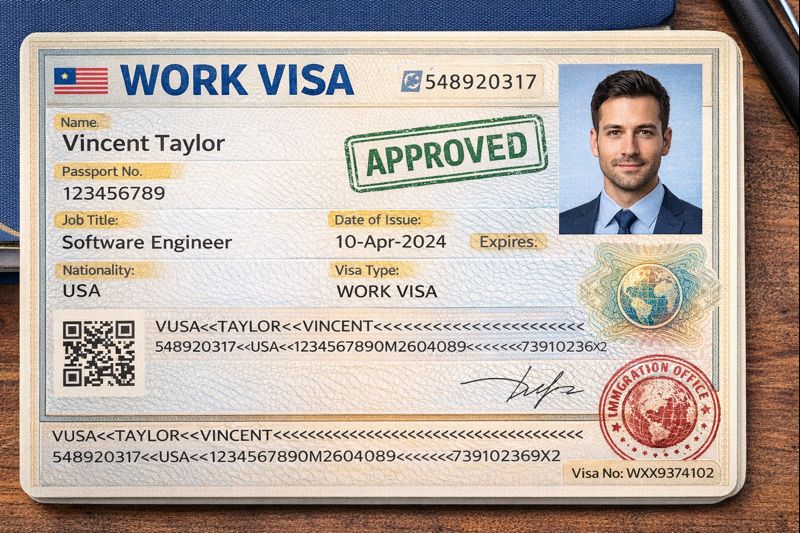
A work visa is an official authorization issued by a country’s government that gives you permission to live and work in that country for a specified period of time.
It may be stamped in your passport, issued as a separate document, or registered electronically in the immigration system.
How does a work visa differ from other visas
- A tourist visa only allows you to visit, not work.
- A student visa primarily allows study, though some permit limited part-time work.
- A work visa’s main purpose is employment.
Work visa application process
A work visa usually requires a job offer from an employer in your destination country, who often sponsors your application.
You will then need to prove your qualifications, pass background checks, and sometimes demonstrate that you are filling a role that can’t easily be filled by a local worker.
What Makes a Work Visa “Easy”?
There are some factors that increase your chances of getting a work visa in a country. I will talk about some of them below :
- Shortage of workers: In some countries, there is a shortage in the working population in some fields, so to fill this gap, they need skilled workers from other countries as immigrants to work in such positions. Sectors like health, technology, and engineering. It’s easier to get a visa for sectors that are on the national occupations shortage list.
- Simple visa process: Most countries now make use of digital means for the application of their visa, making the process less bureaucratic, less difficult, while shortening the period of processing, making the whole process more convenient for applicants.
- Low or no language barrier: Some countries, such as Ireland and Malta, have English among their official languages, so there isn’t much need to be proficient in their local language, which makes the process easier. There are also some sectors, like highly skilled roles in tech or multinational companies, where the working language is English.
- Employers are allowed to hire non-EU workers easily: For some countries, employers are allowed to hire non-EU workers even if there is no proof that there is a shortage of workers in that sector in the country.
- Clear work permit system: The work permit system has been made flexible for foreigners due to a few changes made in the system. For example, in Poland, you can change your employer without needing a new permit application. In countries like the Czech Republic and Slovakia, you can use one permit for your work and residence.
15 easy work visa countries for Nigerians.
1. Estonia
Why it’s easy: Fast processing (30 days), digital application system, and no language requirement initially.
Visa type: Type D long-stay visa (up to 365 days) or temporary residence permit (up to 5 years).
Requirements: Job offer from Estonian employer, valid passport, health insurance, proof of financial stability, and educational qualifications.
Processing time: 30 days (up to 90 days in some cases).
Cost: Approximately €100 (₦166110)
Minimum salary: €820/month.
2. South Korea
Why it’s easy: Fast processing (2-3 weeks), multiple visa categories for different skill levels, employer handles most paperwork.
Visa types: E-7 (Special Occupation), E-1 (Professor), E-2 (Language Instructor), E-5 (Professional).
Requirements: Job offer, employer applies to the Ministry of Justice, proof of qualifications, a valid passport, and an employment contract.
Processing time: 2-3 weeks.
Cost: Single-entry 90-day visa: ₦60,000; Multiple-entry 1-year visa: ₦135,000.
3. Singapore
Why it’s easy: Employer-driven online application, fast processing, electronic approval (no physical visa stamp).
Visa types: Employment Pass (skilled professionals), S Pass (mid-level skilled workers).
Requirements for EP: Job offer, a minimum monthly salary of SGD 5,000, a university degree, a valid passport (6 months validity), and proof of qualifications.
Requirements for S Pass: Job offer, a minimum monthly salary of SGD 2,300, and technical qualifications.
Processing time: Fast (typically within weeks).
4. Australia
Why it’s easy: Points-based system with clear criteria, multiple pathways, and a pathway to permanent residency.
Visa types: Temporary Skill Shortage visa (subclass 482), Skilled Nominated visa (subclass 190), Skilled Independent visa (subclass 189).
Requirements: Minimum 65 points (based on age, experience, education, English proficiency), skills assessment, employer sponsorship (for 482), and biometrics.
Processing time: 2-18 months, depending on visa type.
Cost: Around AUD 4,640 (₦4,521,800) for skilled visas.
5. Portugal
Why it’s easy: New “Green Route” fast-tracks processing to 20 days for shortage sectors, and labor shortages create opportunities.
Visa types: Temporary Stay Visa (under 1 year), D1 Work Visa (long-term).
Requirements: Job offer, passport valid for 2+ years, proof of qualifications, criminal record certificate, proof of accommodation, health insurance (€30,000 EU coverage), and financial evidence.
Processing time: 3-5 months standard, 20 days via Green Route (April 2025).
Cost: Paid in Naira at VFS Global centers.
6. Germany
Why it’s easy: Structured system with clear requirements, Recognition Act helps validate foreign qualifications, job seeker visa available.
Visa types: EU Blue Card (highly qualified), standard Work Visa (skilled workers with vocational/university degrees).
Requirements for EU Blue Card: University degree, job offer paying a minimum of €58,400/year (lower for shortage occupations).
Requirements for Work Visa: Job offer, qualification recognition, valid passport, employment contract, proof of accommodation, and health insurance.
Processing time: 6-12 weeks.
Cost: Approximately €75 (₦124,582.50).
7. The Netherlands
Why it’s easy: Fast processing (as quick as 2 weeks) with recognized sponsors; the employer handles the application.
Visa types: Highly Skilled Migrant visa, Orientation Year Visa (recent graduates from top 200 universities).
Requirements: Job offer from a recognized sponsor, minimum salary of €5,008/month (over 30) or €3,672/month (under 30), a valid passport, educational credentials, and a clean criminal record.
Processing time: As little as 2 weeks with a recognized sponsor.
Cost: Around €350 (₦581,385) [typically paid by employer].
8. Ireland
Why it’s easy: Employer manages application, pathway to permanent residency after 2 years with a Critical Skills permit.
Visa types: Critical Skills Employment Permit, General Employment Permit.
Requirements for Critical Skills: Job offer, minimum salary of €34,000/year (€30,000 for shortage occupations), valid passport, proof of qualifications.
Processing time: 8 weeks (Critical Skills), 12 weeks (General).
Cost: €1,000 (₦1,661,100) [Critical Skills], €1,500 (₦2,491,650) [General] – typically employer-paid.
9. Latvia
Why it’s easy: Quick processing (4-8 weeks), low cost, straightforward requirements.
Visa types: Temporary residence permit for employment (up to 5 years), work visa (shorter durations).
Requirements: Job offer, employment invitation from the Office of Citizenship and Migration Affairs, valid passport, employment contract, proof of accommodation, health insurance, and financial evidence.
Processing time: 4-8 weeks.
Cost: €60-€120 (₦100,000) to (₦200,000).
10. Lithuania
Why it’s easy: Employer obtains a work permit on your behalf, the growing tech sector creates opportunities, and simplified procedures for highly qualified specialists.
Visa type: Temporary residence permit (up to 2 years, renewable).
Requirements: Employment invitation and work permit (obtained by employer), valid passport, employment contract, proof of accommodation, health insurance, and financial evidence.
Processing time: 4-8 weeks.
Cost: Around €120 (₦200,000).
11. Luxembourg
Why it’s easy: High salaries, certain positions exempt from the labor market test, and EU member benefits.
Visa type: Temporary authorization to stay for work purposes.
Requirements: Job offer, employer must advertise position domestically first (exceptions for highly qualified positions/shortage occupations), valid passport, employment contract, proof of qualifications, proof of accommodation, and health insurance.
Processing time: Approximately 3 months.
Cost: Around €80 (₦135,000).
Minimum wage: Over €2,500/month.
12. Czech Republic
Why it’s easy: Employee card combines work and residence permits into one document; the employer initiates the process.
Visa type: Employee card (long-term visa + work permit combined).
Requirements: Job offer, employer applies to the Ministry of Interior, valid passport, employment contract, proof of accommodation, health insurance, clean criminal record.
Processing time: 60-90 days.
Cost: Approximately CZK 2,500 (about €100) (₦166,110).
13. New Zealand
Why it’s easy: Points-based system with clear criteria, transparent process, pathway to permanent residency.
Visa types: Essential Skills Work Visa (1-3 years), Skilled Migrant Category Residence Visa (permanent residency pathway).
Requirements for Skilled Migrant: Minimum 160 points (based on age, experience, qualifications, job offer), a valid passport, proof of qualifications, character certificates, health assessment, and English language proficiency (IELTS).
Requirements for Essential Skills: Job offer in a skills shortage area, employer demonstrates no suitable NZ candidate available.
Processing time: A few weeks (Essential Skills) to several months (residence).
Cost: NZD 495 (work visa), NZD 3,085 (skilled migrant residence).
14. Poland
Why it’s easy: Streamlined process, employer applies for work permit on your behalf, simplified procedures for highly qualified specialists.
Visa types: Work permit (up to 3 years), seasonal work permit, temporary residence, and work permit.
Requirements: Job offer, employer applies to the local labor office for a work permit, valid passport, employment contract, proof of accommodation, health insurance, financial means, and educational credentials.
Processing time: 30-60 days.
Cost: Approximately €340 (₦565,000).
15. Iceland
Why it’s easy: Transparent system, labor shortages create genuine opportunities, and English is widely spoken.
Visa type: Work permit + residence permit.
Requirements: Job offer, employer verifies no suitable EEA candidates available with the Directorate of Labour, valid passport, employment contract, proof of accommodation, and financial stability evidence.
Processing time: Approximately 90 days.
Cost: ISK 16,000 (about €100) (₦167,000).
|
Country |
Why is it “easy” for Nigerians (summary) |
Typical first step |
|
Estonia |
High work visa approval rates, clear D‑visa, and residence‑permit route. |
Secure a job offer, apply for a Type D work visa. |
|
South Korea |
Multiple work visa types (E, D series), online or embassy application. |
Get a contract, apply for an appropriate work visa. |
|
Singapore |
Wide range of passes (EP, S Pass, permits) for professionals and skilled workers. |
Employer applies for EP/S Pass on your behalf. |
|
Australia |
Points‑based skilled visas (189, 190, 491) with PR potential. |
Submit an Expression of Interest on SkillSelect. |
|
Portugal |
Fast‑track work visas and flexible routes are listed as easy for Nigerians. |
Get a job offer or meet income rules for D7/worker visa. |
|
Germany |
Skilled Worker and Job Seeker visas are popular with Nigerians. |
Apply for a Job Seeker or employer‑sponsored work visa. |
|
Netherlands |
Highly Skilled Migrant and EU Blue Card options for non‑EU workers. |
Secure a skilled job with a recognised Dutch employer. |
|
Ireland |
Ranked among the easiest skilled‑worker visa countries, with quick processing. |
Obtain a job offer, then apply for an employment permit. |
|
Latvia |
Seasonal permits, EU Blue Card, residence permits; low competition. |
Get a job offer, apply for a Type D visa, and a residence permit. |
|
Lithuania |
High approval rates, employer‑led permit process. |
Employer files for your permit with the Labour Exchange. |
|
Luxembourg |
High minimum wage, streamlined work visa system. |
Use a job contract to apply for a long‑stay visa/EU Blue Card. |
|
Czechia |
Employee Card combines work and residence, with a strong demand for workers. |
Secure a job and apply for an Employee Card at the consulate. |
|
New Zealand |
Accredited Employer Work Visa, Green List for in‑demand jobs. |
Get an offer from an accredited employer, and apply for AEWV. |
|
Poland |
Strong demand in IT, construction, and manufacturing; considered easy for work visas. |
Receive a job offer, the employer supports a work permit and a D visa. |
|
Iceland |
Often cited among the easiest work visa countries, demand is high in tourism, construction, and healthcare. |
Find an Icelandic employer, apply for a work permit, and a residence permit. |
Which country is easy to get a work visa in Europe?
- Germany
- Portugal
- Estonia
- Poland
- Lithuania
Basic Requirements for a European Work Visa
While most European countries have distinct rules and requirements, the requirements I am about to share are common among most European countries. Check the official Visa application website of the country of your intended visit to get the most accurate and updated information.
- Passport: You need a passport that will be valid for at least 3 to 6 months beyond your stay, and has been registered within the last ten years
- Job Offer from a European Employer: You must show an official job offer with the company letterhead; this must include your job stay duration, job title, salary, and job description.
- Work Permit Approval: In most cases, your employer needs to apply for and get an approved work permit before you apply for your visa. And he/she also needs to prove to the National labor authority of their country that they couldn’t find a local suitable for the position.
- Proof of Qualifications or Experience: You would need to show a certified certificate of your qualifications, degree, master’s… Most countries, like Germany, require proof to show that your educational certificate is equal to theirs
- Health Insurance: You must show proof of having a health insurance policy worth at least €30,000 that will be used for medical emergencies, hospitalization, and repatriation if need be.
- Clean Criminal Record: Most countries require a Police Clearance Certificate (PCC ) from your home country or from a country you have lived in for at least a year. should have been issued within the last six months to ensure you are not a threat to the public.
Countries That Are Harder to Get Work Visas In
These countries are very selective about the immigrants whom they give a work visa :
- United Kingdom: The UK is one of the European countries with difficult work visa approval, as it is very selective. They only demand workers with very high skills; they wouldn’t approve your visa if it’s below their minimum wage, which was raised to £41,700 per year in July 2025 for most applicants. Also, you must have employer sponsorship, which means you must already have been given a job before you apply for a visa, and your employer must also prove that there is no one in the EU who can do that job.
- France: The application process of France is very strict and involves so much paperwork with a said deadline, though they are working on making it more reasonable. Your employer still has to get a work permit for you. The system is also very unpredictable and less transparent as they organise checks to know if a local can do the job without letting you know the state of things.
The salary thresholds are also really high, as the “Talent Qualified Employee” permit requires an annual gross salary of at least €39,582, while the EU Blue Card requires a higher threshold of at least €59,373 annually as of August 2025.
- Switzerland: The difficulty of getting a Swiss work visa is a result of the fact that Switzerland uses a quota system, which means only a very limited number of people can travel each year. The quota for 2026 is 8,500,
- 4,500 B residence permits: This visa is for long stays
- 4,000 L short-stay permits.
Each canton (state) is given a quota, and once it’s filled up, it will not accept new applicants. Also, the quotas are only given to highly skilled, specialized immigrants.
Norway: The requirements to get a Norwegian work visa are clearly stated, but the difficulty comes from the salary thresholds and working standards as compared to your qualifications, as Norway has one of the best working conditions in Europe. This is done to ensure foreign workers do not undercut the local labor market. You must also already have a permanent job offer, and your qualifications would suit the job offer.
Tips to Increase Your Chances of Getting a Work Visa
- Apply for jobs in shortage occupations: some countries usually release national shortage occupations. You have a greater chance of your visa getting approved if you fall into one of those occupations.
- Improve your CV to European standards.
- Learn basic local language (if required): Though it’s not always compulsory, as the working language of some industries is English, it’s really good if you learn the local language of the foreign country you would live in.
- Apply through official government websites.
- Avoid agents promising “guaranteed visas.”
FREQUENTLY ASKED QUESTIONS
Portugal is currently the easiest European country to migrate to from Nigeria. The country introduced a “Green Route” initiative in April 2025 that processes work visas in just 20 days for sectors with labor shortages. Portugal also faces worker shortages in multiple industries, including agriculture, hospitality, construction, and technology, creating numerous opportunities for Nigerian workers.
Estonia offers one of the easiest visa processes for Nigerians in Europe. The country has a fast processing time of just 30 days, a fully digital application system, low fees (approximately €100), and no initial language requirement. Estonia’s Type D visa allows you to work for up to 365 days, while the temporary residence permit lasts up to 5 years.
Ireland is the easiest English-speaking country to get a work permit. The Critical Skills Employment Permit has a straightforward process with just 8 weeks of processing time and requires a minimum salary of €34,000 annually (€30,000 for shortage occupations). Your employer handles the application and typically pays the fees. Additionally, this permit provides a direct pathway to permanent residency after just 2 years.
Germany offers the best job opportunities in Europe. As Europe’s largest economy, Germany actively recruits skilled workers to fill significant labor shortages across multiple sectors, including IT, engineering, healthcare, manufacturing, and trades. The country has a structured immigration system with clear pathways through the EU Blue Card and standard Work Visa, plus it offers job seeker visas that allow you to enter Germany for up to 6 months to find employment.
Ireland is the easiest English-speaking country to get a work permit. The Critical Skills Employment Permit has a straightforward process with just 8 weeks of processing time and requires a minimum salary of €34,000 annually (€30,000 for shortage occupations). Your employer handles the application and typically pays the fees. Additionally, this permit provides a direct pathway to permanent residency after just 2 years.
CONCLUSION
You should know that no country’s visa process is entirely very easy, but applying for countries such as Germany, Portugal, Poland, Lithuania, and Estonia is realistic because of their need for foreign workers and a clear visa application system.
When applying for a visa to a country in Europe, you should apply to countries that have an occupational shortage in a field in which you have expertise to increase your chances. When you apply, you should be patient and apply through legal and honest means, not through agents promising “guaranteed visas”, and submit your documents in a very organised manner.
With the right skills, preparation, and information, working in Europe is possible.